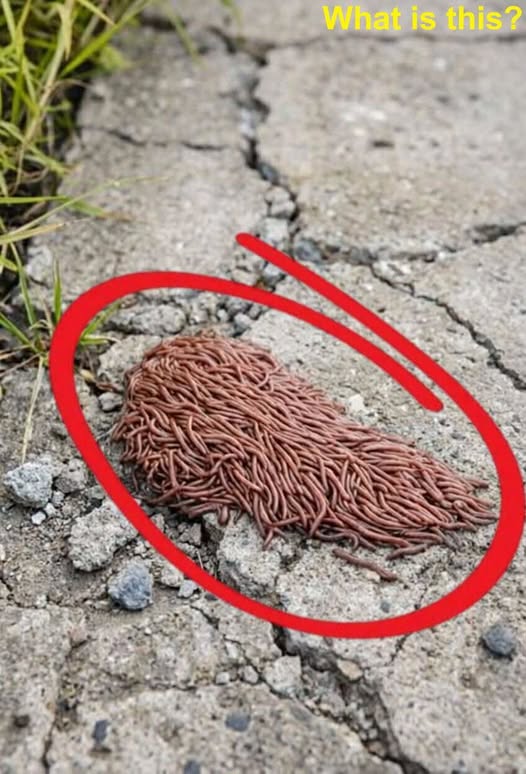
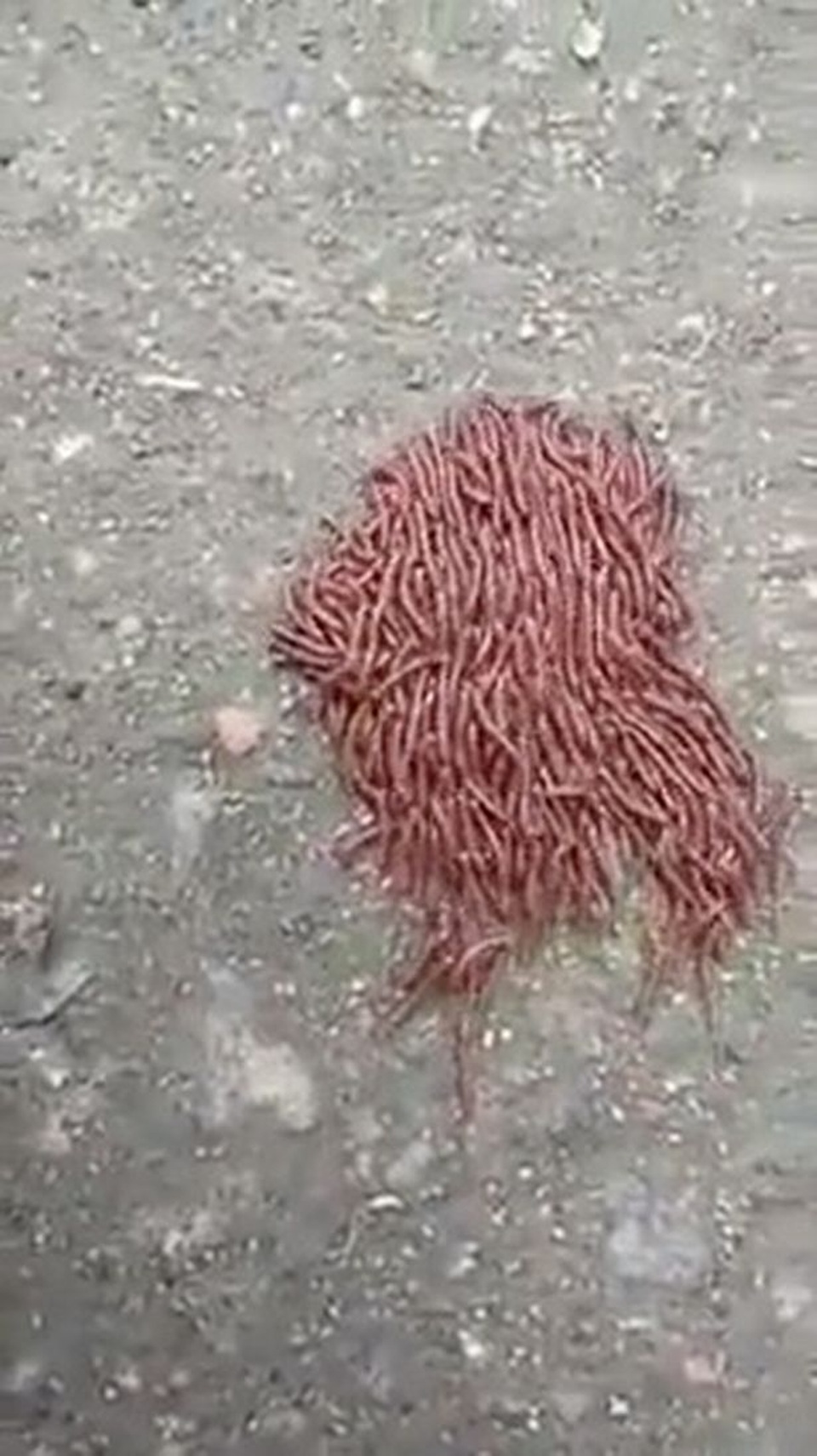
Early one morning after a night of steady rain, a homeowner stepped outside carrying a cup of coffee and a phone. Everything seemed ordinary until something unusual caught their eye on the ground. At first, it looked like a small pile of tangled spaghetti. Then it moved. Slowly, almost rhythmically, the entire mass appeared to shift as if it were breathing. Curious and unsettled, the homeowner recorded the scene and searched online for an explanation, eventually concluding that the strange object was a knot of earthworms.
Stories like this often spread rapidly on social media because they transform an everyday backyard into a scene of mystery. While the sight of hundreds of intertwined worms can certainly be surprising, the behavior itself has natural scientific explanations. Rather than being a sign of something extraordinary, worm clusters are part of the fascinating adaptations that help these animals survive changing environmental conditions.
Understanding why earthworms sometimes gather in large groups reveals just how remarkable these small creatures really are.
What the Viral Story Claims
The article describes finding a moving mass in a backyard shortly after rainfall.
According to the story:
- The object resembled tangled spaghetti.
- The mass appeared to move as one organism.
- Online searches identified it as a cluster of earthworms.
- The worms had supposedly emerged because of low oxygen in the soil after rain.
The explanation involving earthworms is generally plausible, although the article presents the event in dramatic language designed to create suspense.

What Is a Worm Cluster?
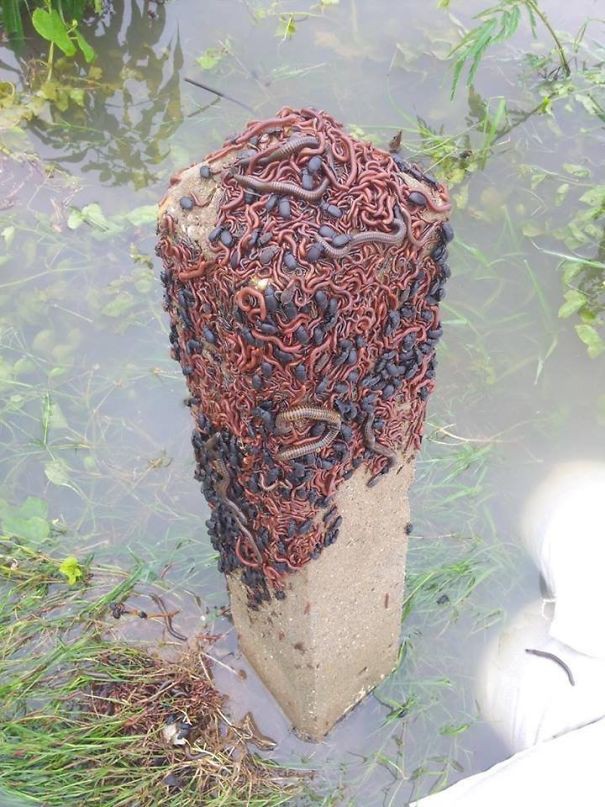
A worm cluster is simply a group of individual earthworms that have become intertwined.
Each worm remains an independent animal.
The appearance of a single moving organism results from dozens or even hundreds of individual movements occurring simultaneously.
From a distance, the mass may seem almost alive as one body, even though it is actually composed of many separate worms.
Why Do Earthworms Come Above Ground?
One of the most common reasons earthworms appear on sidewalks, driveways, and lawns is rainfall.
Several scientific explanations have been proposed.
Low Oxygen in Waterlogged Soil
Earthworms breathe through their moist skin.
After prolonged rainfall, soil pores may fill with water, reducing the amount of oxygen available underground.
Moving to the surface can help worms reach areas where oxygen is more accessible.
Although this explanation is widely accepted, researchers believe it is not the only reason.
Easier Movement
Wet surfaces allow earthworms to travel more easily without drying out.
Some scientists suggest that rainy conditions provide opportunities for worms to disperse to new areas with less risk of dehydration.
Seasonal Activity
During certain times of the year, earthworms naturally become more active because of favorable temperatures and moisture levels.
Why Do Earthworms Form Knots?
Scientists continue studying this behavior, and several possible explanations exist.
These include:
- Temporary crowding after emerging from saturated soil.
- Physical entanglement while moving through confined spaces.
- Moist conditions allowing large numbers of worms to gather in the same location.
- Protective responses to environmental changes.
Some worm species are also known to form temporary clusters during reproduction or when environmental conditions encourage close contact.
Because multiple species display different behaviors, no single explanation applies to every observation.
Are Worm Balls Rare?
Large worm clusters are uncommon enough to surprise most homeowners, but they are not unknown.
Naturalists, gardeners, and biologists have occasionally documented similar gatherings in:
- Lawns
- Forest floors
- Garden beds
- Sidewalks
- Agricultural fields
Most people simply never encounter one because the conditions required are relatively specific.
The Important Role of Earthworms
Although they often go unnoticed, earthworms are among the most valuable animals living beneath our feet.
They contribute to healthy ecosystems by:
- Aerating soil
- Mixing organic matter
- Improving drainage
- Supporting plant growth
- Recycling nutrients
Charles Darwin devoted many years to studying earthworms, concluding that their continuous activity plays a significant role in shaping fertile soils.
Modern soil science continues to support their importance.
Why the Moving Mass Looks So Strange
Human brains are naturally sensitive to unusual movement.
When many thin objects move together in different directions, the brain sometimes interprets them as one larger organism.
This visual illusion contributes to the unsettling appearance of worm clusters.
Combined with the unfamiliar shape, the movement may initially seem difficult to explain.

Myths About Worm Clusters
Throughout history, groups of moving worms have inspired various folk beliefs.
Some traditions interpreted them as:
- Signs of changing weather.
- Messages from nature.
- Unusual natural omens.
Modern biology, however, explains these gatherings through environmental conditions and normal animal behavior rather than supernatural causes.
These cultural stories remain interesting examples of how people once interpreted unfamiliar natural events.
Should You Be Concerned?
In most cases, no.
Earthworms are harmless to people and play an important ecological role.
If a worm cluster appears in a yard, the best approach is usually to leave it undisturbed.
As soil conditions improve, the worms often disperse naturally and return underground.
Avoid using chemicals or attempting to remove them unnecessarily, as they contribute positively to soil health.
The Science of Earthworm Respiration
Unlike mammals, earthworms do not have lungs.
Instead, oxygen passes directly through their moist skin into the bloodstream.
This means they depend heavily on environmental moisture while also requiring access to oxygen.
Finding the right balance explains why changing soil conditions can influence their behavior.
Researchers continue investigating exactly how different soil environments affect earthworm movement and survival.
Why Viral Nature Stories Become Popular
Nature often produces scenes that appear almost unbelievable.
Social media amplifies these moments because they combine:
- Surprise
- Curiosity
- Visual mystery
- Everyday settings
- Easy-to-share videos
Dramatic storytelling can make ordinary biological events seem extraordinary, encouraging millions of people to search for explanations.
Fortunately, science often provides fascinating answers that are just as interesting as the mystery itself.
Conclusion
The viral story about discovering a moving “spaghetti-like” mass in a backyard is dramatic, but the underlying explanation is consistent with known earthworm behavior. Following periods of heavy rain or saturated soil, earthworms may emerge to the surface, and under certain conditions they can become temporarily clustered into large, intertwined groups. Although the sight can be surprising, it represents a natural response to environmental conditions rather than an unexplained phenomenon.
Earthworms remain some of the most important organisms supporting healthy soils, quietly improving ecosystems beneath our feet every day. Their occasional appearance above ground offers a rare glimpse into a hidden world that most people rarely notice.
Ultimately, moments like these remind us that curiosity often begins with surprise. By combining careful observation with scientific understanding, we can transform unusual discoveries into opportunities to appreciate the remarkable complexity of the natural world.
Sources
Charles Darwin. The Formation of Vegetable Mould Through the Action of Worms.
Soil Science Society of America. Educational resources on earthworms and soil ecology.
Royal Horticultural Society (RHS). Information on earthworms in gardens.
University of Illinois Extension. Earthworm biology and soil health.
Smithsonian Environmental Research Center. Resources on soil organisms and ecosystem function.
Encyclopaedia Britannica. Articles on earthworms, annelids, and soil ecology.