I Lifted My Blanket and Found Something I Had Never Seen Before
After a long and exhausting day, there is nothing quite like finally getting home, putting everything aside, and settling into a comfortable bed. For most people, bedtime is a chance to relax, forget about the day’s responsibilities, and enjoy a little peace and quiet.
But sometimes, an ordinary evening can turn into an unexpected encounter with nature.
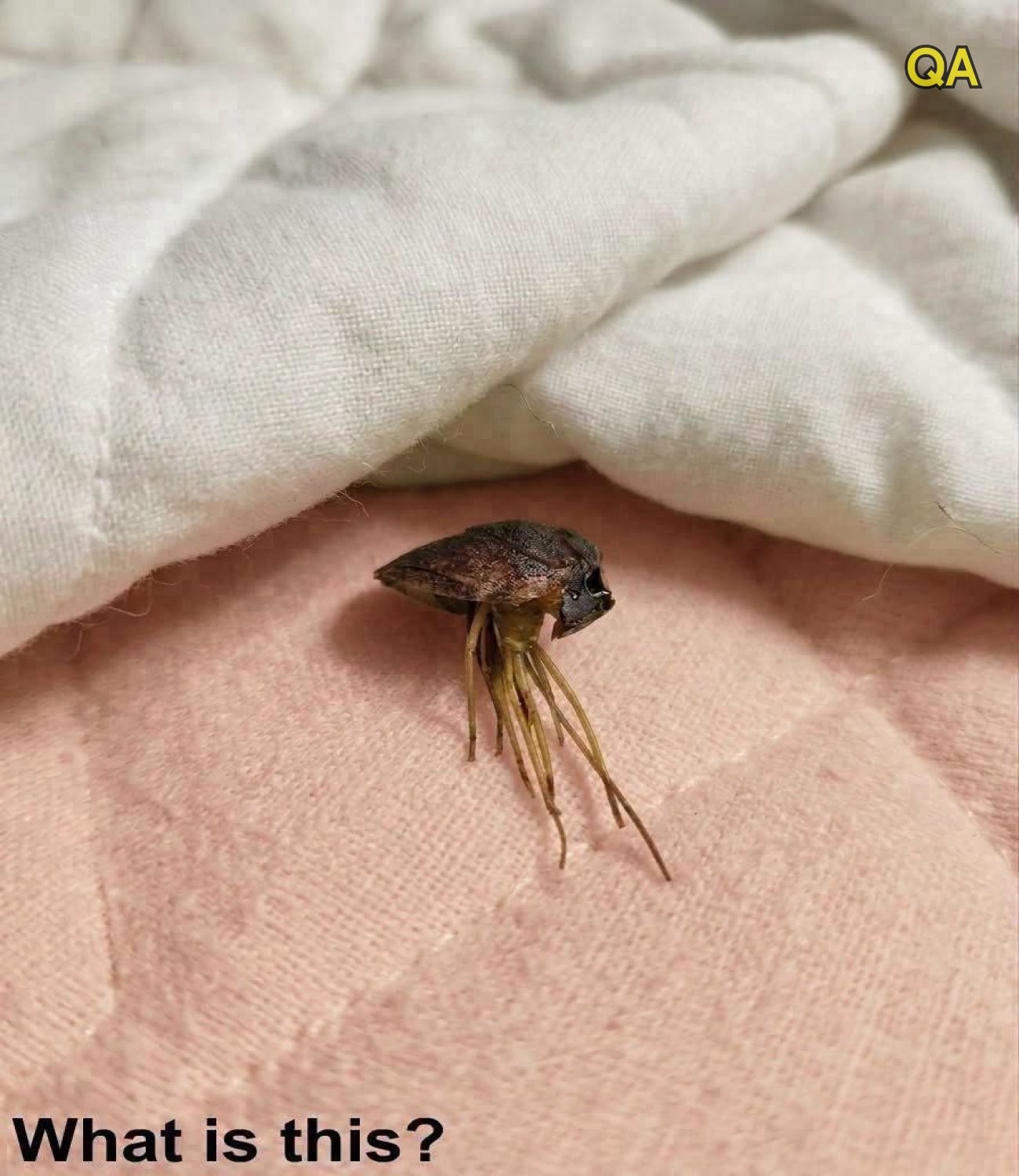
That was exactly what happened when one person lifted their blanket and discovered a strange-looking creature hiding underneath. At first glance, it was difficult to identify. Its unusual body shape, dark coloring, and several thin, elongated legs made it look like something that belonged in a much different environment.
The discovery immediately raised questions. What was this unfamiliar creature? How had it managed to get inside the bedroom? And, perhaps most importantly, was it something that could pose a danger?
What initially appeared to be a frightening mystery eventually led to a fascinating discovery. The insect was identified as a treehopper, a small plant-feeding insect known for its extraordinary appearance and unusual body structure.
Although treehoppers are generally harmless to people, their remarkable shapes can make them surprisingly difficult to recognize. Understanding what these insects are, where they live, and why they sometimes enter homes helps explain how such an unexpected encounter can happen.
My First Thought Was a Strange Spider
When the blanket was lifted, the first reaction was understandably one of surprise. Something was resting beneath the fabric, and its appearance was unlike anything the person had encountered before.
The creature had a dark-looking body with several thin structures extending underneath it. From a distance, its unusual proportions created the impression of a spider or another unfamiliar crawling insect.
Without knowing what it was, there was no reason to reach underneath the blanket or attempt to touch it. Keeping a safe distance was the sensible response.
Instead, the blanket was carefully moved aside to make the creature easier to observe. Looking more closely only made the mystery more interesting.
Its body appeared unusually large compared with its legs. The upper section seemed to have an almost decorative shape, as though the insect were carrying an additional structure on its back.
Many insects have recognizable features, but some species have evolved shapes that make them look remarkably different from familiar household bugs. Certain insects resemble leaves, pieces of bark, plant thorns, or even small branches.
This unusual appearance is one reason people sometimes mistake treehoppers for spiders or other creatures when encountering them unexpectedly.
The important thing was not to assume that the insect was dangerous simply because it looked unfamiliar. A closer identification would provide a much better understanding of what had appeared beneath the blanket.
The Surprising Discovery: It Was a Treehopper
After examining the creature, the unexpected visitor was identified as a treehopper.
Treehoppers are small insects belonging primarily to the family Membracidae. They are members of the larger order Hemiptera, which includes other familiar insects such as aphids, cicadas, and leafhoppers.
According to the University of Illinois’ Illinois Natural History Survey, treehoppers are a diverse group containing approximately 3,200 species worldwide. Their remarkable diversity is one reason their appearances can vary so dramatically.
Some treehoppers are green, while others are brown, yellowish, or decorated with contrasting patterns. Certain species have rounded bodies, while others possess prominent horns, ridges, or unusual projections.
Their most distinctive feature is often an enlarged part of the body called the pronotum.
The pronotum is the upper section of the first segment of an insect’s thorax, located immediately behind the head. In many treehoppers, this structure is unusually developed and can extend upward or backward over much of the insect’s body.
Depending on the species, the pronotum can resemble a thorn, a helmet, a curved horn, or a small piece of vegetation.
These structures are not separate objects attached to the insect. They are part of its natural body anatomy.
This explains why a treehopper can initially look so unusual. What might appear to be an oversized shell or an unfamiliar appendage is often simply the insect’s distinctive pronotum.
Researchers have long been interested in treehoppers because of their unusual body shapes, ecological relationships, and remarkable diversity.
Why Do Treehoppers Have Such Unusual Shapes?
One of the most interesting questions about treehoppers is why their bodies look so different from those of many other insects.
Their enlarged pronotum is a particularly distinctive feature. In different species, it can develop into structures that resemble plant thorns, small leaves, or other natural objects.
These unusual shapes can contribute to camouflage by helping the insects blend into their surroundings.
For a small insect living on a tree branch, remaining unnoticed can be an important survival advantage. A treehopper that resembles a thorn or part of a plant may be more difficult for potential predators to distinguish from the surrounding vegetation.
Some species are particularly convincing examples of natural camouflage. The Missouri Department of Conservation notes that groups of treehoppers can resemble clusters of plant thorns, making them difficult to recognize at first glance.
Their appearance is not identical across the family. Some species have relatively modest body extensions, while others possess dramatic structures that make them look almost like miniature sculptures.
It is also important to understand that the unusual structure on a treehopper’s back should not automatically be mistaken for a collection of legs or a protective covering from another animal.
Correct identification depends on examining the insect’s overall shape, body segments, wings, legs, and other distinguishing characteristics.
What Do Treehoppers Eat?
Unlike insects that enter homes searching for food scraps, treehoppers are primarily plant-feeding insects.
They use specialized piercing and sucking mouthparts to obtain fluids from plants. Rather than chewing leaves in the same way as caterpillars or grasshoppers, they insert their mouthparts into plant tissue and feed on sap.
Different treehopper species prefer different host plants. Depending on the species, these can include trees, shrubs, ornamental plants, and certain herbaceous plants.
According to the University of California Statewide Integrated Pest Management Program, treehoppers occur on a variety of host plants, and at least 40 species are found in California alone.
Their feeding habits also help explain why a bedroom is not a natural habitat for these insects. They generally spend their time outdoors, where suitable plants provide food and shelter.
Some treehoppers produce a sugary substance known as honeydew as a by-product of feeding on plant sap.
This substance can attract ants and other insects. In certain species, ants and treehoppers have a mutually beneficial relationship: ants obtain honeydew, while treehoppers may receive protection from potential predators.
These interactions demonstrate that even very small insects can play interesting roles within larger ecosystems.
How Did a Treehopper Get Inside the Bedroom?
After identifying the unexpected visitor, another question naturally came to mind: How did a plant-feeding insect end up underneath a bedroom blanket?
There is no way to establish the exact route without knowing the circumstances of the discovery. However, several ordinary explanations are possible.
An insect may enter a home through an open window, an exterior door, or another opening. Small insects can also be carried indoors accidentally on clothing, bags, plants, or outdoor equipment.
Treehoppers are mobile insects. According to UC Integrated Pest Management, both adult treehoppers and their immature forms can jump when disturbed.
Some species are also attracted to artificial lighting, which can bring outdoor insects closer to buildings at night.
Once inside, a small insect may move across furniture, curtains, bedding, or other household surfaces while searching for a suitable place to rest or escape disturbance.
Finding one beneath a blanket does not necessarily mean that it has been living there or that the bedroom contains a population of insects.
It may simply have wandered into the wrong place and become trapped in an unexpected location.
Treehoppers are associated with plants rather than mattresses, so discovering one in a bed is an unusual encounter, not evidence of a typical treehopper habitat.
Is a Treehopper Dangerous to Humans?
One of the most important concerns when discovering an unfamiliar insect indoors is whether it can harm people.
Fortunately, treehoppers are generally not considered dangerous to humans. Their feeding structures are adapted for obtaining plant fluids, not for feeding on people.
The Illinois Leafhopper Lab’s treehopper frequently asked questions explain that these insects are generally not harmful to humans.
However, this does not mean that every species should be handled carelessly. Some treehoppers have sharp or prominent body projections, and certain spiny species may cause discomfort if someone steps on them or handles them improperly.
The safest approach is to avoid touching an unfamiliar insect directly.
If one is discovered indoors, a simple removal method is usually sufficient. A container and a piece of stiff paper can be used to gently capture the insect and move it outside, provided it can be approached safely.
It is also sensible to avoid crushing unidentified insects, particularly when their identity is uncertain.
For anyone who experiences an unusual reaction after contact with an insect, appropriate medical advice should be sought rather than assuming that the insect was harmless.
Is a Treehopper the Same as a Bed Bug?
Another understandable concern is whether discovering a small insect in bedding indicates a bed bug problem.
Treehoppers and bed bugs are different insects with different physical characteristics, feeding habits, and preferred environments.
Treehoppers are plant-feeding insects that generally live on vegetation. Bed bugs, by contrast, are specialized insects that feed on the blood of humans and other warm-blooded animals.
They also have different appearances. Treehoppers are often recognized by their enlarged pronotum, which can create unusual hornlike or thornlike shapes.
Bed bugs are generally flatter and more oval-shaped, with a different body structure and no comparable enlarged pronotum.
Finding a treehopper does not, by itself, establish the presence of bed bugs or another household infestation.
Nevertheless, visual identification should be approached carefully. If the insect cannot be confidently identified, taking a clear photograph or consulting a qualified pest identification professional can help establish what it is.
It is also worth remembering that an insect found on bedding is not automatically a bed bug. Different outdoor insects can occasionally enter homes and end up in unexpected places.
Understanding the Treehopper Life Cycle
Treehoppers have a relatively straightforward life cycle, although the details vary between species and geographic locations.
They develop through three main stages: egg, nymph, and adult.
Female treehoppers deposit their eggs on plants or insert them into plant tissue, depending on the species. Some species lay eggs in groups, while others deposit them individually.
When the eggs hatch, young treehoppers emerge as nymphs. These immature insects generally resemble smaller versions of adults, although they may have more noticeable spines and lack fully developed wings.
As they grow, nymphs undergo several molts, shedding their outer covering as their bodies increase in size.
Eventually, they develop into adults capable of reproduction.
According to UC Integrated Pest Management, treehoppers commonly pass through approximately five nymphal growth stages, although the number of generations each year varies by species and location.
Some species complete one generation annually, while others may produce several generations under suitable environmental conditions.
Understanding this life cycle is useful because it explains why treehoppers are generally associated with outdoor vegetation rather than household furnishings.
Do Treehoppers Damage Plants?
Although treehoppers are generally harmless to people, their feeding activity can sometimes affect plants.
Most treehopper species occur in relatively small numbers, and their feeding does not necessarily cause significant damage.
However, larger populations can create problems for certain ornamental plants, trees, shrubs, and agricultural crops.
Treehoppers feed by extracting plant fluids. Some species also lay eggs by making small openings in plant tissue, which can affect young stems and branches.
Another possible consequence is the production of honeydew. When this sugary substance accumulates on leaves and branches, it can encourage the growth of sooty mold, a dark fungus that develops on honeydew-coated surfaces.
The UC Integrated Pest Management Program explains that damage in many landscape settings is generally limited and does not threaten the overall health of established plants.
Where treehoppers become particularly abundant, gardeners can inspect affected vegetation and consider appropriate integrated pest management methods.
For many minor infestations, extensive chemical treatment is unnecessary. Identifying the species and assessing the actual damage are more useful first steps.
What Should You Do If You Find an Unusual Insect in Your Bed?
Discovering an unfamiliar creature in a place where you normally sleep can be uncomfortable, but there is no need to panic.
A calm and practical approach can help determine what happened and whether any further action is necessary.
First, avoid touching the insect. Even when an insect is likely harmless, direct handling is unnecessary when its identity is unknown.
Second, observe its appearance. Look at its overall body shape, number of legs, coloring, wings, and any unusual structures. A photograph can be particularly helpful for identification.
Third, remove it safely. If it can be approached without risk, use a container and a piece of paper to move it outdoors.
Fourth, inspect the surrounding area. Check nearby bedding and furniture if necessary. If there are no additional signs of insects, there may be no reason to assume that a larger problem exists.
Finally, investigate further if similar insects keep appearing. Repeated sightings or unexplained signs of household pests may justify consulting a pest management professional.
These simple steps can help prevent an unusual discovery from becoming an unnecessarily stressful experience.
A Strange Discovery That Reveals the Wonders of Nature
What began as an unexpected encounter beneath a blanket eventually became an opportunity to learn about one of nature’s most unusual insect groups.
Treehoppers may be small, but their extraordinary body shapes, plant-feeding habits, and relationships with other insects make them fascinating subjects for scientific observation.
Their enlarged pronotum can create appearances that seem almost impossible at first glance. Some resemble thorns, others look like miniature helmets, and certain species are so well camouflaged that they can easily be mistaken for parts of a plant.
Although discovering one in a bed would surprise almost anyone, the presence of a single treehopper does not automatically indicate a dangerous situation or a household infestation.
It is simply a reminder that the natural world is full of creatures that most people rarely notice in their everyday lives.
Sometimes, an unfamiliar insect can look frightening simply because we do not recognize it. Learning more about its appearance and behavior often turns that initial uncertainty into curiosity.
The biggest lesson is simple: When you discover an unusual creature in your home, do not immediately assume the worst. Keep a safe distance, identify it carefully, and remember that nature’s strangest designs are not necessarily dangerous.
A surprising visitor beneath the blanket may be an unexpected way to discover just how fascinating the insect world can be.
Sources
- University of California Statewide Integrated Pest Management Program – Treehoppers
- Illinois Natural History Survey – About Treehoppers
- Illinois Leafhopper Lab – Treehopper Frequently Asked Questions
- Missouri Department of Conservation – Treehoppers
- University of Maryland Extension – Treehoppers on Flowers
- University of Connecticut Extension – Insect Guide
Disclaimer: This content is intended for entertainment purposes only and is not based on real events.