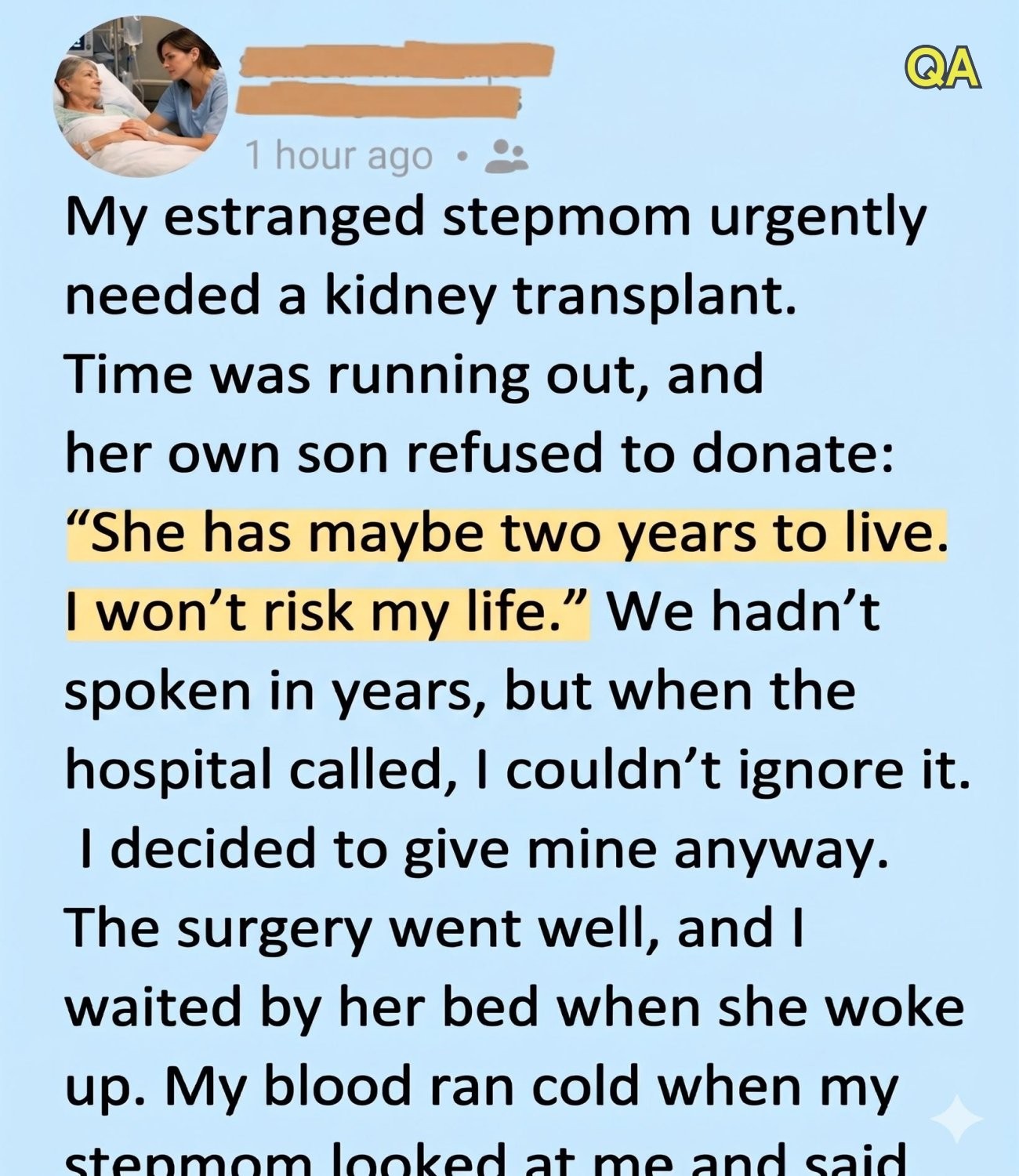
I Donated My Kidney to My Estranged Step-Mother After Years of No Contact …But She Looked at Me Like a Stranger
Family relationships can be complicated, especially when grief, misunderstandings, and years of separation create emotional wounds that seem impossible to heal. Sometimes, however, an unexpected event brings people back together and forces them to reconsider what family, forgiveness, and unconditional love really mean.
For Emily Carter, that moment came when she received an unexpected telephone call from a hospital. Her estranged stepmother, Margaret, was seriously ill with kidney failure and urgently needed a transplant. They had not spoken in almost six years, but Emily suddenly faced a decision that could change both their lives forever.
What followed was an extraordinary act of generosity, a difficult medical journey, and an emotional reunion that neither woman could have anticipated. Yet when Emily finally entered Margaret’s hospital room after donating one of her kidneys, the first question she heard was not an expression of gratitude.
It was a question that broke her heart: “Who are you?”
A Phone Call That Brought Back Years of Memories
Emily had not spoken her stepmother’s name aloud in years. Since her father’s unexpected death, the relationship between them had gradually deteriorated. There had been no dramatic confrontation or definitive farewell. Instead, their separation had developed through unanswered telephone calls, missed family gatherings, and misunderstandings that neither woman knew how to resolve.
By the time six years had passed, Margaret had become almost a stranger.
That changed one Tuesday afternoon when Emily received a telephone call from a woman identifying herself as Sarah, a member of the transplant department at St. Mary’s Hospital.
“Am I speaking with Emily Carter?” the caller asked.
After Emily confirmed her identity, Sarah explained that the hospital was trying to contact family members regarding Margaret’s medical condition.
Margaret’s kidneys were failing. She had been receiving dialysis, a treatment that helps remove waste products and excess fluid from the blood when the kidneys can no longer perform these functions adequately. However, her medical condition had become increasingly serious, and her doctors were evaluating the possibility of a kidney transplant.
Emily was stunned. She had known nothing about her stepmother’s illness.
Her first question concerned Margaret’s biological son, Daniel. Surely he had already been considered as a potential donor?
Sarah explained that Daniel had undergone an evaluation but had decided against donating a kidney.
Emily understood that decision was deeply personal. Living kidney donation involves surgery and potential short-term and long-term health considerations. Nobody should be pressured into becoming an organ donor, regardless of their relationship with the recipient.
Nevertheless, the news brought back memories of a family that had once been much closer.
Remembering the Woman Who Helped Raise Her
Emily had lost her biological mother when she was young. When her father married Margaret, Emily was nine years old and uncertain about what the arrival of another maternal figure would mean.
She worried that Margaret might expect her to forget her mother or accept someone new in her place.
But Margaret never demanded that Emily call her Mum. Instead, she built their relationship through ordinary acts of care.
She learned how Emily liked her sandwiches prepared, stayed awake to help with school projects, and attended school performances even when she struggled to understand what was happening onstage.
Margaret was not a perfect parent, and their relationship was not always easy. Like many stepfamilies, they experienced disagreements, particularly during Emily’s teenage years. Nevertheless, Margaret made an effort to ensure that the young girl felt included and cared for.
For Emily, those memories mattered.
Everything changed after her father died unexpectedly. Both women were dealing with grief, but instead of supporting one another, they gradually withdrew. Disagreements about family belongings and misunderstandings involving Daniel created additional tension.
Eventually, Emily stopped calling Margaret. Margaret stopped reaching out, too.
Neither woman appeared to know how to repair the relationship.
Now, sitting alone in her bedroom after the hospital call, Emily remembered the small things Margaret had once done for her, including leaving a glass of milk outside her bedroom when she stayed awake studying late into the night.
Emily knew she did not owe Margaret a kidney. Their shared history did not create an obligation to undergo major surgery.
But she could not ignore one difficult question: If she had an opportunity to help save Margaret’s life and chose not to explore it, would she regret that decision for the rest of her life?
Deciding to Become a Living Kidney Donor
The following morning, Emily contacted the hospital and expressed her willingness to undergo testing.
“I want to find out if I’m a match,” she told the transplant team.
The doctors explained that living kidney donation required considerably more than a simple blood test. Potential donors must undergo detailed medical assessments to determine whether donation is safe and whether their kidney is suitable for the intended recipient.
These evaluations can include blood group testing, tissue compatibility assessments, kidney function measurements, imaging examinations, and reviews of the donor’s overall physical and psychological health.
The medical team also discussed the potential risks of surgery, recovery expectations, and the long-term implications of living with one kidney.
Emily listened carefully. She understood that the decision could affect her own health and that there were no guarantees that the procedure would be entirely free of complications.
Her friends were equally concerned.
Rachel, her closest friend, questioned whether Emily was making the right decision.
“You haven’t spoken to that woman in years,” Rachel reminded her. “What if she doesn’t even want your help?”
Emily had no easy answer.
She was not donating her kidney in exchange for an apology. She was not expecting Margaret to suddenly become the mother figure she remembered, nor was she trying to force the family back together.
Her motivation was much simpler. Despite everything that had happened, she still cared about the woman who had helped raise her.
A few weeks later, the initial results showed that Emily was compatible with Margaret.
Further medical assessments and approvals followed. The transplant team continued evaluating both women, ensuring that the procedure was medically appropriate and that Emily’s decision was voluntary.
Eventually, the hospital scheduled the operation.
The Night Before the Transplant
Despite having made her decision, Emily struggled to sleep on the night before surgery.
She lay in her hospital bed listening to the sounds of medical equipment and activity in the corridor. Her thoughts repeatedly returned to Margaret and the years they had spent apart.
She wondered whether Margaret knew who had volunteered to donate the kidney.
She also wondered whether her stepmother would welcome her or reject her once they finally met again.
There was no guarantee that donating an organ would repair their relationship. Even if the transplant succeeded, years of emotional distance could not simply disappear overnight.
The following morning, the medical team prepared Emily for surgery. The nurses reassured her that she could withdraw her consent, even at this late stage, if she changed her mind.
Emily remained certain of her decision.
The operation proceeded, and when she eventually regained consciousness, she felt exhausted and experienced pain around her surgical area.
A nurse noticed that she was awake and approached with reassuring news.
“Everything went well, Emily. Your kidney is functioning beautifully.”
Emily closed her eyes and breathed out with relief.
Then the nurse delivered the news she had been waiting for.
Margaret was also doing well, and the transplanted kidney was functioning as expected.
For Emily, it was an overwhelming moment. The woman she had once considered family had received another opportunity to continue her life.
“Who Are You?” The Unexpected Hospital Reunion
After several hours of recovery, Emily asked whether she could visit Margaret.
The nurse was initially hesitant because Emily needed to rest following her own operation. Eventually, however, arrangements were made for a short visit.
When Emily entered Margaret’s hospital room, she was surprised by how different her stepmother looked.
Margaret appeared considerably smaller and more fragile than the woman Emily remembered. Her skin was pale, her hair had thinned, and medical equipment surrounded her bed.
Emily pulled a chair beside her and sat quietly.
For several minutes, she simply watched Margaret sleeping. After everything that had happened, she finally had an opportunity to be in the same room with her again.
Eventually, Margaret began to wake.
Her eyelids fluttered before she slowly opened her eyes. She looked around the room and then turned her attention toward the unfamiliar-looking visitor beside her bed.
Margaret frowned.
“Who are you?” she asked.
The question was devastating.
Emily had imagined many possible reactions to their reunion. She had considered tears, apologies, awkward silence, and even anger. But she had never imagined that Margaret might not recognise her at all.
Trying to control her emotions, Emily managed a quiet response.
“It’s Emily.”
Margaret continued looking at her with an expression of confusion.
Before Emily could explain further, a nurse approached and gently reminded Margaret who was sitting beside her.
“Margaret, this is your stepdaughter. She’s the one who donated her kidney.”
Margaret looked at Emily again.
For a moment, she seemed to search through her memories, studying the younger woman’s face as though trying to connect it with someone from her past.
Then her eyes filled with tears.
“Oh,” she whispered.
A small smile appeared.
“She’s an angel. She’s always been my angel.”
Emily could no longer hold back her emotions.
She covered her face and began to cry. Carefully, she leaned forward and hugged Margaret, mindful of their recent surgeries and the medical equipment surrounding the bed.
Margaret gently patted her back.
It was a familiar gesture, one Emily remembered from childhood, when Margaret used to comfort her after difficult days at school.
For a brief moment, the years of separation seemed to disappear.
Emily remembered being nine years old again, sitting beside the woman who had once made her feel safe.
Learning to Rebuild a Relationship After Years Apart
The days following the transplant were challenging for both women.
Emily needed time to recover from the operation, while Margaret remained under close medical supervision. Although the transplant had initially gone well, doctors continued monitoring her kidney function and overall condition.
During this period, Emily began visiting whenever her own recovery allowed.
She talked about ordinary things, including memories from childhood, family experiences, and small moments they had once shared. Sometimes Margaret seemed to recognise her immediately. On other occasions, she appeared confused or addressed Emily by another name.
The doctors explained that Margaret’s memory and ability to recognise people were sometimes inconsistent. They cautioned Emily against assuming that every moment of confusion had a single explanation. Her medical team would need to assess any ongoing cognitive difficulties separately from the transplant itself.
Emily gradually learned to accept that their reunion might not develop exactly as she had imagined.
She stopped expecting every conversation to produce a meaningful memory or every visit to end with an emotional expression of affection.
Instead, she focused on being present.
Sometimes, simply sitting beside Margaret was enough.
Daniel Finally Returns to the Hospital
One afternoon, Daniel appeared at the hospital.
Emily noticed his discomfort when he saw her sitting beside Margaret. Their family history had always been complicated, and the circumstances surrounding the transplant had created another difficult situation between them.
Daniel looked at Emily and asked whether she was the person who had donated the kidney.
She nodded.
He looked down at the floor before admitting that he had not expected anyone to volunteer for such a serious operation.
Emily did not argue with him.
She understood that donating a kidney was a personal decision and that Daniel had the right to consider his own health, circumstances, and concerns. She had never believed that he should be forced to donate simply because Margaret was his biological mother.
Equally, Emily knew that her decision belonged to her alone.
She had not donated the kidney to prove that she was a better daughter or to make Daniel feel guilty. She had made the choice because she wanted to help someone who had once played an important role in her life.
After a brief visit, Daniel eventually left.
Margaret watched him go before turning towards Emily.
“Are you staying?” she asked.
Emily reached for her hand.
“For a little while, yes.”
Margaret smiled.
“Good. I like having you here.”
For Emily, those simple words meant more than she could explain.
What Living Kidney Donation Really Involves
Although Emily’s experience is an emotional story about family and reconciliation, it also highlights an important medical issue: living kidney donation is a significant decision that requires careful consideration.
According to the National Institute of Diabetes and Digestive and Kidney Diseases (NIDDK), a kidney transplant is an established treatment option for some people experiencing kidney failure. A transplant allows a healthy donated kidney to take over many of the functions that the recipient’s damaged kidneys can no longer perform effectively.
Living donors may include relatives, partners, friends, or people who choose to donate to someone they do not personally know. However, a potential donor must undergo extensive medical testing to establish whether donation is appropriate.
Having a compatible blood group or tissue match does not automatically mean someone is medically suitable to donate.
Transplant specialists also assess kidney function, general health, surgical risks, and psychological readiness. The purpose is to protect both the donor and the recipient.
Living with one functioning kidney is possible for many carefully selected donors, but donation is not without risks. Potential complications can include surgical problems, infection, pain, and longer-term health considerations. Donors also need appropriate follow-up care after surgery.
In the United States, the Organ Procurement and Transplantation Network (OPTN) emphasises that living donation must be voluntary. Potential donors should receive independent information about the process, have their questions answered, and be able to withdraw from the evaluation or donation process at any time.
These safeguards are particularly important when family relationships are involved. Emotional pressure, guilt, financial expectations, or a sense of obligation should never replace an informed and voluntary decision.
For recipients, a successful transplant also does not mean that medical treatment ends. Anti-rejection medication, regular appointments, and ongoing monitoring are generally necessary to protect the transplanted kidney.
Anyone considering living kidney donation should discuss their individual circumstances with a qualified transplant team rather than making a decision based solely on an emotional story.
Months Later, a Different Kind of Family Relationship
Several months passed after the transplant.
Margaret’s health improved considerably, although her recovery was not always straightforward. She continued to experience difficult days, and her memory remained inconsistent.
Sometimes she called Emily by her correct name. Sometimes she used another name, and occasionally she appeared unable to recognise the woman sitting beside her.
Emily learned that rebuilding a relationship did not necessarily require recovering every lost memory.
She continued visiting, sharing conversations, and offering companionship whenever she could. She did not demand that Margaret explain the past or apologise for the years they had spent apart.
There were no guarantees that their relationship would return to the way it had been when Emily was a child. They were both different people, shaped by experiences that had changed them.
Yet small moments of familiarity continued to appear.
Every so often, Margaret would reach for Emily’s hand, smile gently, and whisper the same affectionate words.
“My angel.”
Those moments reminded Emily of the woman she remembered from childhood. They also gave her a different perspective on the years they had lost.
Why Forgiveness Does Not Always Mean Forgetting
Looking back, Emily understood that her decision had never been about receiving recognition or appreciation.
She had not donated her kidney to erase the disagreements between them. She had not expected a medical procedure to resolve complicated family dynamics or guarantee a permanent reconciliation.
She had simply remembered someone who had once cared for her when she was a vulnerable little girl dealing with the loss of her mother.
The experience also changed how she thought about family.
For a long time, she had believed that family members should always remain connected, regardless of their disagreements. But real relationships are often more complicated. People experience grief differently, communicate poorly, and sometimes allow misunderstandings to continue for years.
Distance does not always mean that affection has completely disappeared. Equally, caring about someone does not mean that every painful experience must be ignored or that reconciliation is always possible.
Forgiveness can be a personal process, and rebuilding trust often requires patience, honesty, and mutual effort.
Emily could not bring her father back. She could not recover the birthdays, holidays, and ordinary conversations that had passed without Margaret. Nor could she guarantee that their relationship would never become difficult again.
But she had been able to make a decision that gave Margaret another opportunity to live.
And whenever Margaret reached for her hand and called her an angel, Emily was reminded that their shared history had not necessarily disappeared.
Perhaps she did not need Margaret to remember every detail of their past. Perhaps she did not need a perfect apology or an explanation for every year of silence.
What mattered was that, in those precious moments, they could still find a connection.
Sometimes family relationships are repaired through long conversations and difficult apologies. Other times, they begin again through small gestures, shared memories, and the willingness to spend time together.
For Emily, the most meaningful part of the experience was not the recognition she received after the operation. It was discovering that the affection she had carried for Margaret had survived years of separation.
She had given her stepmother a kidney, but the experience had also given both women an opportunity to reconsider their relationship.
They could not change what had happened before. They could only decide what to do with the time they had left.
And sometimes, that is where the possibility of a new beginning starts.
Sources
- National Institute of Diabetes and Digestive and Kidney Diseases (NIDDK) – Kidney Transplant
- Organ Procurement and Transplantation Network (OPTN) – Living Donor Informed Consent
- NHS Blood and Transplant – Living Donor Kidney Transplant
- NHS Blood and Transplant – Living Organ Donation Frequently Asked Questions
- National Institute of Diabetes and Digestive and Kidney Diseases (NIDDK) – Choosing a Treatment for Kidney Failure
Editorial note: The family events and personal experiences in this article are presented as described in the supplied narrative and have not been independently verified. The medical background is supported by the official sources listed above.
Disclaimer: This content is intended for entertainment purposes only and is not based on real events.