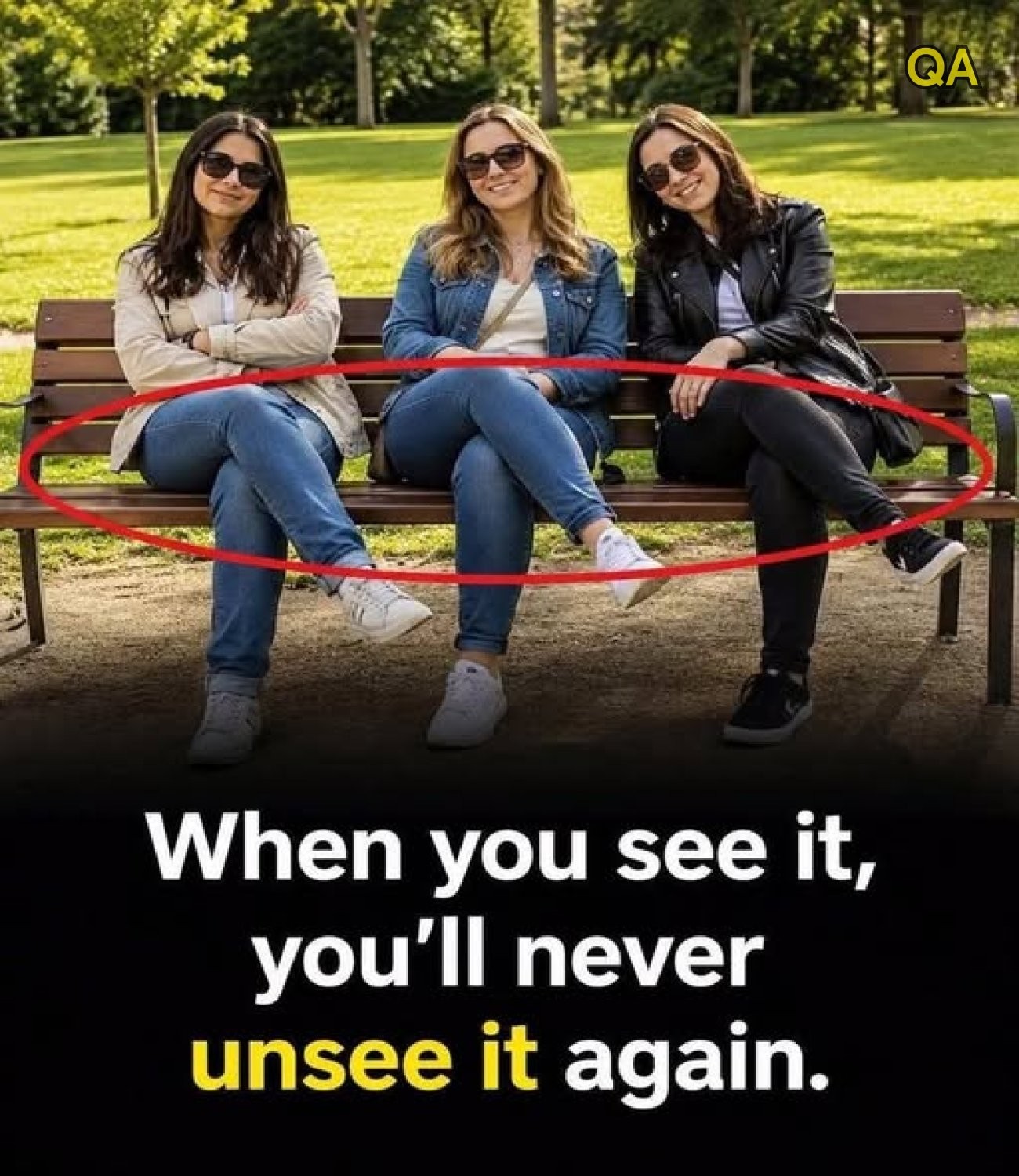
Three Women on a Bench Optical Illusion Explained
At first glance, the image appears to show a perfectly ordinary moment in a park. Three women are smiling together on a sunny day, seemingly seated on a wooden bench. Their posture looks relaxed, their clothing appears natural, and the scene contains many familiar details that make it easy to understand immediately.
Yet this seemingly simple photograph has become a popular visual puzzle because something important does not add up. Many viewers inspect the women’s legs, shoes, knees, and poses, assuming that the mystery must involve an extra limb, a missing foot, or an unusual overlap in the image. The answer, however, is not found in the women themselves.
The key detail is the bench. Although it appears to have a backrest, frame, supports, and armrests, there seems to be no visible seat beneath the three women. They look as though they are sitting comfortably in midair.
This is what makes the three-women-on-a-bench image an effective optical illusion. It takes advantage of the human brain’s tendency to recognize familiar objects quickly. Once viewers decide they are looking at people sitting on a park bench, they often stop checking whether every part of that bench is actually present.
The Answer: The Bench Seat Appears to Be Missing
The puzzle’s central trick is straightforward: the women appear to be seated on a bench that has no visible horizontal seat. The structure behind and around them resembles a normal bench so strongly that the mind fills in the missing portion automatically.
Rather than noticing the absent seat right away, many people focus on the red circle or search for an anatomical inconsistency. That reaction is understandable. Visual puzzles often encourage viewers to expect a hidden object, an unusual body position, or a carefully altered detail. In this case, the more obvious explanation is also the one most easily overlooked.
Once the missing seat is noticed, the image can look completely different. The women no longer appear simply to be posing together; instead, the viewer begins asking how the composition was created and whether a surface may be concealed by clothing, shadows, image cropping, editing, or the angle of the photograph.
Without verified information about the image’s original source, it is not possible to determine exactly how the effect was produced. It may be a staged photograph, an edited image, a perspective-based trick, or a picture in which a supporting surface is obscured. What can be explained with confidence is why the image initially appears convincing.

Why the Optical Illusion Works
Human vision is not a camera that records every visual detail with equal precision. The brain actively interprets what the eyes receive. It uses context, previous experience, expectations, lighting, depth cues, and recognizable patterns to produce a fast understanding of a scene.
In this image, the context is especially powerful. A wooden bench in a park is a common object. People sitting closely together and smiling for a photograph is also a familiar social scene. Because the visual elements fit an everyday pattern, the brain reaches a quick conclusion: three women are sitting on a bench.
That conclusion is useful in ordinary life. People constantly make rapid assessments of surroundings without examining every line, shadow, and object in detail. This ability helps the brain process an enormous amount of information efficiently. However, it can also make viewers vulnerable to visual illusions designed around familiar assumptions.
The missing-seat puzzle demonstrates a principle often described in perception research as top-down processing. In top-down processing, existing knowledge and expectations influence how people interpret sensory information. Seeing the bench backrest and armrests may lead the mind to infer a seat even when the visible evidence is incomplete.
Bottom-up processing works differently. It begins with the details that are directly available to the senses: shapes, edges, colors, textures, and spatial relationships. If a viewer slows down and studies the lower part of the image, bottom-up attention may reveal that the expected seating surface is not clearly visible.
Selective Attention and the Search for a Hidden Mistake
Another reason this image can be difficult is selective attention. People cannot consciously focus on every aspect of a complex scene at the same time. Attention is directed toward what seems most relevant, especially when viewers receive a prompt suggesting that there is a puzzle to solve.
If viewers are told to look for an odd feature near the women’s legs, they may concentrate on crossed knees, footwear, or overlapping clothing. The red circle in some versions of the image can intensify that effect by guiding attention toward a particular area. As a result, viewers may spend time searching for a small irregularity rather than questioning the larger structure of the bench.
This is not a sign that someone is inattentive or unintelligent. It reflects the normal limits of attention. Psychological research has repeatedly shown that people can fail to notice visible information when their focus is occupied by another task or expectation. This general phenomenon is often discussed under concepts such as inattentional blindness and change blindness.
Visual puzzles are built around those limits. They present a scene that is ordinary enough to encourage a quick interpretation but unusual enough to reward a second look. In the case of the apparent missing bench seat, the puzzle succeeds because the viewer’s mind completes an expected object before verifying its full structure.
The Importance of Context in Visual Perception
Context plays a major role in nearly all optical illusions. A line may look longer or shorter depending on nearby lines. A color may appear brighter or darker depending on its background. A stationary image may seem to move because of repeated patterns and eye movements. The three-women-on-a-bench image uses context in a more everyday way: it makes an incomplete scene feel complete.
The women’s relaxed expressions and natural poses are important. If the people in the photograph looked uncomfortable or were positioned in a visibly impossible way, viewers might immediately inspect the bench. Instead, the social cues suggest normality. The image tells a coherent visual story before the viewer has time to analyze its physical details.
Objects around the women also contribute to the impression. The backrest and side elements provide enough of the outline of a bench to activate recognition. The brain then supplies the missing expectation: a seat must be there because benches usually have seats.
This tendency to perceive complete objects from incomplete information is related to principles studied in Gestalt psychology. Gestalt approaches to perception emphasize that people often organize visual elements into meaningful wholes rather than treating every feature as separate. A partly obscured or incomplete object can still be recognized when the surrounding information strongly supports one interpretation.
Could the Image Be Edited or Staged?
Images shared online are often reposted without clear attribution, date, location, or production details. That makes it important to distinguish between explaining an illusion and making unsupported claims about how a specific photograph was created.
A missing-seat appearance could potentially result from several techniques. A seat might be hidden behind clothing or shadows. The visible bench frame could be arranged at an angle that disguises a supporting surface. The image may have been cropped in a way that removes contextual clues. It could also be digitally altered.
None of these possibilities should be treated as confirmed without access to the original photograph, creator statement, or reliable reporting. Responsible image analysis means acknowledging uncertainty when the source and production process cannot be independently verified.
For viewers, the practical lesson is not necessarily to assume that every surprising image is manipulated. Instead, it is useful to pause before drawing conclusions. Checking the source, looking for the earliest available version, and comparing coverage from credible outlets can help establish whether an image has context that is missing from a viral post.
How to Solve Visual Puzzles More Effectively
Optical illusions are intended to be entertaining, but they can also encourage careful observation. A few simple habits can make it easier to spot the key feature in images like this one.
Examine the Entire Scene First
Before focusing on a highlighted circle or a suggested clue, look at the full composition. Ask whether the setting, furniture, shadows, and object positions make physical sense. The answer is sometimes found in a large feature rather than a tiny detail.
Question Familiar Assumptions
When an object seems obvious, consider whether all of its expected parts are actually visible. In this puzzle, the brain recognizes a bench quickly, but a closer inspection reveals that the seat is not clearly present.
Look for What Is Missing
Many visual puzzles lead viewers to search for something added, such as an extra object or an impossible shape. Sometimes the more useful question is the opposite: what should be here but is absent?
Change Your Viewing Distance
Looking at an image from farther away can help reveal the overall pattern. Zooming in can help identify overlaps, edges, and shadows. Switching between these perspectives may prevent attention from becoming locked onto one misleading clue.
Verify Claims Before Sharing
Viral images can be entertaining without being fully explained. If a post presents an extraordinary claim about a photograph, check whether a trustworthy source identifies the original image, photographer, location, or method. This is especially important when images are used to support news, health, political, or public-safety claims.
What This Puzzle Teaches About Everyday Observation
The three women on a bench optical illusion is more than a quick internet riddle. It is a small example of how people interpret the visual world. Most of the time, mental shortcuts are helpful. They allow people to identify faces, objects, settings, and social situations rapidly.
But rapid interpretation can occasionally conceal an important detail. In this image, the expected bench seat becomes mentally available even though it does not appear clearly in the photograph. The viewer’s first impression is shaped not only by what is visible, but also by what the brain expects to see.
This does not mean that perception is unreliable in every situation. It means perception is an active process. Eyes provide information, while the brain organizes, prioritizes, and interprets that information. Optical illusions make this process easier to notice because they create a harmless conflict between expectation and observation.
The lasting appeal of this puzzle comes from its simplicity. There is no need for a complicated mathematical trick or hidden message. The scene looks ordinary, and that is precisely why it works. The apparent absence of the bench seat is hiding in plain sight.
Conclusion
The answer to the three-women-on-a-bench puzzle is that the bench appears to have no visible seat beneath the women. Viewers are often drawn toward their legs and clothing, but the real inconsistency lies in the furniture itself.
The illusion works because people recognize a familiar scene so quickly that they may mentally fill in a detail that is not clearly shown. It offers an accessible example of how context, expectation, selective attention, and visual perception influence what people notice. Once the absent seat is spotted, the image becomes difficult to view in the same way again.
Sources
Disclaimer: This content is intended for entertainment purposes only and is not based on real events.