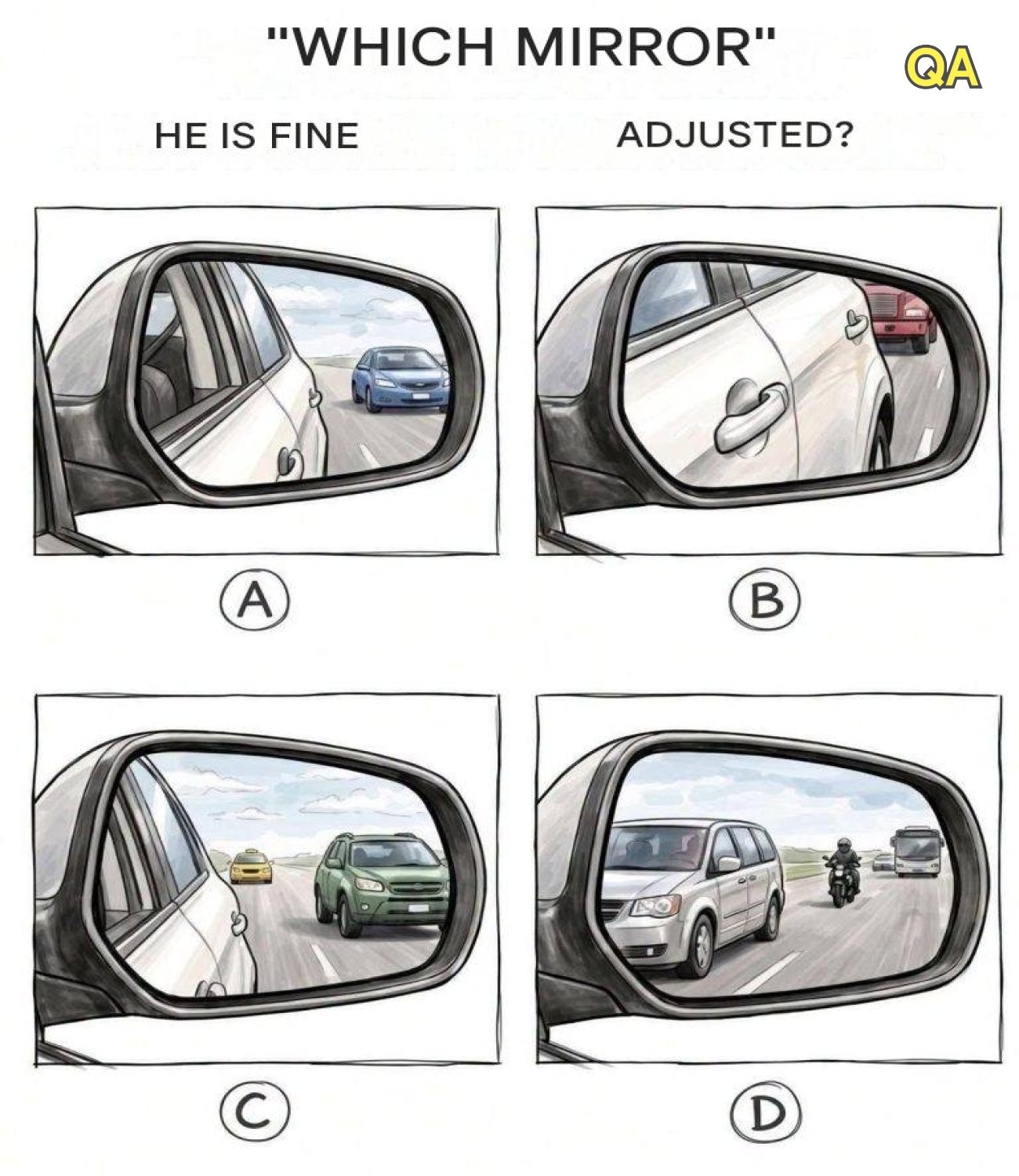
Are Your Side Mirrors Adjusted Correctly …The Simple Trick That Could Help Prevent a Collision
Your vehicle’s side mirrors are among the most important tools for maintaining awareness of surrounding traffic. Yet many drivers may be using them incorrectly without realizing it. A small adjustment to the angle of your mirrors could help you see more of the road, reduce traditional blind spots, and make lane changes safer.
For years, many motorists have been taught to position their side mirrors so that a portion of their own vehicle remains visible. While this approach provides a familiar reference point, it can also take up valuable mirror space that could otherwise be used to monitor nearby traffic.
There is another approach worth considering: the Blindzone and Glare Elimination (BGE) technique, also commonly called the Blindzone Glare Elimination Technique. It involves positioning the outside mirrors farther outward to provide a wider view of the lanes alongside the vehicle.
So, which of the four mirror positions shown in the original illustration is the best choice?
The four positions demonstrate different viewing angles:
- Position A: A large portion of the vehicle’s door is visible in the side mirror.
- Position B: Even more of the vehicle’s side appears in the mirror, reducing the available view of surrounding traffic.
- Position C: Only a narrow strip of the vehicle remains visible.
- Position D: The vehicle’s body is outside the mirror’s field of view, allowing the driver to see more of the adjacent roadway.
Position D represents the outward-facing approach used by the traditional BGE adjustment method. It can help drivers monitor vehicles approaching from behind and moving alongside them.
However, it is important to understand that no mirror arrangement eliminates every blind spot. The National Highway Traffic Safety Administration (NHTSA) recommends positioning mirrors to improve visibility while continuing to look over your shoulder before changing lanes.
Let’s explore why mirror positioning matters, how the BGE method works, and what you can do to improve your awareness behind the wheel.
Why Correct Side Mirror Adjustment Matters
Every vehicle has areas around it that cannot be seen directly from the driver’s seat. These areas are commonly known as blind spots.
Blind spots are particularly important when changing lanes, merging onto highways, overtaking other vehicles, or moving away from the curb. Another vehicle may be travelling beside or slightly behind yours without appearing clearly in your mirrors.
The size and location of these areas depend on several factors, including vehicle design, mirror size, seating position, window dimensions, and the driver’s height.
For example, a motorcycle travelling alongside an SUV may be difficult to detect because of the vehicle’s body structure and mirror positioning. Similarly, a smaller car can temporarily disappear from a driver’s view when moving between the rearview mirror and the side mirror.
Traditional mirror positioning can contribute to this problem when too much of the vehicle’s own body occupies the reflective surface.
Although seeing your own car may feel reassuring, it does not necessarily provide the widest or most useful view of surrounding traffic.
Adjusting the mirrors outward can give more space to observe vehicles in adjacent lanes. The goal is to coordinate the interior rearview mirror and both outside mirrors so they provide complementary views of the roadway.
Understanding the Blindzone Glare Elimination Technique
The Blindzone Glare Elimination technique is an established approach to mirror adjustment that aims to improve the driver’s overall field of view.
The method is designed to reduce the areas that remain hidden between the interior rearview mirror and the outside mirrors.
Instead of pointing the side mirrors toward the vehicle’s body, drivers angle them farther outward to capture more of the adjacent lanes.
According to guidance published by the National Highway Traffic Safety Administration, drivers can improve their outside mirror coverage by using specific head positions when adjusting each mirror.
The three mirrors have different but complementary functions:
- Interior rearview mirror: Provides a view of traffic directly behind the vehicle through the rear window.
- Left side mirror: Helps monitor traffic approaching from behind and travelling alongside the driver’s side.
- Right side mirror: Helps monitor traffic approaching from behind and travelling alongside the passenger’s side.
When the mirrors are properly coordinated, a vehicle approaching from behind should move through the driver’s field of view as it enters an adjacent lane.
For example, a car travelling in the left lane may initially appear in the interior rearview mirror. As it gets closer, it should become visible in the left side mirror. Eventually, the driver should be able to detect it through peripheral vision.
This transition can make it easier to monitor surrounding traffic without relying on one mirror alone.
The technique may also help reduce direct headlight glare from vehicles approaching behind at night by changing the angle of the outside mirrors.
Nevertheless, the effectiveness of any mirror setup depends on the vehicle, the driver’s seating position, and the surrounding conditions. It should never be treated as a replacement for direct visual checks.
How to Adjust Your Side Mirrors Correctly
Adjusting your mirrors does not require special equipment or complicated procedures. The BGE method can generally be completed in a few minutes while your vehicle is parked.
The most important thing is to begin from your normal driving position and follow the adjustment steps carefully.
Step 1: Position Your Interior Rearview Mirror
Start by sitting comfortably in the driver’s seat.
Adjust the interior rearview mirror until you can see as much of the rear window as possible. Ideally, you should be able to monitor approaching traffic directly behind you without moving your head significantly.
Make sure your normal driving posture is comfortable and that the mirror provides a clear view through the rear window.
If your rear window is partially obstructed by passengers or luggage, remember that your visibility may be reduced. Never allow stored items to create unnecessary obstructions.
Step 2: Adjust the Driver’s Side Mirror
Move your head toward the driver’s side window until it is close to the glass.
From this position, adjust the left side mirror outward until you can just see a small portion of your vehicle’s side.
The purpose of moving your head is to establish the correct outward angle rather than simply adjusting the mirror while sitting upright.
When you return to your normal driving position, the vehicle’s body should generally disappear from the mirror or occupy very little of its reflective surface.
This positioning provides more room to observe vehicles travelling alongside you.
Step 3: Adjust the Passenger’s Side Mirror
Now move your head toward the middle of the vehicle, approximately above the centre console.
From this position, adjust the right side mirror outward until you can just see a small portion of the passenger side of your vehicle.
Return to your normal seated position and check the mirror again.
As with the driver’s side, the vehicle itself should generally be outside the mirror’s main viewing area.
Because passenger-side mirrors are sometimes convex, remember that objects may appear smaller and farther away than they actually are. Take this into account when judging the position of nearby traffic.
Step 4: Return to Your Normal Driving Position
Once both mirrors have been adjusted, sit upright in your usual driving position.
Look at the left and right mirrors and make sure they provide useful views of the adjacent lanes.
You should not see large sections of your vehicle taking up the reflective surface. Instead, the mirrors should help you monitor the roadway beside and behind your car.
This is the general principle illustrated by position D.
Remember that the exact adjustment may vary depending on your vehicle’s design and the manufacturer’s recommendations. The objective is improved visibility, not following a particular mirror position regardless of your circumstances.
How to Check Whether Your Mirrors Are Working Together
After adjusting your mirrors, take a little time to become familiar with the new viewing angles.
One useful way to do this is to observe your surroundings while the vehicle is safely parked. You can ask a passenger or another person to walk around the vehicle at a safe distance while you remain in the driver’s seat.
This exercise can help you identify which areas are visible through the mirrors and which areas remain outside your field of view.
You can also become familiar with the mirror transitions during normal driving by observing traffic carefully.
Ideally, a vehicle approaching from behind should gradually move from the interior rearview mirror into the appropriate side mirror and then into your peripheral vision as it travels alongside you.
If a vehicle repeatedly disappears from view between these areas, reconsider your mirror positioning when the vehicle is safely parked.
Never adjust your mirrors while driving or deliberately create a dangerous situation to test their coverage.
Why You Should Still Check Your Blind Spots
One of the most important things to understand about mirror adjustment is that even an excellent setup cannot provide a complete view of everything around your vehicle.
Mirrors have physical and optical limitations. Depending on their shape and position, they may not show every vehicle, cyclist, motorcyclist, or pedestrian approaching from the side.
This is why a shoulder check remains an essential part of safe driving.
Before changing lanes, follow a consistent routine:
- Check the interior rearview mirror to understand what is happening behind you.
- Check the side mirror on the side toward which you intend to move.
- Activate your turn signal in advance.
- Look over the appropriate shoulder to check the blind spot directly.
- Move only when the lane is clear and the manoeuvre can be completed safely.
Keep your shoulder check brief and avoid turning your entire body or allowing your attention to remain away from the road ahead.
The California Driver’s Handbook also emphasizes checking blind spots before changing lanes, merging, turning, or leaving a parking space.
Combining mirror checks with direct observation gives you a more complete understanding of your surroundings.
Common Mirror Adjustment Mistakes to Avoid
Even experienced motorists can develop habits that reduce their visibility. Understanding these mistakes can help improve everyday driving practices.
1. Keeping Too Much of Your Car in the Mirror
One common mistake is positioning the side mirrors so that a large section of the vehicle’s door or rear quarter panel remains visible.
Although this may provide a familiar reference point, it can reduce the amount of surrounding roadway visible in the mirror.
Consider testing a slightly more outward adjustment while parked and checking whether it provides better coverage of adjacent lanes.
2. Adjusting Mirrors While the Vehicle Is Moving
Trying to reposition a mirror while driving can distract you from traffic conditions.
Always make adjustments before setting off. If you notice a problem during your journey, find a safe place to stop before changing the mirror position.
3. Forgetting to Readjust After Someone Else Drives
Different drivers have different heights, seating positions, and preferred driving postures.
If another person has used your vehicle, check all three mirrors before starting your journey.
A mirror arrangement that works well for one driver may not provide the same visibility for someone sitting in a different position.
4. Ignoring Dirty or Damaged Mirrors
Dirt, dust, rainwater, and condensation can reduce mirror visibility.
Clean the reflective surfaces regularly using an appropriate automotive glass cleaner and a soft cloth.
Also check that the mirror housing is secure and that the reflective surface has no cracks or damage that could interfere with your view.
5. Relying Entirely on Electronic Safety Systems
Many modern vehicles include blind-spot monitoring systems, which use sensors to detect vehicles in nearby areas.
These systems can provide useful additional information through dashboard indicators, warning sounds, or other alerts.
However, their performance depends on the vehicle’s technology, sensor coverage, and operating conditions.
Drivers should understand the limitations described in their owner’s manual and continue checking mirrors and blind spots themselves.
Do Different Vehicles Require Different Mirror Settings?
Yes. Vehicle design can significantly affect mirror visibility.
A small passenger car, a large SUV, a pickup truck, and a commercial van may have very different blind-spot areas.
Larger vehicles often have different window configurations, seating heights, body dimensions, and mirror arrangements.
For example, a pickup truck with a high rear body structure may have different visibility limitations from a compact sedan. A commercial van may also have restricted rear visibility because of its cargo area.
Some larger vehicles use additional convex mirrors to improve visibility along their sides. These mirrors provide a wider viewing angle, although objects may appear smaller than they would in a conventional flat mirror.
If your vehicle includes additional mirrors, cameras, or blind-spot monitoring equipment, consult the owner’s manual to understand how these features should be used.
Drivers who regularly switch between different vehicles should also take time to become familiar with each vehicle’s visibility limitations before entering traffic.
What Safety Organizations Recommend
Improving visibility is an important part of defensive driving, and several established road-safety organizations provide guidance on mirror use and blind-spot awareness.
The National Highway Traffic Safety Administration explains that outside mirrors can be positioned to minimize blind spots along the sides of a vehicle. Its guidance describes the head-positioning technique used to adjust both side mirrors and emphasizes the importance of looking over your shoulder before changing lanes.
The American Automobile Association (AAA) also discusses the Blindzone Glare Elimination technique. Its driver-training guidance highlights the importance of coordinating all three mirrors to create a more continuous view of traffic approaching from behind.
AAA additionally recommends becoming familiar with unfamiliar vehicles before driving them, particularly when borrowing or renting a car.
These recommendations share an important principle: mirrors are tools for improving awareness, but safe driving still requires active observation and good decision-making.
There is no single mirror position that guarantees protection in every driving situation. Vehicle design, driver posture, weather, lighting, and traffic conditions all influence visibility.
Additional Tips for Safer Driving and Better Visibility
Correct mirror positioning is only one part of maintaining awareness on the road. A few additional habits can help make everyday journeys safer.
- Adjust your seat first: Establish a comfortable driving position before adjusting the mirrors. Changing your seat position afterward can affect what you see.
- Keep your windows clean: Dirty windows can make it harder to identify vehicles and other road users.
- Maintain a safe following distance: Give yourself sufficient space to respond to changing traffic conditions.
- Use turn signals consistently: Communicate your intentions before changing lanes or turning.
- Stay alert around motorcycles and bicycles: Smaller road users can be harder to detect, particularly in congested traffic.
- Understand your vehicle’s technology: Learn how your blind-spot warnings, cameras, and other driver-assistance features operate.
- Check your mirrors regularly: Develop a consistent scanning routine instead of looking at the mirrors only when preparing to change lanes.
These habits support a more complete approach to defensive driving and help drivers respond more effectively to their surroundings.
The Bottom Line: A Small Mirror Adjustment Can Improve Road Awareness
Your side mirrors may seem like simple pieces of equipment, but their positioning can make a meaningful difference to how much of the surrounding roadway you can observe.
Keeping a large portion of your own vehicle visible may feel comfortable because it provides a familiar reference point. However, adjusting the mirrors farther outward can give you a wider view of adjacent traffic.
The Blindzone Glare Elimination technique offers an established alternative that coordinates the interior rearview mirror and both outside mirrors to improve overall visibility.
Position D in the original illustration represents this outward-facing approach. It is worth considering if your current mirror settings leave too much of your vehicle visible.
Before your next journey, take a few minutes to check your seating position, adjust your mirrors while parked, and become familiar with the views they provide.
Most importantly, remember these three essential principles:
- Adjust your mirrors before starting the vehicle.
- Use all three mirrors alongside your direct and peripheral vision.
- Always perform a shoulder check before changing lanes or moving sideways.
The safest mirror arrangement is one that helps you maintain awareness of surrounding traffic while supporting careful observation and responsible driving. A simple adjustment may improve your visibility, but attentive driving remains your most important safety tool.
Sources
The following organizations provide additional information about vehicle visibility, mirror adjustment, and safe driving practices:
- National Highway Traffic Safety Administration (NHTSA) – Official guidance on vehicle safety and reducing blind spots.
- American Automobile Association (AAA) – Driver education and recommendations for mirror positioning.
- AARP – How to Make Your Car Mirrors Account for Blind Spots – Practical information about mirror adjustment and driver awareness.
- California Department of Motor Vehicles – Official driver handbook covering blind spots and safe lane changes.
- American Association of Motor Vehicle Administrators (AAMVA) – Driver safety guidance concerning blind-spot monitoring and driver-assistance technology.
- SAE International – Automotive engineering research concerning vehicle mirrors and driver fields of view.
Disclaimer: This content is intended for entertainment purposes only and is not based on real events.