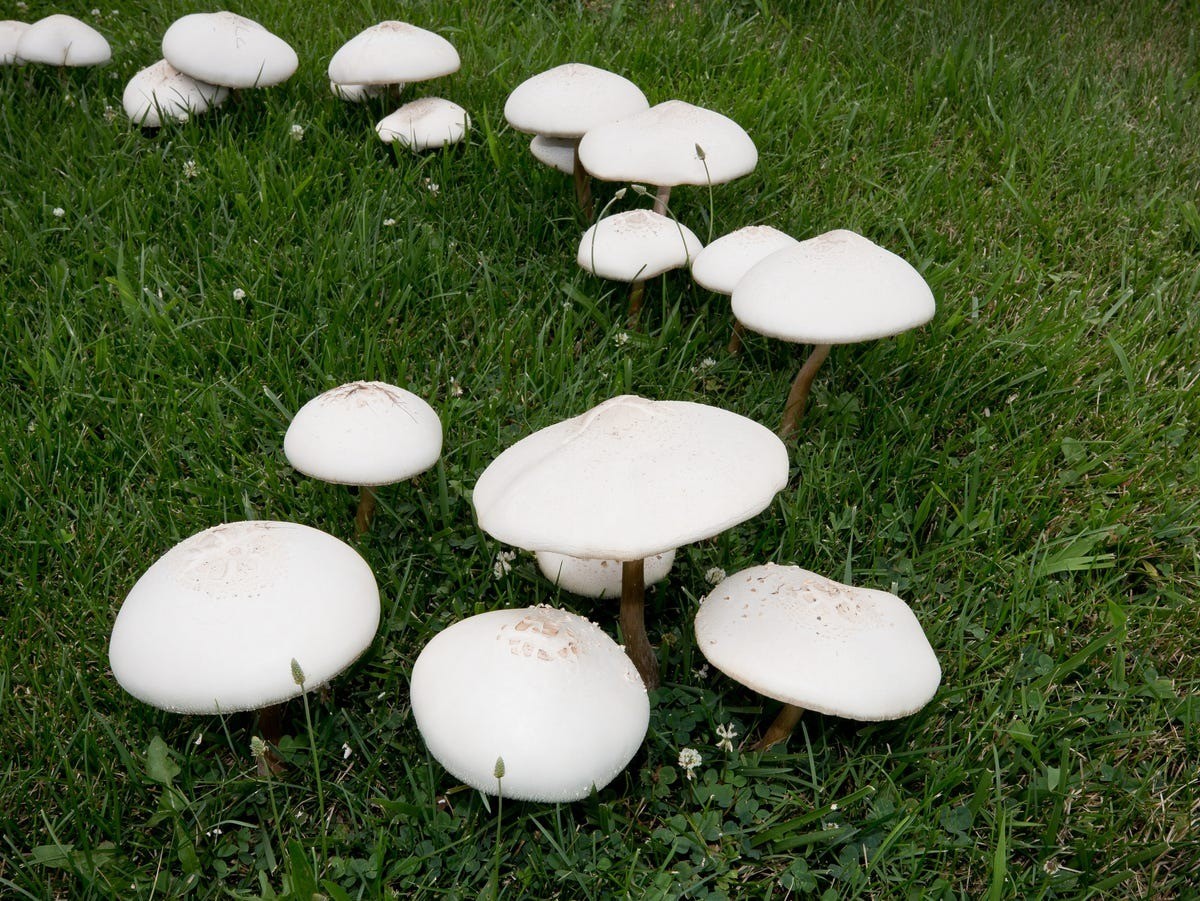
You step outside after a few days of rain and notice something unusual.
Small white mushrooms have suddenly appeared across your lawn.
At first, they may look harmless. Some are tiny and almost invisible among the grass, while others seem to appear overnight, standing like little white umbrellas above the soil.
So what do they mean?
The good news is that mushrooms in your yard are usually not a sign that your lawn is dying. In many cases, they are simply evidence that fungi are breaking down organic material beneath the soil.
However, their appearance can tell you something about the conditions in your yard.
From excess moisture to buried organic matter, compacted soil and changing weather, those little white caps can provide clues about what’s happening below the surface.
Here are 15 things white mushrooms in your yard might be telling you.

1. Your Soil Contains Plenty of Organic Matter
One of the simplest explanations for mushrooms is that your soil contains organic material for fungi to break down.
Dead roots, grass clippings, leaves, wood fragments and other plant material can all provide food for fungi.
The mushrooms you see are actually only the visible reproductive structures of a much larger fungal network living underground.
So rather than automatically viewing mushrooms as a problem, consider them a possible sign that microorganisms are actively decomposing material in your soil.
2. Your Yard Has Been Getting Plenty of Moisture
Mushrooms generally thrive when conditions are moist.
After several rainy days, you may suddenly notice many more mushrooms appearing across the lawn.
The moisture creates favorable conditions for fungal growth, particularly when combined with mild temperatures.
This is why mushrooms can seem to appear almost overnight after periods of wet weather.
As the soil dries, many of these mushrooms will naturally disappear.
3. Your Lawn May Have Poor Drainage
If mushrooms repeatedly appear in exactly the same areas of your yard, drainage could be worth investigating.
Water that remains in the soil for extended periods creates a damp environment that fungi often favor.
Look for areas where puddles form after rain or where the ground remains noticeably wetter than the surrounding lawn.
Improving drainage, when necessary, can help reduce persistent moisture problems.
4. Your Soil May Be Compacted
Compacted soil can make it harder for water and air to move through the ground properly.
Heavy foot traffic, vehicles, construction activity and certain soil types can all contribute to compaction.
When soil becomes dense, drainage and root development can be affected.
If mushrooms are appearing alongside thin or struggling grass, compaction may be one factor worth considering.
Aeration can sometimes help improve soil structure and allow water and air to move more effectively through the root zone.
5. There May Be Buried Wood Beneath the Lawn
Sometimes the explanation is hidden underground.
Old tree roots, buried branches, leftover construction materials or decaying wood can provide fungi with a long-lasting food source.
You may therefore notice mushrooms appearing in a particular area even when everything on the surface looks normal.
If mushrooms repeatedly grow in a ring or concentrated patch, buried organic material could be contributing to the fungal activity.
6. Your Lawn Is Experiencing a Seasonal Change
Mushrooms aren’t necessarily associated with one particular season.
Their appearance depends more on the combination of moisture, temperature and available organic material.
Warm, damp periods can create particularly favorable conditions.
That means you may notice mushrooms after seasonal rain, during periods of high humidity or when temperatures fluctuate between warm days and cool nights.
Their sudden appearance doesn’t necessarily mean something new is wrong with your lawn.
The environmental conditions may simply have become suitable for fungi.
7. Fungi Are Breaking Down Dead Material
Fungi play an important role in natural ecosystems.
They help decompose dead plant material and return nutrients to the soil.
In a lawn, this could include old roots, leaves, grass clippings and other organic debris.
The mushrooms you see are part of that decomposition process.
In other words, a mushroom isn’t necessarily causing decay.
It may be helping recycle material that is already dead.
8. Your Grass May Be Receiving Too Much Water
Frequent irrigation can create conditions that encourage mushroom growth.
If you’re watering your lawn heavily even when rainfall has already provided plenty of moisture, the soil may remain wetter than necessary.
This doesn’t mean every mushroom problem is caused by overwatering.
Rainfall, soil type, shade and drainage all matter.
But if mushrooms appear regularly after irrigation, take a closer look at your watering schedule.
Watering deeply and appropriately rather than constantly keeping the surface wet can be beneficial for many lawns.
9. Shaded Areas May Be Staying Damp
Look closely at where the mushrooms are growing.
Are they concentrated beneath trees?
Along the side of a building?
Near a fence?
Shaded areas often dry more slowly than areas exposed to direct sunlight.
Less sunlight can therefore contribute to prolonged moisture, especially after rainfall.
If mushrooms consistently appear in shaded locations, the combination of shade and moisture may explain their presence.
10. Your Yard Has a Healthy Fungal Community
It may sound strange, but mushrooms aren’t automatically bad news.
Healthy soil contains an enormous variety of microorganisms, including fungi.
Many fungal species perform useful ecological functions by decomposing organic material and interacting with plants and soil organisms.
The presence of mushrooms therefore doesn’t automatically mean your lawn is unhealthy.
In some situations, it simply means the soil ecosystem is active.
Of course, the specific mushroom species matters if you’re concerned about toxicity or pets and children.
Never assume that an unidentified mushroom is edible simply because it looks harmless.
11. You May Be Seeing Fairy Rings
Some mushrooms grow in circular patterns known as fairy rings.
These rings form when fungal networks expand outward through the soil.
Depending on the species and conditions, the surrounding grass may appear darker, greener, lighter or even thinner than nearby areas.
Fairy rings can vary considerably in appearance.
Some are barely noticeable apart from the mushrooms themselves, while others create obvious circular patterns in the lawn.
If you repeatedly see mushrooms forming a ring, you’re likely looking at a fungal colony expanding through the soil.
12. Your Lawn May Be Under Stress
Mushrooms themselves don’t necessarily mean the grass is unhealthy.
But if mushrooms appear alongside yellowing grass, thinning patches or poor growth, it’s worth looking at the broader conditions.
Possible contributing factors include:
-
Poor drainage
-
Excessive shade
-
Soil compaction
-
Improper watering
-
Nutrient imbalance
-
Heavy thatch
-
Root problems
Rather than blaming the mushrooms, examine what else is happening in the affected area.
They may simply be one visible clue among several.
13. Your Grass Clippings May Be Feeding Fungi
Grass clippings are organic material, and fungi can help decompose them.
Leaving reasonable amounts of clippings on the lawn is generally not a problem when mowing correctly.
However, excessively thick layers of organic debris can contribute to a favorable environment for fungal activity.
If you regularly see mushrooms after mowing, consider whether large amounts of grass clippings or other organic material are accumulating in particular areas.
Good lawn maintenance can help keep organic material from becoming excessively concentrated.
14. Your Soil Conditions Are Changing
The appearance of mushrooms can sometimes reflect a temporary shift in your yard’s environment.
A period of rain can dramatically increase soil moisture.
A change in temperature can alter fungal activity.
New mulch, fallen leaves or decaying roots can provide additional organic material.
Even changes in irrigation can affect conditions underground.
This is why mushrooms can appear suddenly and then vanish just as quickly.
The fungal network may have existed beneath the soil for a long time.
The visible mushrooms simply appear when conditions become favorable for reproduction.
15. You Should Take a Closer Look — Not Panic
Perhaps the most important message is that seeing white mushrooms doesn’t automatically mean you have a serious lawn problem.
In many cases, they’re a temporary and natural part of the soil ecosystem.
However, their appearance can be a useful reason to inspect your yard.
Ask yourself:
Has it been unusually rainy?
Does water collect in this area?
Is the soil compacted?
Is there a lot of shade?
Could there be buried wood or old roots?
Is the grass itself showing signs of stress?
Answering these questions can help you determine whether the mushrooms are simply temporary visitors or a clue to an underlying lawn-care issue.
Should You Remove White Mushrooms From Your Lawn?
If mushrooms are simply appearing in the grass, you don’t necessarily need to use a chemical treatment.
Many mushrooms disappear naturally as environmental conditions change.
If you want to remove them for cosmetic reasons, you can pick or rake them out carefully.
Wear gloves when handling unidentified mushrooms, and avoid allowing children or pets to eat them.
Removing the visible mushroom doesn’t necessarily eliminate the fungal network underground.
That’s because the mushroom is only one part of the organism.
If the conditions that support fungal growth remain, more mushrooms may eventually appear.
Should You Use Fungicide?
Seeing mushrooms doesn’t automatically mean you need a fungicide.
In many situations, treating the mushrooms themselves doesn’t address the reason they appeared.
If excess moisture is the issue, improving drainage may be more useful.
If irrigation is excessive, adjusting the watering schedule may help.
If the soil is compacted, aeration could be worth considering.
If buried organic material is providing food for fungi, the mushrooms may continue appearing until that material decomposes.
The best response depends on what’s actually happening in the lawn.
Are White Mushrooms Dangerous?
This is where caution is important.
There are many different types of mushrooms, and appearance alone is not a reliable way to determine whether a mushroom is safe to eat.
Some wild mushrooms can be poisonous.
For that reason, never eat an unidentified mushroom from your yard.
Keep children and pets away from mushrooms if you’re unsure what species they are.
If someone or a pet accidentally eats an unknown mushroom, contact an appropriate medical or veterinary poison service for guidance rather than waiting for symptoms to appear.
When Should You Be Concerned About Your Lawn?
Mushrooms by themselves are usually not a reason to panic.
However, it’s worth investigating if they are accompanied by other persistent problems.
Pay attention if you notice:
-
Large areas of dying grass
-
Persistent standing water
-
Strong or unusual odors
-
Rapidly spreading bare patches
-
Extensive root damage
-
Repeated fungal growth in the same problem area
These signs may indicate that something beyond ordinary fungal activity is affecting your lawn.
A Better Way to Think About Mushrooms
It’s tempting to look at a mushroom in your yard and think:
“I need to get rid of that.”
But mushrooms are part of a much larger underground ecosystem.
The visible cap is only the small portion you can see.
Below the surface, fungal networks may be breaking down organic material and interacting with the soil.
So instead of immediately reaching for a chemical treatment, take a moment to investigate.
Look at the weather.
Check the soil.
Examine drainage.
Notice whether the mushrooms are concentrated in shade or around trees.
Look at the health of the grass nearby.
Those clues can tell you much more than the mushroom itself.
The Little White Mushrooms May Be Telling You a Story
White mushrooms appearing across your lawn can certainly be surprising.
But in many cases, they’re not a sign of disaster.
They may simply be telling you that your soil is moist, organic material is decomposing and fungi are active beneath the surface.
Sometimes, however, they can point toward conditions worth correcting, such as excessive moisture, poor drainage, compacted soil or heavy shade.
The key is not to panic — and not to assume every mushroom means the same thing.
Instead, treat those little white caps as clues.
Your lawn has an entire ecosystem beneath your feet, and every now and then, something from that hidden world appears above the surface.
A mushroom may be nothing more than a temporary visitor.
Or it may be your yard’s way of saying:
“Take a closer look down here.”