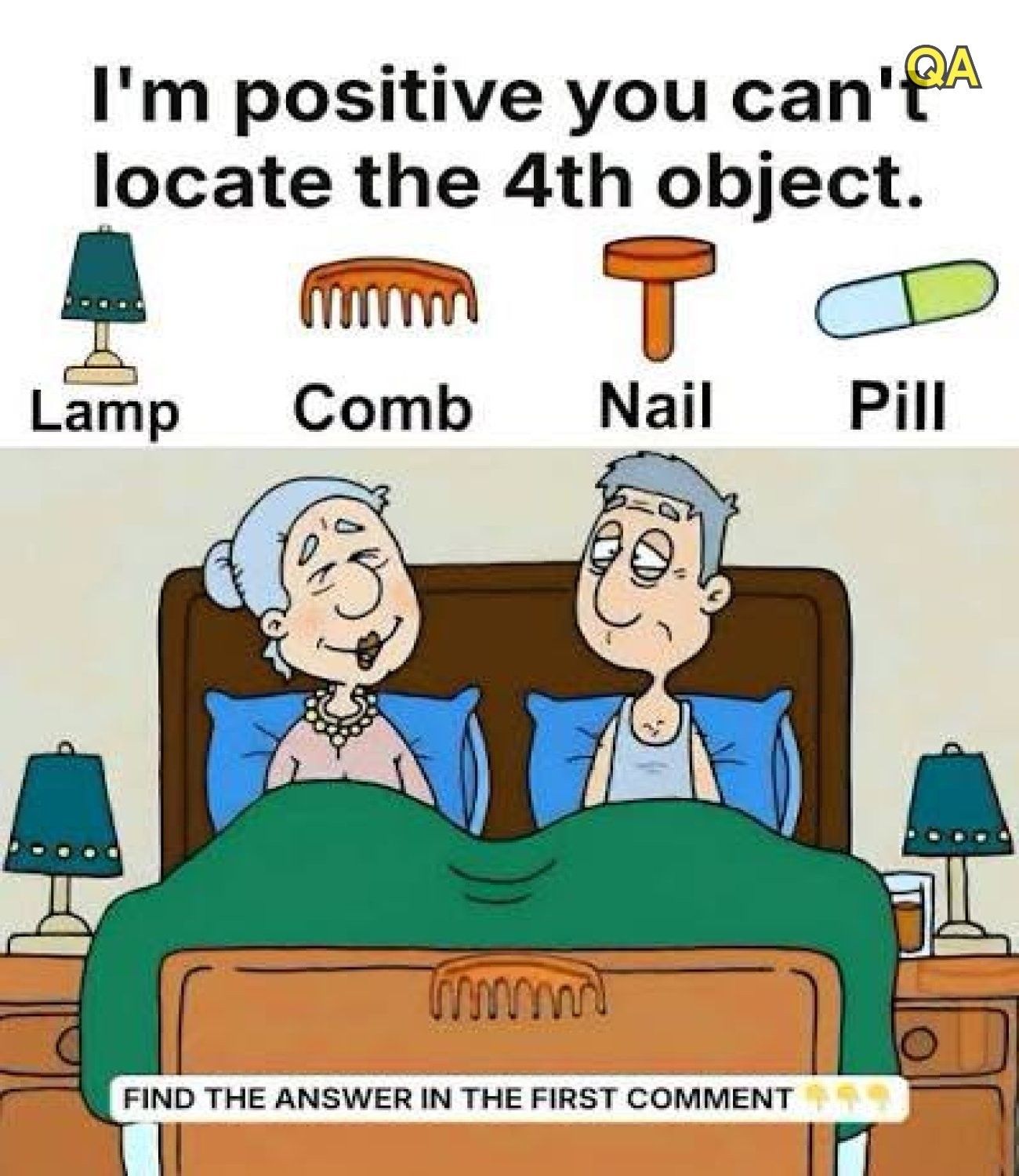
Hidden-object puzzles turn an ordinary illustration into a focused visual-search challenge. A bedroom scene featuring an older couple, bedside furniture, bedding, and household details may appear simple at first. However, the puzzle asks viewers to locate four objects concealed within the drawing: a lamp, a comb, a nail, and a pill.
The appeal is straightforward: the objects are familiar, yet their placement encourages the viewer to look beyond the most obvious features of the scene. Instead of searching for a completely separate item, participants must identify outlines, patterns, and details that resemble the target object. This kind of puzzle is less about “good eyesight” alone and more about visual attention, patience, and the strategies people use to inspect a complex image.
Whether you find all four objects immediately or need several attempts, hidden-picture games can be an enjoyable way to pause, concentrate, and engage with an illustration. The challenge also offers a useful introduction to how the brain organizes visual information in everyday life.
The Four Hidden Objects to Look For
Before reading the hints, take a moment to inspect the picture from top to bottom. The four requested objects are:
- A lamp
- A comb
- A nail
- A pill
In a well-designed hidden-object illustration, some of these items may be represented directly, while others may be integrated into lines, shadows, furniture, fabric, or facial details. The objects are often easier to recognize once viewers stop treating the illustration as a single scene and begin examining it as a collection of smaller visual areas.
It is worth noting that puzzle difficulty is subjective. A detail that stands out immediately to one viewer may be nearly invisible to another. Screen size, image quality, lighting, visual acuity, familiarity with puzzles, and even how quickly someone scans the scene can affect the result.
Why Hidden-Object Puzzles Can Feel So Difficult
Human vision does not process every element in a picture with equal attention. The brain rapidly interprets the broad meaning of a scene: in this case, people resting in a bedroom. Once that overall meaning is established, viewers may naturally focus on faces, furniture, clothing, and other expected features. Small details that blend into the environment can receive less attention.
Psychologists often describe visual search as the process of looking for a target among other items. Searching is usually easier when the target has a distinctive feature, such as a bright color or unusual shape. It becomes more demanding when the target shares features with its surroundings or is deliberately disguised within the artwork.
That is why a comb might be missed if its teeth resemble decorative lines in bedding or furniture. A nail may be difficult to notice when it appears as a narrow line among other narrow lines. A small pill can also be challenging if it is positioned in an area where viewers do not expect to search for it.
These puzzles take advantage of a familiar aspect of perception: people often see what they expect to see. When an image looks like a comfortable domestic scene, the mind may quickly categorize it and move on. The puzzle asks viewers to interrupt that automatic interpretation and inspect the details more deliberately.
Hidden Object Hint: Finding the Lamp
The lamp is generally the most accessible object in this type of bedroom puzzle because lamps naturally belong near a bed. Begin by checking the bedside tables, upper corners of the image, and areas close to the headboard. If the puzzle illustration includes obvious lamps as part of the room’s furnishings, make sure you consider whether one is simply visible or whether the target lamp is disguised in another part of the scene.
A useful method is to look for the basic components of a lamp: a base, a narrow support, and a shade-like outline. In cartoons and line drawings, these elements may be simplified. The shape could be incorporated into another object rather than shown as a realistic lamp.
Because viewers often expect lamps in a bedroom, this target may be noticed quickly. Still, the best approach is not to assume the first lamp-shaped feature is necessarily the intended answer. Check whether it matches the style and placement of the other concealed objects in the puzzle.
Hidden Object Hint: Finding the Comb
The comb is commonly more difficult because its defining feature is a row of evenly spaced teeth. Those teeth can blend easily into striped bedding, wood grain, decorative trim, folds in fabric, or the lower edge of furniture.
To search effectively, focus on the foot of the bed and nearby lower sections of the image. Rather than looking for a complete comb immediately, search for a repeated sequence of short, parallel marks. Once you identify a possible set of teeth, look for a longer spine or handle that completes the object.
This is a good example of why visual-search puzzles reward a change in perspective. A viewer who is looking only for a familiar, fully drawn comb may miss it. A viewer looking for a repeated pattern may identify it much faster.
Hidden Object Hint: Finding the Nail
A nail is one of the easiest items to disguise because it has a simple form: a long, narrow shaft with a small head. In a detailed illustration, that form can be hidden among seams, bedposts, picture frames, handles, wall details, or lines in wooden furniture.
Instead of searching only for a literal hardware item, scan for a thin shape that seems slightly out of place. Look carefully at the edges of furniture and background elements. In many visual puzzles, the target object is rotated, partly obscured, or merged with a nearby outline. Rotation is especially important because the brain may not recognize a familiar item as quickly when it is not upright.
Searching slowly is often more productive than repeatedly sweeping the entire illustration. Divide the scene into four zones and inspect each one before moving to the next. This method reduces the chance of returning to the same obvious areas while overlooking less prominent details.
Hidden Object Hint: Finding the Pill
The pill is presented as the most challenging object in the original puzzle description. It is said to be concealed within the older woman’s mouth area, where its small size and coloring may make it appear to be part of the illustration rather than a separate item.
Small hidden objects are difficult because they occupy little visual space and can be overlooked during a quick scan. Viewers also tend to focus on the overall expression of a face rather than analyzing each line around the mouth. Once the puzzle tells you to look closely in that area, the answer may become much easier to see.
This type of clue illustrates an important feature of hidden-picture games: recognition often depends on knowing what to search for. After the target category is identified, the brain can direct attention toward shapes and locations that previously seemed unimportant.
Practical Strategies for Solving Hidden Picture Puzzles
There is no single correct way to solve a visual puzzle, but several simple approaches can make the process more organized and enjoyable.
Search the Image in Sections
Break the image into smaller areas: top left, top right, center, bottom left, and bottom right. Examine one section at a time rather than allowing your eyes to move randomly. This systematic approach helps you cover the full picture and makes it easier to remember where you have already looked.
Look for Shapes Before Objects
Instead of searching for “a nail” or “a comb” as complete items, identify their basic visual features. A nail may look like a short line with a rounded end. A comb may appear as a rectangle with repeated teeth. A lamp may be suggested by a shade-shaped triangle or trapezoid. Looking for component shapes can be more effective than looking for a fully realistic object.
Change Your Viewing Distance
Step back from the screen or zoom in, depending on the image. Viewing the full illustration from farther away can make an unusual silhouette more noticeable. Zooming in can reveal details that are too small to inspect comfortably at normal size. If you are using a phone, rotating the device or increasing the display size may also help.
Pause and Reset Your Attention
If you have been staring at the same image for several minutes, take a brief break. Looking away and returning can make previously overlooked details seem more apparent. This does not guarantee an answer, but it can reduce the tendency to repeatedly scan the same familiar areas.
Try a Different Search Order
Many people begin at the top left and move across an image. If that method is not working, search from the center outward, inspect only the outlines, or focus first on dark areas and then on light areas. A new search pattern can interrupt visual habits that may be causing you to miss a clue.
What Visual Puzzles Can and Cannot Do
Hidden-object games are popular because they offer a low-pressure mental challenge. They can encourage sustained attention, careful observation, and pattern recognition during play. They may also provide a satisfying sense of completion when a difficult item is found.
However, it is important to avoid overstating their benefits. Solving visual puzzles should not be presented as a medical treatment or a proven way to prevent cognitive decline. Major health organizations generally emphasize broader factors for brain health, including regular physical activity, social connection, adequate sleep, management of chronic health conditions, and engagement in mentally stimulating activities.
Puzzles can be one enjoyable part of an active and varied routine. For people who like them, they may offer a screen-based or print-based activity that requires concentration without requiring specialized equipment. Families can also use them as a shared activity, allowing children and adults to compare strategies and discuss what they notice in the picture.
Why People Enjoy “Most People Miss One” Challenges
Claims that “most people miss one” are common in entertainment puzzles because they create a sense of curiosity and friendly competition. Such statements should be understood as promotional language unless they are supported by a clearly described survey or study. There is no universal score that determines whether someone is observant, intelligent, or better at puzzles than others.
People solve these challenges differently for many valid reasons. Some have more experience with hidden-picture books or mobile puzzle games. Others may prefer methodical searching, while some rely on quick pattern recognition. The style of the drawing, the quality of the reproduction, and the viewer’s device can all change the difficulty.
The most useful measure is personal enjoyment. If you found three objects quickly but needed a hint for the fourth, the puzzle still did its job: it encouraged you to slow down, revisit the image, and view ordinary details in a different way.
Final Thoughts on the Four Hidden Objects Puzzle
The lamp, comb, nail, and pill make this bedroom-themed hidden-object challenge more complex than it first appears. The lamp may be the easiest target because it fits naturally into the setting. The comb and nail require closer attention to patterns and outlines. The small pill, reportedly located around the older woman’s mouth, is designed to be the final detail that many viewers overlook.
If you did not find every object on your first attempt, there is no need to worry. Hidden-picture puzzles are designed to make familiar things difficult to recognize. Their charm comes from that moment when a disguised shape finally becomes clear.
Take another look, inspect the scene one area at a time, and remember that the hardest clue is often not far away. Sometimes it is simply hidden in plain sight.
Sources
Disclaimer: This content is intended for entertainment purposes only and is not based on real events.