The Mystery of the Pale Ring Mark: A Wife’s Unexpected Discovery After 26 Years of Marriage
After twenty-six years of marriage, I had come to believe that I knew almost everything about my husband, Mark. We had built a life together through ordinary routines, difficult challenges, shared memories, and countless small moments that had gradually become the foundation of our relationship. I knew his habits, his expressions, and even the subtle changes in his voice when something was bothering him.
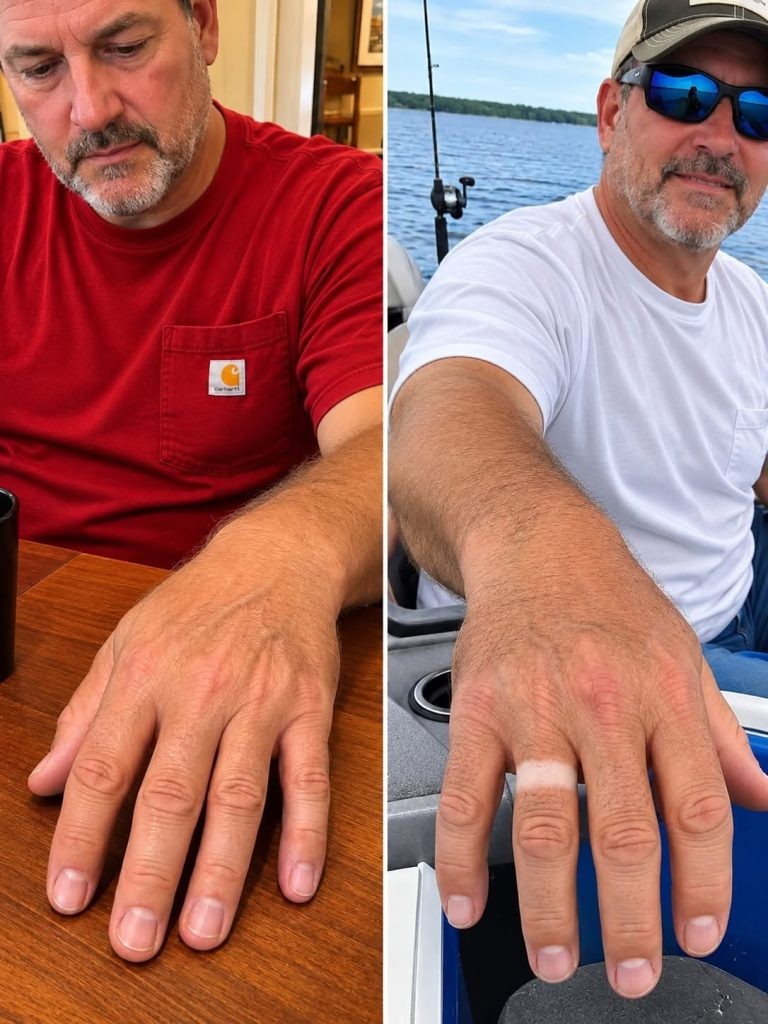
That was why a small detail caught my attention one seemingly ordinary afternoon. Mark was reaching across the kitchen table for his glass of water when I noticed something unusual on his left ring finger. There was a pale, perfectly circular mark where a wedding ring would normally sit.
At first, I barely thought anything of it. But then I remembered something important: Mark had not worn his wedding ring for twelve years.
The discovery seemed insignificant, yet something about it unsettled me. After more than two decades together, I had learned to recognize the difference between an ordinary explanation and an answer that concealed something more complicated.
A Small Detail That Raised Unexpected Questions
I looked at his hand again, trying not to make my curiosity obvious. The pale band appeared unusually distinct, almost as though something had recently covered that part of his finger for an extended period.
Eventually, I asked him about it.
Mark froze for a moment. It was brief, perhaps only a second, but I noticed the hesitation immediately. His expression changed before he answered.
He explained that the mark probably came from holding a fishing rod during his annual trip to Loon Lake. According to him, the pressure of the handle had left the unusual impression.
His explanation sounded reasonable at first. Fishing rods have handles that can create pressure against the hands, especially during long hours outdoors. However, I had spent years fishing with my father when I was younger. I knew what ordinary fishing-related marks looked like, and this particular mark seemed different.
Before I could ask another question, Mark changed the subject. He began talking about something unrelated, behaving as though the conversation had never happened.
I tried to continue with my afternoon, but his reaction stayed in my mind. It was not simply the mark that bothered me. It was the sudden hesitation, the hurried explanation, and the uncomfortable expression that crossed his face.
The Annual Fishing Trip That Had Always Been a Tradition
For nine years, Mark had taken the same annual fishing trip with several of his closest friends. It was a tradition he looked forward to every year, and I had never considered it unusual.
The destination was Loon Lake, a peaceful location that held sentimental value for both of us. It was also the place where Mark had once promised that he wanted to spend his life with me.
Over the years, his fishing weekends had become predictable in the most comforting way. He would leave home with his fishing equipment, a cooler, and enough supplies for several days. When he returned, he usually had amusing stories about the weather, the fish that got away, and the occasional disagreement among his friends.
He also brought me something small from each trip. Sometimes it was freshly caught fish. Other times, it was a jar of wild blueberry jam from a local shop.
These little gestures had become part of our shared routine. I never expected expensive gifts or elaborate surprises. The fact that he remembered me while spending time away with his friends was enough.
That was why his behavior following this year’s trip felt so unfamiliar.
Instead of returning home relaxed and cheerful, Mark seemed withdrawn. He carried his belongings upstairs almost immediately and avoided the usual conversation about his weekend.
When I asked whether he had caught anything interesting, his response was vague. He mentioned the weather, then changed the subject. When I asked about his friends, he gave an answer that seemed inconsistent with something he had said earlier.
It was difficult to identify exactly what had changed. Nothing dramatic had happened, and he had not openly admitted to anything unusual. Nevertheless, the familiar rhythm of our conversations had disappeared.
Why His Behavior Felt Different This Time
People naturally change their behavior from time to time. Stress at work, tiredness, personal concerns, and unexpected events can all affect how someone communicates with the people around them.
I understood that. After twenty-six years together, I knew that marriage did not mean having access to every thought or emotion my husband experienced.
Everyone deserves some privacy, and spending time with friends should not automatically become a reason for suspicion.
Still, several changes had occurred simultaneously. Mark was unusually quiet, his answers about the trip were inconsistent, and he seemed reluctant to discuss an activity he had previously enjoyed describing in great detail.
Even his humor was missing.
Normally, Mark would return from fishing with at least one ridiculous story. He enjoyed exaggerating the size of the fish he had supposedly caught and joking about his friends’ questionable fishing abilities.
This time, there was none of that.
I wondered whether something unpleasant had happened during the weekend. Perhaps he had experienced an argument with one of his friends. Perhaps there had been an accident, a disagreement, or some personal matter he was not ready to discuss.
There were many possible explanations, and I knew that assuming the worst would not help either of us.
But the pale mark on his finger continued to bother me.
The Wedding Ring and the Accident That Changed Everything
Twelve years earlier, Mark had been involved in a serious construction accident that injured his left hand. Several fractures required medical treatment, and the doctors needed to remove his wedding ring before they could properly address the injuries.
It had been a difficult period for both of us. The accident brought unexpected medical appointments, physical discomfort, and uncertainty about how much movement Mark would eventually regain in his hand.
Fortunately, he recovered sufficiently to return to many of his usual activities. However, the injury left his knuckle crooked, permanently changing the shape of his finger.
His wedding ring was eventually repaired, but wearing it became uncomfortable. The altered shape of his knuckle made the ring difficult to put on and remove, and he eventually decided to stop wearing it.
I understood his decision completely.
To us, the ring had never been the only symbol of our marriage. We had already shared twelve years together before he stopped wearing it, and removing it had not changed the meaning of our commitment.
Rather than discard the ring, Mark placed it inside a small wooden box in his dresser. It was a simple keepsake, something connected to our wedding day and the life we had built since then.
For years, I had assumed that it remained there untouched.
That memory became particularly important when I noticed the pale circular mark. If Mark had not worn his wedding ring for twelve years, what could have created such a clearly defined impression on his finger?
A Sleepless Night Filled With Unanswered Questions
That evening, I tried to behave normally. We ate dinner, discussed ordinary household matters, and went through the familiar routine of preparing for the next day.
Mark appeared tired and went to bed without offering much conversation.
I lay awake beside him, replaying the afternoon’s events in my mind. The mark, his explanation, and his unusual behavior seemed connected, although I could not determine how.
I considered whether I was reading too much into an ordinary physical mark. Perhaps he had borrowed equipment from someone. Perhaps he had worn another ring temporarily. There could have been an explanation that had nothing to do with our marriage.
Yet I could not ignore the fact that his story about the fishing trip had been unusually difficult to follow.
My mind returned to the years we had spent together. I remembered our wedding day, the construction accident, the long recovery, and the small wooden box where his original wedding ring had been stored.
What troubled me most was not the possibility that something had happened during his trip. It was the growing feeling that there was something important he was choosing not to tell me.
Trust in a long-term relationship is built through countless everyday interactions. It develops when people communicate honestly, explain difficult situations, and make an effort to understand one another.
When communication suddenly changes, even a small unexplained detail can become difficult to dismiss.
The Wooden Box in His Dresser
The following morning, Mark left for work as usual.
I watched him drive away before returning to the bedroom. I knew exactly where the wooden box was kept. It had occupied the same section of his dresser for years.
My hands trembled slightly as I opened the drawer.
The small box was still there, looking almost exactly as I remembered it. Its wooden surface had become slightly worn with age, but the familiar shape and simple design brought back memories of our wedding.
I lifted the lid carefully.
Inside was Mark’s original wedding ring.
For several moments, I simply stared at it. The ring was exactly where I expected it to be. Its presence confirmed that the explanation he had given me about his fishing rod did not answer the question I was trying to understand.
I picked up the ring and held it in my palm.
It was an ordinary piece of jewelry, but it represented twenty-six years of shared experiences. It reminded me of the promises we had made, the difficult periods we had overcome, and the everyday decisions that had allowed our relationship to continue.
Looking at it, I realized that the situation was no longer something I could comfortably ignore.
When a Marriage Faces an Unexpected Mystery
There is a difference between having questions and having answers. At that moment, I had plenty of questions but very little reliable information.
I did not know whether Mark had experienced an event during his fishing trip that he was afraid to discuss. I did not know why he had reacted so strangely when I asked about the mark. I also did not know whether the change in his behavior was connected to something happening in his personal life.
What I did know was that his explanation had not satisfied me.
I thought about confronting him immediately, but I wanted to understand what I was asking before beginning a difficult conversation. Accusing someone without knowing the facts could create unnecessary conflict and make an already uncomfortable situation harder to resolve.
At the same time, remaining silent would not make my concerns disappear.
After twenty-six years of marriage, I believed we deserved an honest conversation, even if the truth turned out to be uncomfortable.
Relationships are not defined by the absence of difficult moments. They are shaped by how people respond when uncertainty, disappointment, and misunderstandings arise.
Sometimes, the most important step is simply acknowledging that something feels different and asking the other person to explain.
What the Pale Ring Mark Really Meant
As I closed the wooden box, I looked again at the ring resting inside. The pale mark on Mark’s finger remained unexplained, and the events of the previous weekend continued to raise questions.
I thought about Loon Lake, the place where our relationship had taken such an important turn many years earlier. It had always represented happy memories, familiar traditions, and the beginning of the life we had built together.
Now, for the first time, it seemed connected to something I did not understand.
I placed the wedding ring back inside the box and returned it to the dresser. I knew that finding the ring had not solved anything. It had simply confirmed that the explanation I had received was incomplete.
When Mark returned home, I would need to ask him again. This time, I intended to have a direct conversation rather than allow assumptions and unanswered questions to grow.
Whatever had happened during those three days at Loon Lake, I wanted to hear the truth from him.
After twenty-six years together, I knew that one mysterious mark could not explain the entire story of our marriage. But I also knew that trust required honesty, and honesty was something neither of us could afford to take for granted.
The little wooden box was back in its place. The wedding ring was still inside. And somewhere between the memories of our wedding day and the strange silence that followed Mark’s latest fishing trip was a question that I could no longer ignore.
Sources
Editorial note: The supplied draft is a first-person fictional narrative. Its characters and events have not been independently verified, so external news organizations and medical authorities cannot responsibly be presented as sources for the story. The expanded article preserves its fictional, suspense-driven nature rather than presenting invented events or expert opinions as established facts.
- Reuters – International news and reporting.
- BBC News – International news and background reporting.
- The Guardian – International reporting and analysis.
Disclaimer: This content is intended for entertainment purposes only and is not based on real events.