An Unexpected Assignment on Christmas Eve
Christmas Eve was supposed to be a time for family, familiar traditions, and the excitement of children waiting for Santa Claus. But for one mother of three, the holiday took an unexpected turn when a last-minute work assignment threatened to change everything.
At exactly 5:58 p.m., her father-in-law, Elwood, handed her a delivery assignment to Texas. She looked down at the paperwork and immediately noticed something unusual. The name originally listed for the route was Keaton, Elwood’s favorite son. Someone had crossed it out and written her name in its place.
She reminded Elwood that her Christmas vacation had been approved months earlier. Her children were expecting to celebrate at home, and she had already made plans around the time off.
Elwood offered little explanation. Keaton had other plans, he said, so she would have to take the delivery instead.
The timing could hardly have been worse. Her husband, Nate, was already stranded in Ohio while completing another delivery. With no one available to care for the children, she faced an impossible choice: refuse the assignment and risk creating problems at work, or accept it and spend Christmas away from home.
Eventually, she agreed to make the journey. Elwood signed permission allowing the children to accompany her, and she began preparing for a holiday unlike any her family had experienced before.
Three Children, Three Different Christmas Worries
The news was especially difficult for the children, who had spent weeks looking forward to Christmas.
Rowan, the oldest at eleven, listened quietly as his mother explained what had happened. He understood that adults sometimes faced difficult responsibilities, but that did not mean he was happy about losing the holiday they had planned.
Hattie was much more upset. She had imagined Christmas Eve at home, surrounded by familiar decorations, presents, and family traditions. The thought of spending the evening traveling instead was deeply disappointing.
Five-year-old Wes had a different concern. He wanted to know whether Santa would still find them if they were sleeping in a truck instead of their house.
His mother tried to reassure him with a joke. Of course Santa would find them, she explained. He had a CB radio and would know exactly where to go.
The joke brought a little laughter, but it could not completely hide the disappointment. The children had done nothing wrong, yet they were being asked to give up the Christmas they had been anticipating.
Their mother was struggling, too. She felt frustrated by the sudden change, worried about Nate, and concerned about how the children would remember the holiday. Still, she knew that letting her anger take over would make the evening even harder.
She packed their presents, gathered the essentials for the trip, and bought a tiny five-dollar Christmas tree. It was a simple decoration, but she hoped it would help make the truck feel a little more like home.
A Small Christmas Celebration at an Oklahoma Truck Stop
Later that evening, the family stopped at a truck stop outside Oklahoma City.
Instead of gathering around their Christmas tree at home, they prepared for the holiday inside the sleeper compartment of their truck. They ate pancakes, arranged their presents, and found a place for the little tree.
It was not the celebration they had imagined. There were no familiar decorations, no traditional family gathering, and no chance to spend the evening with their father.
But their mother did her best to create a special moment.
She wanted the children to understand that Christmas was not defined entirely by where they celebrated or how much money they spent. Even in an unfamiliar place, they could still share food, laughter, and the excitement of opening presents.
The little tree became the center of their temporary celebration. It was small enough to fit inside the truck, but it represented something important: their determination to make the best of a difficult situation.
For a family whose livelihood involved transportation, unexpected schedules were part of the job. Yet this assignment felt different because it had replaced vacation time that had already been approved.
Still, the mother put those frustrations aside for the moment. Christmas morning was approaching, and she wanted her children to have something joyful to remember.
Christmas Morning Brings an Unexpected Surprise
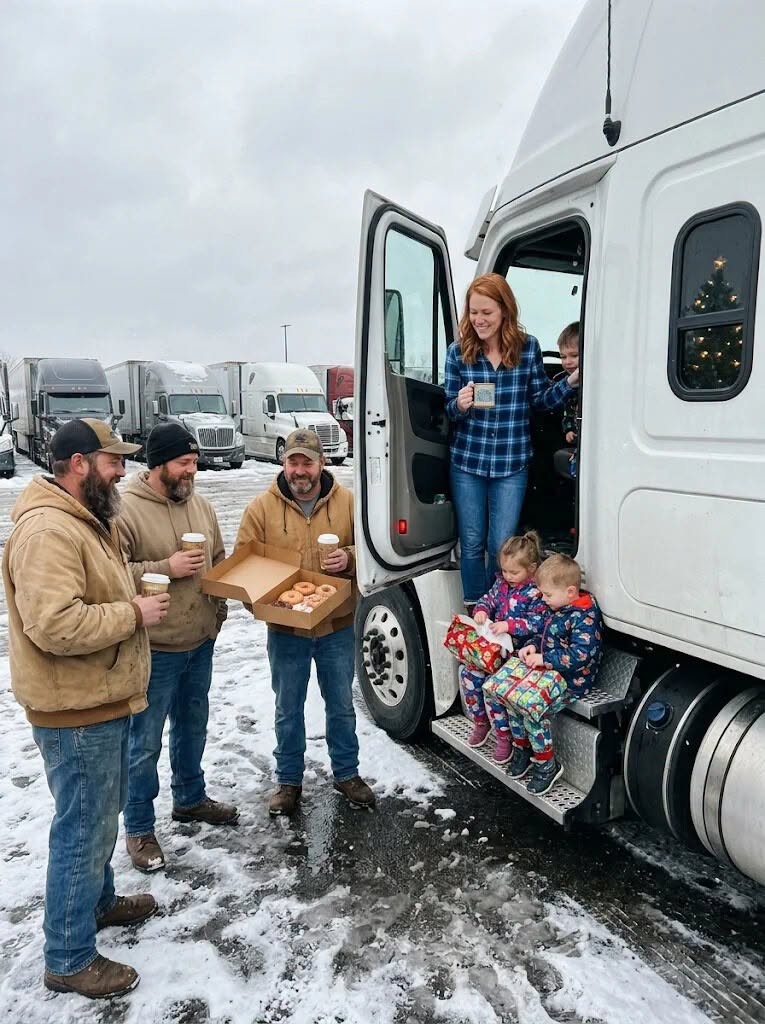
When Christmas morning arrived, the family opened their presents beside the truck.
The setting was unusual, but the children were finally able to enjoy the gifts they had been waiting for. Their mother watched them unwrap their presents, relieved to see their excitement returning.
Then a truck driver named Odell noticed them.
Curious about why three children were celebrating Christmas beside a delivery truck, he approached and asked what had happened. The mother explained the unexpected assignment and how their holiday plans had changed at the last minute.
Odell listened carefully. Rather than simply offering a few sympathetic words, he decided to do something to make the morning better.
He contacted other drivers over the radio and told them about the family.
What happened next was something none of them had expected.
Within a short time, nearly thirty truck drivers gathered around the family’s vehicle. Some brought donuts, others arrived with toys and stuffed animals, and several carried small gifts for the children.
But the presents were only part of what made the moment special.
The drivers brought laughter, encouragement, and a sense of community. They had never met the family before, yet they were willing to spend part of their Christmas morning making three children feel welcome.
The children, who had begun the holiday feeling disappointed, suddenly found themselves surrounded by people eager to share their happiness.
Every new gift brought another smile. The drivers applauded as the children opened their presents, turning an ordinary truck stop into an unexpected Christmas gathering.
For their mother, the kindness was deeply moving. These strangers had no responsibility to help her family. They simply saw children having a difficult holiday and decided to make it better.
A Short Video Brings Attention to the Workplace Dispute
Odell recorded part of the gathering and shared the video online. The footage captured the cheerful Christmas celebration and the generosity of the drivers who had come together.
But the video also drew attention to the circumstances that had brought the family onto the road.
Other drivers who worked for the same company recognized the truck. They began asking questions about the assignment, particularly why the mother had been given a delivery that had originally been intended for Keaton.
The questions eventually reached the company office.
Marlene, the office manager, confirmed that the mother’s Christmas vacation had been approved months earlier. This detail mattered because it showed that the family had not simply misunderstood the schedule.
The vacation had already been arranged. The last-minute assignment had changed those plans.
As more people learned what had happened, Elwood was questioned about his decision. He eventually acknowledged that he had deliberately changed the schedule.
The incident raised an important question about fairness in a family-operated business. Should personal relationships determine who receives preferred assignments and who is expected to sacrifice approved time off?
The Christmas gathering had brought unexpected happiness, but the workplace disagreement still needed to be resolved.
Elwood Explains Why He Changed the Assignment
When the mother finally confronted Elwood, he explained that his decision had been motivated by concern for Keaton.
He was afraid that Keaton might relapse after losing his mother. According to Elwood, he had been trying to protect his son during an emotionally difficult period.
His explanation added another layer to an already complicated situation.
The mother’s anger began to make room for understanding. She could recognize that Elwood’s fear might be genuine and that he wanted to support his son.
However, understanding someone’s reasons does not automatically make a decision fair.
She explained that protecting one family member should not require another family to give up its plans without discussion. Her children mattered, too. Their Christmas was important, and her previously approved vacation deserved respect.
There was a difference between supporting Keaton and placing an unexpected burden on someone else.
Family relationships can make professional decisions difficult, especially when relatives work together. Personal concerns sometimes become mixed with business responsibilities, and people may assume that one family member will always make sacrifices for another.
But a fair workplace needs clear expectations.
The mother was not asking Elwood to ignore Keaton’s difficulties. She was asking him to recognize that everyone deserved consideration.
Keaton’s Apology Opens the Door to a Solution
When the family eventually returned, another important conversation took place.
Keaton apologized to the mother. He explained that he had not known about the arrangement and had not realized that she had been assigned his delivery after her vacation had already been approved.
His apology helped clarify the situation.
The disagreement was no longer about blaming Keaton. Instead, it became clear that the main problem was the way the assignment had been changed and the lack of communication surrounding the decision.
Rather than allowing resentment to grow, the mother proposed a practical solution.
She asked for a written holiday rotation that would clearly explain how assignments were distributed. Everyone would know in advance who was expected to work during major holidays, and no one would be unexpectedly required to give up approved time off without a fair process.
Elwood agreed.
A written schedule could not undo the disappointment of that Christmas, but it could help prevent the same problem from happening again. More importantly, it gave the family a way to address the conflict without allowing it to damage their relationships permanently.
The experience had shown them that good intentions were not enough. Fairness also required communication, consistency, and respect.
What This Christmas Story Teaches About Family and Fairness
The family’s experience offers several lessons about working with relatives.
First, communication matters. When an employee has already received approval for vacation time, any proposed change should be discussed openly. Last-minute decisions can affect not only the employee but also children, spouses, and other family members who have made plans around that time.
Second, workplace policies should apply consistently. Assignments should not depend entirely on personal preferences or assumptions about which employee is more willing to make sacrifices.
Third, compassion should extend to everyone involved. Keaton’s difficulties deserved understanding, but the mother’s family deserved consideration as well.
A written holiday rotation was a simple but meaningful step toward fairness. It could make responsibilities more predictable and reduce the chance of future misunderstandings.
For family-operated businesses, this kind of structure is especially valuable. Separating personal concerns from professional decisions can protect both the workplace and the relationships within it.
The mother was not simply asking for a better schedule. She wanted her family to be treated with the same respect given to everyone else.
The Christmas Tree That Reminded Them of Unexpected Kindness
Looking back, the mother knew that Christmas had not gone according to plan.
Her children had missed the traditional celebration they had expected, and she had spent the holiday managing a delivery assignment she had never intended to accept.
Yet the experience had also introduced them to something they might never have encountered otherwise.
Nearly thirty truck drivers had taken the time to make three children feel special. Odell had noticed a family having a difficult morning and had brought others together to help.
Their generosity showed that a meaningful Christmas does not always require expensive presents, elaborate decorations, or a perfectly planned celebration.
Sometimes, the most memorable moments come from people who notice someone else’s struggles and choose to respond with kindness.
The tiny five-dollar Christmas tree became a reminder of that unusual holiday. It represented the family’s effort to preserve their traditions, as well as the generosity of strangers who helped turn disappointment into joy.
For Rowan, Hattie, and Wes, Christmas became a story about more than presents or the place where they celebrated. It became a memory of laughter, unexpected gifts, and people who cared enough to make their morning special.
For their mother, the experience carried another lesson: kindness and fairness can exist together. She could appreciate the truck drivers’ generosity while still asking for better treatment at work.
The holiday had not been perfect. But it had given the family a memory they would not easily forget.
Sometimes, family is found not only among the people who share your home or your last name, but also among strangers who choose to show compassion when it matters most.
And that little Christmas tree was a reminder of the morning when a group of truck drivers made an unexpected difference.
Editorial Note: This is a fictionalized narrative based on the supplied draft. The characters and events have not been independently verified and should not be presented as a documented real-life incident.