Fiction: An Unexpected Prom Entrance That Changed Everything
My husband dropped the box of refreshments he was carrying when he saw Nate walk into the school gymnasium. The room was filled with teenagers celebrating prom night, but within seconds, almost everyone seemed to notice the same person.
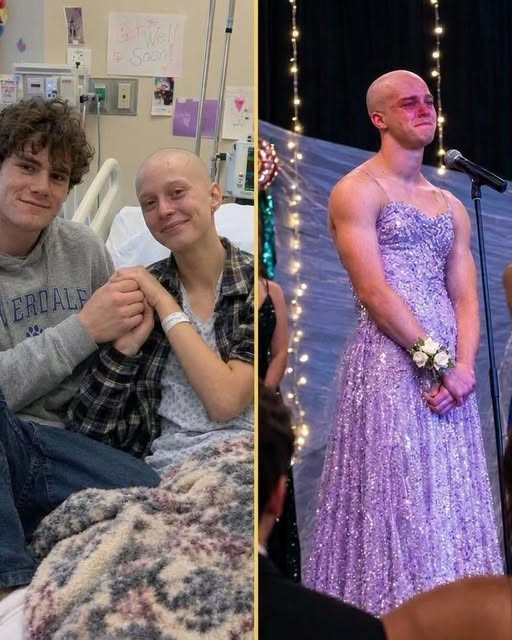
Nate, our seventeen-year-old daughter Olivia’s former boyfriend, had arrived looking completely different from the boy we remembered. His head was shaved, leaving him entirely bald, and he was wearing an elegant floor-length gown.
For a moment, nobody seemed to know how to react. Some students exchanged confused looks, while others whispered to their friends. A few immediately reached for their phones, curious about the unexpected entrance.
My attention went straight to Olivia. She stood near the dance floor in a beautiful blue prom gown. Her expression had changed the moment she recognized Nate.
Olivia had recently lost her hair during difficult medical treatments. Preparing for prom had already been an emotional experience. She had considered wearing a wig, but eventually decided to attend without one. It was her way of choosing comfort and confidence rather than allowing other people’s possible reactions to determine whether she enjoyed an important milestone.
We had supported her decision, although I knew it had taken considerable courage. She understood that people might stare or ask questions, but she wanted to experience prom as herself.
That was why Nate’s appearance initially seemed so upsetting. His shaved head and unusual outfit looked like an imitation of Olivia’s circumstances, and my husband immediately assumed he had returned to embarrass her.
Before my husband could approach him, Nate walked toward the DJ’s microphone. The music stopped, and conversations gradually faded. Students turned toward the front of the room.
Olivia remained where she was. I could not tell whether she felt uncomfortable, angry, or simply overwhelmed by the situation.
Then Nate began speaking. His voice was unsteady, and his first few sentences made it clear that the entrance meant something very different from what we had imagined.
The Breakup Had a Different Story Behind It
Until that evening, I had believed Nate had ended his relationship with Olivia because he could not cope with her medical situation. The timing had made the separation especially painful.
Our daughter was already navigating appointments, treatment-related changes, and the emotional uncertainty that came with facing a serious health challenge. Losing an important relationship at the same time seemed like another disappointment she should never have had to experience.
My husband had struggled with the situation, too. He had watched Olivia work hard to maintain some sense of normal teenage life. Seeing Nate return in such an unexpected way appeared, at first, to be another threat to her confidence.
However, Nate did not begin by defending his appearance. He began with an apology.
He admitted that he had walked away from their relationship without properly explaining what had happened. He also acknowledged that his actions had left Olivia with questions and hurt feelings.
Then he explained that their separation had not been caused by a lack of affection. Instead, it had grown out of fear, misunderstanding, and two teenagers attempting to protect each other without knowing how to communicate honestly.
As I listened, I realized that the story I had accepted was incomplete. Olivia had never told us the entire conversation that led to their breakup. Perhaps she had wanted to spare us additional worry while dealing with everything else happening in her life.
Nate continued, explaining how Olivia’s diagnosis had changed their relationship and how his own fear had influenced his behavior.
When Concern Becomes Difficult to Manage
Before Olivia became ill, she and Nate had enjoyed a relatively ordinary teenage relationship. They attended school events, spent time with friends, talked about their plans, and looked forward to experiences such as prom.
After her medical difficulties began, however, their everyday routine changed. Nate became increasingly worried about her well-being. He wanted to accompany her whenever possible and constantly checked whether she needed anything.
At first, Olivia appreciated his attention. Knowing that someone cared about her made difficult days feel less isolating. But gradually, Nate began putting aside more and more of his own activities.
He canceled plans with friends, reduced the time he spent on personal interests, and became reluctant to enjoy anything that did not involve Olivia. His intentions were understandable, but the relationship started carrying an emotional responsibility that neither teenager knew how to manage.
Olivia noticed the changes. Even while concentrating on her own well-being, she worried about what Nate was giving up. She did not want him to feel that caring about her meant abandoning his friendships, interests, education, or personal goals.
She also struggled with guilt. Whenever Nate canceled something because he wanted to stay with her, she felt responsible. She began wondering whether his concern was preventing him from experiencing the ordinary opportunities that should have been part of his teenage years.
Instead of explaining those feelings directly, Olivia made a decision she believed would solve the problem.
She told Nate that she no longer loved him.
The statement was not true. She still cared deeply about him, but she thought ending the relationship would give him permission to return to his own life.
She believed that if he understood she no longer wanted to be with him, he would stop feeling obligated to remain constantly available. It was a painful decision, but from her perspective, it seemed kinder than watching him continue making sacrifices.
Nate accepted what she said, although he did not understand why her feelings appeared to have changed so suddenly. Their relationship ended without either of them fully explaining what they needed.
Standing in the gymnasium, I finally understood the misunderstanding. Olivia had tried to protect Nate from worry, while Nate had tried to protect Olivia through constant attention. Both cared, but neither had found a healthy way to express that concern.
Why Nate Chose a Gown and a Shaved Head
The explanation behind Nate’s appearance was just as unexpected as the story of their breakup.
Months earlier, Olivia had made a joke about prom. She had told Nate that if she ever needed cheering up, he should surprise her by wearing a formal dress to the event. At the time, it had been an ordinary conversation between two teenagers sharing a laugh.
Nate remembered it.
He explained that choosing the gown was his way of bringing back a happy memory. He wanted Olivia to remember that their relationship had included laughter, friendship, and moments when neither of them had to think about medical appointments or difficult circumstances.
The shaved head had another meaning. Nate knew Olivia had decided to attend prom without wearing a wig. He understood that she might receive unwanted attention, even though she had made a personal choice about her appearance.
He hoped that his own unexpected appearance would redirect some of that attention. Rather than allowing Olivia to feel that she was the only person being noticed for looking different, he wanted to make himself the center of curiosity for a while.
His intention was not to suggest that their experiences were identical. He knew that shaving his head for an evening could never represent what Olivia had experienced during medical treatment. Instead, he wanted to demonstrate that he was willing to step outside his comfort zone to make her smile.
As he explained this, the atmosphere in the room changed. The initial surprise gradually gave way to understanding.
My husband, who had been ready to confront Nate, lowered his shoulders. He was still protective of Olivia, but he could now see that the entrance had not been intended as an insult.
For me, the most important part was hearing Nate acknowledge that good intentions did not automatically make every decision right. He admitted that he had made mistakes and that he should have communicated more openly instead of allowing fear to determine his choices.
Understanding Each Other Without Rushing the Future
Nate’s apology did not immediately repair everything that had happened. A meaningful gesture could open a conversation, but it could not erase weeks of uncertainty or automatically restore trust.
Olivia had also made decisions that deserved an honest discussion. She had hidden her feelings because she believed she knew what was best for Nate. Although her intentions were caring, she had not given him the opportunity to understand her concerns or make his own choices.
Both teenagers needed to recognize that caring about someone did not mean making every decision on that person’s behalf.
As parents, we sometimes want to solve difficult situations quickly. When our children are struggling, it can be tempting to decide what they should do, who they should spend time with, and which experiences they should avoid.
But Olivia was seventeen, and prom was her evening. She deserved the opportunity to decide how she wanted to respond without feeling pressured by her parents, her former boyfriend, or the watching students.
After Nate finished speaking, the DJ waited. Nobody immediately knew whether the evening should continue as normal or whether the moment required something more.
Olivia eventually walked toward Nate. They spoke quietly, away from the microphone and the growing crowd. I could not hear their conversation, but I noticed that her expression had become more relaxed.
She accepted his invitation to dance.
It was a simple slow dance, not a public announcement that they were back together. Neither teenager made promises about their future. They simply shared a song and allowed themselves to enjoy the moment.
At one point, Olivia laughed. It was a genuine, unguarded laugh that I had not heard often enough during the difficult weeks before prom.
Watching her smile reminded me that emotional recovery does not always require a dramatic resolution. Sometimes, being able to talk honestly, feel understood, and enjoy an ordinary experience can be meaningful in itself.
Why Teenagers Need Support During Difficult Medical Experiences
Although this story is fictional, the emotions at its center reflect challenges that families may encounter when a young person experiences a serious medical condition.
Medical treatment can affect more than physical well-being. Changes in appearance, interruptions to school routines, uncertainty about the future, and shifts in friendships can all influence a teenager’s sense of identity and independence.
Hair loss, in particular, may carry personal and social significance. For some young people, it is a visible reminder of treatment. Others may experience questions, unwanted attention, or concerns about how classmates will respond.
There is no single correct way to approach these changes. Some teenagers may prefer wigs, hats, or other forms of covering. Others may feel more comfortable showing their natural appearance. Respecting the individual’s decision is important because personal appearance is closely connected to confidence and self-expression.
Families and friends can help by listening rather than assuming what a young person needs. Practical assistance may be welcome, but so may ordinary conversations about music, school, hobbies, friendships, and future plans.
It is equally important to remember that teenagers who support someone experiencing illness may have their own emotional needs. Friends and partners can experience uncertainty, sadness, and anxiety without knowing how to discuss those feelings.
Encouraging honest communication can help prevent misunderstandings. It also allows young people to maintain appropriate boundaries, continue their personal interests, and seek support from trusted adults when a situation feels overwhelming.
Support should never become an expectation that one teenager must sacrifice every aspect of personal life for another. Healthy relationships leave room for care, independence, communication, and mutual respect.
A Prom Night That Was About More Than Appearance
There were still difficult days ahead for Olivia. Her treatment journey had not suddenly become easier, and one evening of music and dancing could not change the uncertainty surrounding her health.
But that was not the purpose of prom.
For one evening, Olivia had the opportunity to enjoy something that mattered to her. She wore the blue gown she had chosen, attended without a wig because that was what felt right to her, and spent time with friends.
Nate’s unexpected entrance had initially made us fear that someone was about to turn her personal decision into a public spectacle. Instead, it became an opportunity for two young people to acknowledge the misunderstandings that had separated them.
My husband and I learned something, too. Our instinct to protect Olivia had led us to assume the worst before understanding what was happening. Being protective is natural, especially when a child is facing difficult circumstances, but listening remains just as important.
Nate still had to demonstrate through his actions that he understood Olivia’s needs. Olivia still had to decide what kind of relationship, if any, she wanted with him. Their future would depend on conversations and choices beyond that evening.
As the music continued, I stopped thinking about the dropped refreshments, the surprised faces, and the phones held above the crowd.
Instead, I watched my daughter dance in her blue gown. She looked comfortable, happy, and entirely present in the moment.
That was what I wanted to remember.
Olivia had not allowed a difficult medical experience to take away her opportunity to celebrate an important milestone. She had chosen to attend prom on her own terms, and she had the freedom to decide what Nate’s apology meant to her.
Whether they eventually became a couple again was uncertain. What mattered that night was that they had begun communicating honestly and that Olivia had found a reason to smile.
Sometimes, the most meaningful moments are not about resolving every problem. They are about allowing people to be more than the challenges they face, recognizing the importance of personal choices, and making room for happiness even when life remains complicated.
For our family, that prom night became a reminder that illness does not have to define every experience, that friendship and relationships require honest communication, and that young people deserve the space to make their own decisions.
And for Olivia, it was simply a night of music, laughter, a blue gown, and one unforgettable dance.
Sources
Editorial note: The article is a fictional narrative. The following official resources provide general background on emotional support, appearance changes, and maintaining relationships during serious medical experiences. They do not verify the fictional events or characters.
- National Cancer Institute (NCI) – Emotional Support for Young People with Cancer
- National Cancer Institute (NCI) – Support for Families: Childhood Cancer
- National Cancer Institute (NCI) – Self-Image, Sexuality, and Cancer
- National Cancer Institute (NCI) – Hair Loss and Cancer Treatment
- National Health Service (NHS) – Hair Loss
Disclaimer: This content is intended for entertainment purposes only and is not based on real events.