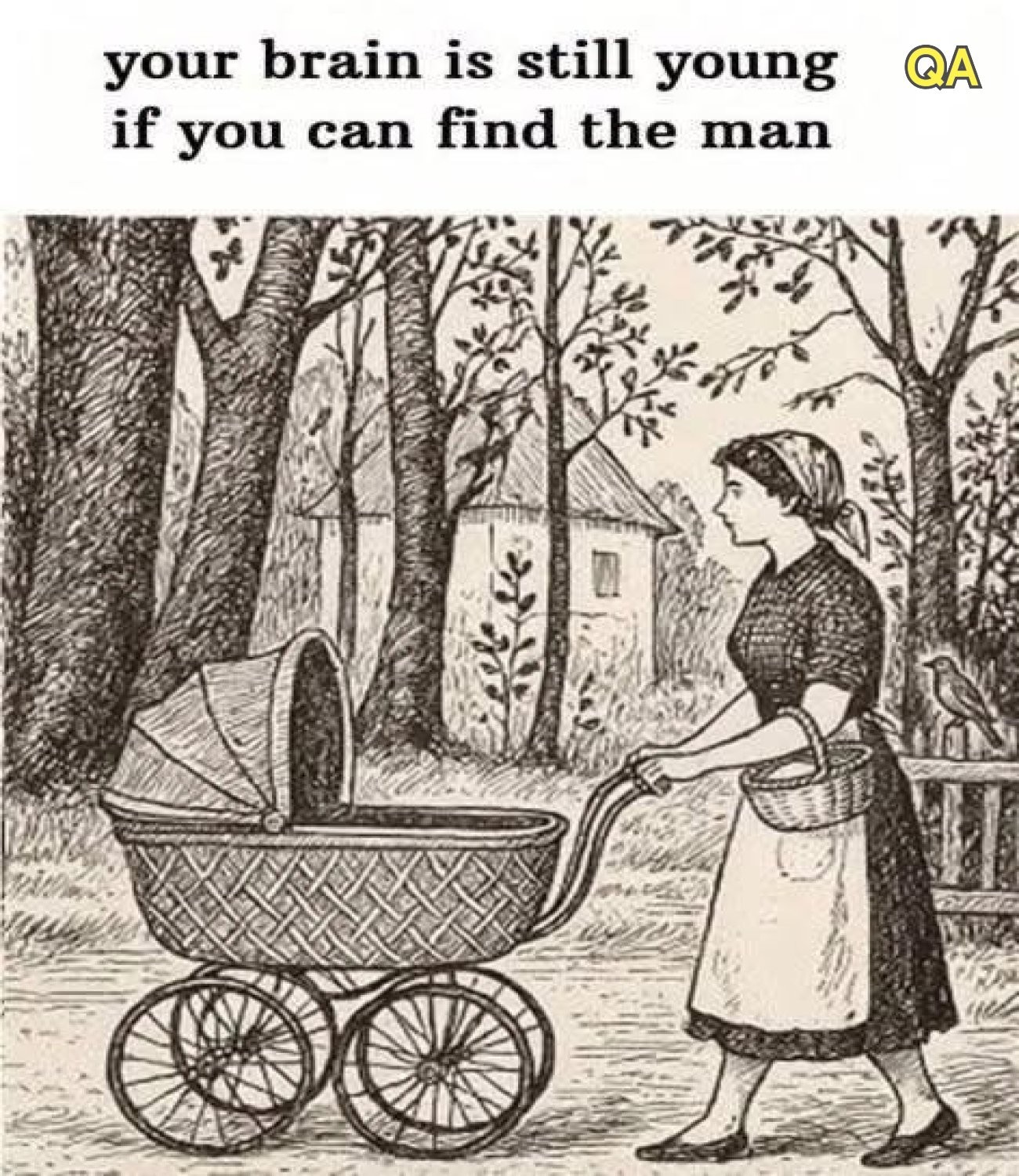
Can You Find the Hidden Man in This Optical Illusion …Look Closely
Have you ever looked at an ordinary picture and felt certain you had noticed every detail, only to discover an entirely different image hiding in plain sight? Optical illusions have a remarkable ability to challenge our perception, revealing how differently the human brain can interpret the same visual information.
One fascinating example is the hidden man optical illusion, which challenges viewers to identify a man’s face concealed within a peaceful countryside illustration. At first glance, the scene appears straightforward: a woman pushes a baby carriage along a wooded path, surrounded by trees, branches, and shadows. Nothing seems particularly unusual.
However, another image is waiting to be discovered. The outlines and shapes that initially appear to form an ordinary landscape may also create the features of a human face.
Viral versions of this puzzle often include an intriguing question: Can only people with young eyes find the hidden man? Although this claim makes the challenge more interesting, it raises questions about visual perception, attention, and the relationship between age and eyesight.
So, can you discover the hidden face? More importantly, why can something so obvious to one person remain invisible to another? Understanding the science behind optical illusions can make this simple visual challenge even more interesting.
What Is the Hidden Man Optical Illusion?
The hidden man optical illusion is an example of a multiple-image visual puzzle. It uses a single illustration to communicate two different visual interpretations.
The first interpretation is usually easy to recognize. Viewers notice the woman, the baby carriage, and the surrounding countryside. Their brains quickly organize the illustration into a familiar scene, making the main objects relatively easy to identify.
The second interpretation is considerably more difficult to recognize. Within the same collection of shapes, lines, shadows, and outlines, another image forms the appearance of a man’s face.
Instead of drawing the face separately, the artist incorporates its features into the existing landscape. A curved branch might contribute to the outline of the head, while darker areas and surrounding shapes may suggest facial features.
This technique encourages viewers to reconsider what they are seeing. The objective is not necessarily to find an additional object but to recognize that the existing illustration can be interpreted in another way.
That is the central appeal of the puzzle: the picture remains exactly the same, but your understanding of it changes.
Why Is the Hidden Face So Difficult to Recognize?
Human vision involves much more than the eyes collecting light. The brain continuously processes visual information, identifies patterns, and organizes individual details into meaningful objects.
When you look at a countryside illustration, your visual system attempts to recognize familiar elements. Trees, people, pathways, and everyday objects are identified through combinations of edges, colors, shapes, and spatial relationships.
This process helps people understand complicated surroundings efficiently. However, it can also make hidden-image puzzles challenging.
Once your brain recognizes the woman and the baby carriage, it tends to interpret other visual elements according to that initial understanding. A dark area becomes a shadow, a curved line becomes a branch, and an unusual outline becomes part of the landscape.
Consequently, you might look directly at the shapes that contribute to the hidden man’s face without recognizing their alternative meaning.
The difficulty comes from changing your interpretation rather than simply improving your ability to see small details.
How the Brain Recognizes Familiar Patterns
One important concept behind optical illusions is pattern recognition. The human brain is particularly effective at identifying familiar arrangements, even when the available information is incomplete.
For example, people can often recognize a familiar person from a distance, identify an object in a dimly lit room, or understand a partially obscured shape. The brain uses visual clues and surrounding context to interpret what the eyes receive.
Psychologists often discuss this process in relation to Gestalt principles of perception. These principles describe how people naturally organize visual elements into larger, meaningful patterns.
Several principles are particularly relevant to hidden-image puzzles:
- Figure and ground: The brain distinguishes objects from the background surrounding them. In an optical illusion, the background may become a recognizable object when attention changes.
- Similarity: Visually similar elements are often perceived as belonging together, helping the brain organize complicated illustrations.
- Closure: People naturally fill in missing visual information to recognize incomplete shapes and familiar objects.
- Proximity: Elements positioned close together are often interpreted as parts of the same group or object.
These principles help explain why a collection of branches, shadows, and irregular outlines can suggest both a countryside landscape and a human face.
When you discover the hidden image, the illustration has not changed. Your brain has simply recognized another possible arrangement of the same visual information.
Five Ways to Find the Hidden Man
If you have been examining the illustration without success, changing your viewing strategy may help. Rather than staring harder at the same section, try approaching the image from a different perspective.
1. Examine the Entire Picture First
Begin by looking at the complete illustration rather than immediately zooming in on individual objects.
Viewing the picture from a normal reading distance can help you notice larger patterns that might be difficult to recognize when concentrating on tiny details.
Sometimes, the hidden image becomes more apparent when individual objects blend together into broader shapes.
2. Stop Concentrating on the Obvious Objects
For a moment, forget that the illustration contains trees, branches, shadows, and a baby carriage.
Instead, examine their outlines without immediately assigning names to them.
Ask yourself whether a particular arrangement of curves, edges, and shaded areas could represent something different.
This simple change in approach can encourage your brain to consider interpretations beyond the familiar countryside scene.
3. Search for Familiar Facial Features
Human faces are highly recognizable visual patterns. Even a relatively small arrangement of shapes can suggest a forehead, eyes, nose, or mouth.
Rather than searching for an entire face immediately, examine combinations of lines and contrasting areas that might represent individual facial features.
Pay attention to how several separate elements could work together to create a recognizable facial outline.
4. Examine the Negative Space
One of the most useful techniques for solving hidden-image puzzles is examining negative space.
Negative space refers to the areas surrounding or separating objects in an illustration. Artists frequently use these spaces to create additional shapes and visual relationships.
For example, an opening between two branches might contribute to the outline of a face. A gap between objects may become more meaningful when viewed as part of a larger composition.
Instead of concentrating exclusively on the objects themselves, consider the shapes formed by the empty spaces around them.
5. Relax Your Eyes and Change the Viewing Distance
Staring intensely at one small section can make it harder to appreciate the overall arrangement.
Try relaxing your gaze and allowing your eyes to move naturally across the illustration. You can also experiment with viewing the picture at different sizes or distances.
Changing the scale may affect which visual details become most noticeable. However, there is no guaranteed viewing technique that works for everyone.
The Aha Moment: When the Hidden Image Suddenly Appears
One of the most enjoyable aspects of optical illusions is the sudden moment when an unfamiliar image becomes recognizable.
You might spend several minutes examining the illustration without finding anything unusual. Then, a particular arrangement of shapes suddenly begins to resemble a man’s face.
A line that previously appeared to be a branch may now look like part of a forehead. A shaded section might suggest an eye, while another outline contributes to the overall shape of the head.
This experience is commonly described as an aha moment. It occurs when a new interpretation suddenly makes sense.
Once you recognize the alternative image, you may find it considerably easier to identify it again. Your brain now has an additional interpretation available, allowing you to recognize the same visual features differently.
This is one reason people enjoy sharing optical illusions. Discovering the hidden image can feel surprisingly satisfying, particularly when it has remained unnoticed for several minutes.
Can Only People With Young Eyes See the Hidden Man?
The suggestion that only people with young eyes can identify the hidden man is one of the most attention-grabbing aspects of this viral puzzle.
However, there is no established scientific evidence that this particular optical illusion can determine someone’s age or assess the health of their eyesight.
How quickly someone recognizes the hidden face can depend on several different factors, including:
- Image quality: Low resolution or poor image compression can make important visual details difficult to distinguish.
- Screen size: Viewing the illustration on a small mobile display may produce a different experience from examining it on a larger screen.
- Contrast and lighting: Display brightness and surrounding lighting can influence how easily individual shapes are perceived.
- Visual attention: People may initially concentrate on different sections of the illustration.
- Previous experience: Someone familiar with hidden-image puzzles may be more accustomed to looking for alternative visual patterns.
- Hints and expectations: Knowing that a human face is concealed in the picture can change how viewers examine it.
Age can influence certain aspects of vision. For example, normal age-related changes may affect the ability to focus on nearby objects, adapt to changes in lighting, or distinguish some visual details.
However, recognizing a concealed face in one illustration is not a reliable measurement of these changes.
If you cannot identify the hidden man immediately, it does not mean your eyesight is deteriorating. Likewise, finding the face within seconds does not establish that you have exceptionally sharp vision.
The claim should therefore be understood as playful social media wording rather than a scientifically supported eyesight test.
What Optical Illusions Reveal About Human Vision
Optical illusions provide an accessible way to explore how the human visual system interprets information.
Although the eyes collect visual signals, the brain actively processes those signals to create a meaningful representation of the surrounding environment.
Context plays an important role in this process. The same arrangement of shapes may produce different interpretations depending on what someone expects to see.
For example, if you are told to search for a man’s face, you may begin examining the illustration for facial features. If someone instead asks you to identify the trees, you may concentrate on the branches and surrounding landscape.
The physical image remains unchanged, but your attention influences which details become most noticeable.
This demonstrates an important characteristic of visual perception: what people notice is influenced by both the information presented to their eyes and the way their brains organize that information.
It also explains why two people can examine the same optical illusion and describe different things first. Their initial interpretations may depend on attention, expectations, and previous visual experiences.
Why Hidden-Image Optical Illusions Are Popular Online
Hidden-image puzzles regularly attract attention on social media because they combine simplicity with an engaging challenge.
Unlike complicated games or quizzes, these illustrations generally require no specialist knowledge, equipment, or preparation. Anyone with access to the image can participate.
The challenge also creates an opportunity for social interaction. People can share the illustration with friends, family members, and online communities, inviting others to discover the concealed image.
Questions such as how quickly someone found the hidden face naturally encourage discussion and comparison.
Another important factor is the satisfaction associated with solving a visual puzzle. Recognizing something that was previously difficult to see creates a small but enjoyable sense of achievement.
These characteristics make optical illusions particularly suitable for short-form online content. They are visually interesting, easy to understand, and encourage people to spend additional time examining an image.
How to Challenge Friends Without Revealing the Answer
If you decide to share the hidden man optical illusion with friends or family, avoid immediately pointing toward the concealed face.
Part of the enjoyment comes from discovering the alternative image independently. Revealing its exact location too early can remove much of the challenge.
Instead, provide a small hint that encourages a different approach.
For example, suggest examining the outlines rather than concentrating on individual objects. You could also recommend paying attention to the spaces between branches and other elements of the illustration.
Another idea is to turn the puzzle into a friendly group activity. Ask everyone to examine the picture independently before discussing what they noticed.
Remember that the challenge is intended for entertainment. The time someone takes to recognize the hidden image should not be treated as a measure of intelligence, age, or visual ability.
What If You Still Cannot See the Hidden Man?
There is no reason to feel frustrated if the hidden image remains difficult to recognize.
Some optical illusions are easier to understand once you know the visual technique being used. Others depend heavily on image quality, viewing conditions, and the particular way the illustration has been constructed.
If you are having difficulty, consider taking a short break before looking again. Returning to the picture with a fresh perspective may help you notice details that previously escaped your attention.
You can also experiment with changing the image size, adjusting your viewing distance, or examining the negative spaces surrounding the main objects.
If necessary, ask someone to provide a general hint without identifying the exact location of the hidden face.
Most importantly, remember that an optical illusion is not an examination that everyone must pass. Its purpose is to encourage curiosity, demonstrate the fascinating nature of visual perception, and provide an enjoyable challenge.
Final Thoughts: Can You Find the Hidden Man?
The hidden man optical illusion demonstrates how a familiar picture can contain more than one possible interpretation. What initially appears to be a simple countryside scene may also contain the outline of a human face, encouraging viewers to reconsider the shapes and patterns they see.
The puzzle is a reminder that human vision involves active interpretation rather than simply recording everything in front of us. Attention, context, expectations, and pattern recognition all contribute to the way we understand visual information.
Although the claim that only people with young eyes can solve the puzzle makes for an entertaining challenge, it should not be confused with a scientific eyesight assessment.
Whether you discover the hidden man immediately or need several attempts, the real reward is experiencing that satisfying moment when another image suddenly becomes clear.
Did you find the hidden man? Share the puzzle with someone else and see whether they notice the face as quickly as you did.
You may also enjoy reading Creepy Many-Legged Bug for another unusual visual discovery.
Sources
The following established organizations provide reliable background information about visual perception, human vision, and age-related changes in eyesight. The optical illusion discussed in this article should not be interpreted as a validated scientific test.
Disclaimer: This content is intended for entertainment purposes only and is not based on real events.