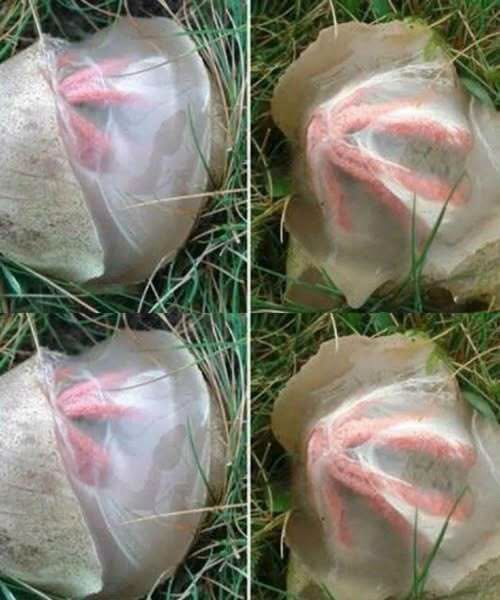
A Strange Red Discovery in the Garden
It was an ordinary day in the garden until something unusual caught my attention.
Near the edge of a garden bed sat a glossy, bright red growth. Its appearance was so unexpected that I stopped immediately, unsure what I was looking at. It seemed out of place among the familiar plants, soil, and greenery.
My first reaction was not curiosity. It was fear.
The strange shape and intense colour made me wonder whether I had discovered something dangerous. Could it be poisonous? Was it an invasive organism? Could it spread through the garden or pose a risk to the plants, pets, or people around the house?
I had no answers, but my imagination quickly began producing possibilities.
For a moment, I considered walking away and pretending I had never seen it. The discovery had interrupted the peaceful feeling of the garden, turning an ordinary corner of the yard into something unfamiliar and unsettling.
Yet something made me stay.
Choosing Curiosity Instead of Running Away
I decided to take a closer look, although I remained cautious.
With every step, the strange red growth became easier to observe. Its glossy surface, unusual folds, and vivid colour were clearly visible. From a distance, it had looked almost threatening. Up close, however, it appeared completely still.
Nothing about it suggested that it was moving towards me or actively causing harm.
That did not mean I could immediately assume it was safe. An unfamiliar fungus should never be touched or eaten simply because it looks harmless. But observing it carefully helped me separate what I could actually see from what I had imagined.
The difference was surprising.
A few moments earlier, my mind had turned the mysterious growth into a potential danger. Now I was beginning to see it as something unusual that deserved investigation rather than an immediate fearful reaction.
The discovery had not changed. My understanding of it had.
The Search That Changed My Perspective
Still wanting an explanation, I turned to the internet and began searching for information about unusual red fungi and similar garden growths.
Eventually, the search results suggested that the organism might be a harmless fungus.
Relief came almost immediately.
The tension I had been carrying began to disappear, followed by a little embarrassment. I had spent so much time imagining the worst without first establishing what I was looking at.
Of course, an online search alone cannot reliably identify every fungus or determine whether it is safe. Without a confirmed species identification from a qualified source, it would be irresponsible to make a definite claim about its toxicity.
But the experience still changed the way I thought about the discovery.
The red growth no longer seemed like an unexplained threat. It had become an unusual part of the natural world, something that could exist quietly in a garden without matching anything I had seen before.
What had frightened me most was not necessarily the organism itself. It was the uncertainty surrounding it.
How Fear Can Fill the Gaps Before Facts Arrive
Looking back, I realised how quickly my mind had created a frightening explanation.
I had seen something unfamiliar and immediately connected it with danger. Before I had gathered any meaningful information, I had already imagined the possible consequences.
It was an interesting reminder of how people sometimes respond to uncertainty.
When we encounter something we do not understand, we may instinctively search for the most alarming explanation. A strange sound becomes a warning. An unfamiliar object becomes suspicious. An unexpected change becomes something to fear.
These reactions can sometimes help us remain cautious, particularly when genuine risks are involved. But fear can also lead us to make assumptions before we have enough information.
The answer is not to ignore every warning sign or approach every unfamiliar thing without care. It is to recognise the difference between being appropriately cautious and allowing imagination to replace evidence.
That distinction became the real lesson of my garden discovery.
A Different Feeling in the Garden
By the evening, the garden seemed different.
The red growth was still there, and the plants around it had not changed. The familiar paths, flower beds, and patches of soil remained exactly as they had been that morning.
What had changed was my perspective.
I no longer looked at the unusual growth as though it were automatically something terrible. Instead, I saw it as a reminder that nature contains countless forms and organisms that may look unfamiliar to someone encountering them for the first time.
Not everything strange is dangerous. Not everything beautiful is safe, either. Understanding requires more than a first impression.
That afternoon had shown me the value of slowing down, observing carefully, and looking for reliable information before reaching a conclusion.
The Unexpected Lesson Behind a Strange Garden Discovery
The experience stayed with me long after I had left the garden.
It was never really about the red fungus. It was about the moment when fear almost prevented me from learning something new.
I had initially wanted to turn away because I did not recognise what I was seeing. But staying curious, while keeping a safe distance, allowed me to approach the situation more thoughtfully.
There is an important difference between caution and assumption. Caution encourages us to investigate potential risks. Assumption encourages us to decide what something means before we understand it.
Sometimes, the unfamiliar becomes less frightening when we take the time to learn about it. A strange discovery can become an opportunity to question our first reactions and recognise how easily our imagination can influence our judgment.
The world had not changed that day. The garden was still the same place it had always been.
What changed was my willingness to look beyond my initial fear.
And that turned an unusual discovery into an unexpected lesson I would remember.