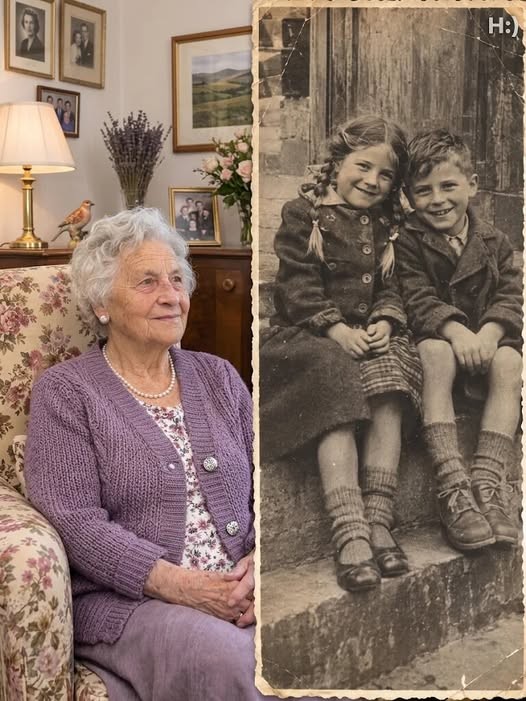
A Childhood Friendship That Began in Warsaw
My name is Zofia Lewin Berman, although almost everyone who knows me calls me Zoe. I was born in Warsaw in 1929, during a time when the world still seemed full of possibilities. My childhood was filled with ordinary happiness: the smell of fresh bread drifting through the apartment building, afternoons spent reading, the sound of children playing in the courtyard, and the familiar footsteps of neighbors coming home.
But among all the memories I carried from those early years, one person remained especially important.
His name was Stanislaw Nowak.
Stanislaw lived directly across the hall from my family. We were close in age, and before long, we became inseparable. We spent nearly every afternoon together, inventing games, exploring the streets around our building, and sharing the small secrets that children believe are the most important things in the world.
We had different dreams, but that never mattered.
Stanislaw wanted to become an engineer and build bridges. He was fascinated by the structures that connected distant places. Whenever we crossed a bridge, he would stop and study its shape, imagining how he might design something even stronger one day.
I wanted to become a teacher.
I loved books and enjoyed explaining things to other children. I imagined standing in front of a classroom, helping young students discover the world through stories, numbers, and questions.
We often talked about our futures as though they were already waiting just around the corner.
We believed we would grow up in the same city, remain friends, and eventually accomplish everything we had imagined.
At that age, neither of us understood how quickly the world could change.
The Little Silver Swallow That Became a Promise
In 1939, shortly before our lives were turned upside down, Stanislaw gave me a small gift.
It was a delicate pendant shaped like a swallow, made of silver with a little blue detail. It was not expensive or particularly elaborate, but to me, it was beautiful.
I remember holding it in my palm and looking at the tiny bird.
Stanislaw told me that swallows always returned home.
Then he made a promise.
“Swallows always come back,” he said. “So will you.”
I smiled because I thought he was being dramatic. We were children, and I could not imagine a future in which we would no longer see each other.
I placed the pendant around my neck and promised that I would never lose it.
Neither of us knew that those few words would remain with me for the rest of my life.
As the political situation in Europe deteriorated, the atmosphere in Warsaw changed. Conversations among adults became quieter and more serious. Families worried about the future, and the uncertainty that had once seemed distant began approaching their homes.
When World War II broke out in September 1939, everything changed.
My family made the difficult decision to leave Poland and travel to America. It was not a decision we made lightly. We were leaving behind our home, our familiar streets, our relatives, and everything that had made childhood feel safe.
Most painfully, I had to leave without saying a proper goodbye to Stanislaw.
There was no final afternoon together, no long conversation, and no opportunity to explain what was happening.
One day, he was simply part of my everyday life. Then suddenly, he was somewhere behind me, in a city I might never see again.
I took the swallow pendant with me.
It was one of the few things I could carry that connected me to the boy I had left behind.
A New Life in America, but an Old Memory Never Disappeared
America became my new home.
My family eventually settled in Chicago, where I slowly learned to build a life around unfamiliar streets, a different language, and a culture that was not quite the one I had known in Warsaw.
Growing up as an immigrant was not always easy. There were things I missed that I could never fully explain to people who had never experienced leaving their childhood home behind.
I missed the sounds of Warsaw. I missed the apartment building where Stanislaw and I had lived. I missed the feeling that the people around me had known me since I was little.
And I missed my friend.
For a time, I tried to contact him. I wrote letters, hoping that somehow they would reach him. I asked questions whenever someone mentioned Poland or Warsaw. I wanted to know whether he was safe, whether his family had survived, and whether he remembered me.
But no answer ever came.
As the years passed, I gradually accepted that I might never know what had happened to him.
I grew older. I studied, became a teacher, and eventually fulfilled the dream I had spoken about as a little girl.
Teaching gave me a meaningful life. I spent years helping children learn, encouraging them to ask questions, and watching them discover their own abilities.
I married a kind man named Abe. Together, we raised three children and built a family filled with the everyday moments that make a home feel complete.
There were birthdays, school events, family dinners, holidays, and countless small memories.
I loved my husband and the life we created.
Yet somewhere inside me, a small part of my childhood remained in Warsaw.
I never forgot Stanislaw.
The silver-and-blue swallow pendant stayed with me through the decades. It survived moves, changes in fashion, family celebrations, and the many stages of my life.
Sometimes, I would take it out and remember the boy who had given it to me.
I wondered whether he had grown up to become an engineer. I wondered whether he had built his bridges. I wondered whether he had ever thought about the little girl who had promised to return.
Eventually, I stopped expecting answers.
But I never stopped remembering.
The Pendant Finds Its Way to a New Generation
As the years passed, I became a grandmother.
One of my favorite people to spend time with was my granddaughter, Maya. She was curious, thoughtful, and always interested in family stories.
She enjoyed hearing about my childhood in Poland, especially the memories that seemed so different from her own experiences.
One afternoon, I showed her the swallow pendant.
I explained how Stanislaw had given it to me in 1939, just before my family left Warsaw.
I told her about our friendship, our childhood dreams, and the promise he had made.
“Swallows always come back,” I repeated.
Maya listened carefully. She examined the little silver bird and asked whether I had ever seen Stanislaw again.
I told her the truth.
No, I had not.
I had no idea where he was or whether he was still alive.
The pendant had become more than jewelry. It was a reminder of a childhood that had disappeared almost overnight and of a friendship that had never received a proper ending.
Eventually, I passed it on to Maya.
I wanted her to have something meaningful from my past, something that carried a story beyond its appearance.
I never imagined that giving her the pendant would lead to an event that would change the rest of my life.
An Unexpected Discovery at Room 214
One evening, Maya returned home from work with an expression I had never seen before.
She looked excited, but there was something else in her face too. She seemed almost unable to believe what she was about to tell me.
Maya worked in a care facility, where she helped look after elderly residents. During one of her shifts, she had been assisting a man named Stanislaw Nowak.
He was an elderly resident who had spent much of his life carrying memories of Poland.
At some point, Maya had worn my swallow pendant to work.
The moment Stanislaw noticed it, everything changed.
He recognized the little silver-and-blue bird.
He asked where she had gotten it. Maya explained that it belonged to her grandmother and that the pendant had been given to her when her grandmother was a little girl living in Warsaw.
Then he asked a question that made her stop.
“Is your grandmother’s name Zofia?”
Maya told him yes.
The elderly man became emotional. He wanted to know whether I was still alive and whether I might be willing to meet him.
He had apparently spent decades wondering what had happened to the girl he once knew.
Maya could hardly believe that the man in her care facility might be the same Stanislaw I had talked about throughout her childhood.
Before she left work, he asked her to bring something home to me.
It was a small wooden box.
Inside were several objects carefully preserved over many years.
There was an old photograph of two children standing together. Their faces were young, their expressions innocent, and their clothes belonged to another time.
There was also an old book, a key that had once belonged to my grandmother’s apartment, and a letter.
The moment I saw the photograph, my hands began to tremble.
I recognized the children immediately.
It was Stanislaw and me.
I had not seen that photograph in more than eight decades.
Then I opened the letter.
His handwriting had changed with age, but the message was unmistakably personal. He wanted me to know that he had never forgotten our friendship, our promise, or the little girl who had once worn the swallow pendant.
He had found me again.
After all those years, he had found me.
“Zosia.” “Staś.” The Reunion We Never Thought Would Happen
The following morning, Maya accompanied me to the care facility.
My heart was beating so quickly that I could barely concentrate on anything around me. I had imagined this moment in countless ways over the years, but I had never truly believed it would happen.
We walked down the hallway until we reached Room 214.
I paused outside the door.
What if I was mistaken? What if the man inside was only someone who had heard the story? What if the years had changed him so much that I would not recognize him?
Then I entered.
There he was.
He was an elderly man now. His hair had turned white, his face carried the marks of time, and his hands looked much older than the hands I remembered from childhood.
But his eyes were familiar.
For a moment, neither of us spoke.
Then he looked at me and whispered the name he had used when we were children.
“Zosia.”
I felt tears gathering in my eyes.
“Staś,” I answered.
And suddenly, eighty years seemed to disappear.
I walked toward him, and we embraced.
We cried. We laughed. We held each other as though we were trying to make up for every birthday, every difficult year, and every ordinary afternoon we had missed.
There was so much we wanted to say, but the first few moments belonged to emotion rather than words.
I had imagined seeing Stanislaw again when I was young. I had wondered whether he would recognize me and whether he would remember the pendant.
Now, after a lifetime of separation, he was sitting in front of me.
The boy from across the hall had become an old man, but some part of him had never stopped being my friend.
The Secret His Family Had Kept for Decades
As we began talking, Stanislaw told me something I had never known.
During the war, my grandmother had remained in Warsaw.
While my family had managed to escape to America, she had not been able to leave with us. Her circumstances became increasingly difficult as the occupation continued.
The Nowak family had helped hide and protect her.
They had taken risks to keep her safe, offering her shelter and assistance when the situation was dangerous.
My grandmother died in 1942.
Hearing this was heartbreaking. I had spent most of my life wondering what had happened to her, carrying unanswered questions about the family and home I had left behind.
But Stanislaw continued.
His family had made sure she received a proper burial. They had not allowed her to become just another forgotten name in a city devastated by war.
They had preserved some of her belongings, including the apartment key that was now sitting inside the wooden box.
Stanislaw had kept those memories safe.
He told me that my grandmother had left a message for me: if I ever had the chance, I should return someday.
I listened in silence.
For decades, I had believed that everything I had left behind in Warsaw had vanished. I had imagined that the war had erased every connection to my childhood.
But the truth was different.
Someone had remembered.
Someone had protected what remained.
And someone had carried a message across generations, waiting for the day it could finally reach me.
I looked at the old key again.
It was no longer simply a piece of metal. It represented a home, a family, and a part of my history that I had never completely recovered.
Two Lives, One Unfinished Promise
In the days that followed, Stanislaw and I spent hours talking.
We compared memories, filled in missing details, and discovered how much our lives had changed.
He had not become the bridge engineer he once dreamed of being, but he had built a life of his own. He had experienced love, raised a family, and known the happiness and responsibilities of adulthood.
I had become a teacher, married Abe, and raised three children.
We had both loved deeply.
We had both experienced loss.
Our spouses were gone, and our children and grandchildren had grown into adults with lives of their own.
We were no longer the two children who had once played in the hallways of an apartment building in Warsaw.
Yet our friendship had survived in a way neither of us could have predicted.
We spoke about our childhood dreams, the streets we remembered, and the people who had shaped our lives.
Sometimes, we laughed so much that Maya would look at us in surprise.
At other times, we sat quietly, holding hands and remembering those who had not lived long enough to witness our reunion.
There was no need to pretend that the lost years could be recovered.
We knew that time had taken away many opportunities. We could not return to 1939 or change what had happened.
But we could choose what to do with the time that remained.
And that was enough.
A Wedding at Ninety-Six and Ninety-Seven
As our friendship grew again, something unexpected happened.
The affection we had carried from childhood became a deeper companionship.
We had known each other before the world separated us. We had lived entire lives without one another, yet meeting again felt strangely natural.
There was no need to rush or pretend we were young.
We understood the importance of the years we had lived, the families we had raised, and the people we had loved before finding each other again.
In December, at the ages of ninety-six and ninety-seven, we decided to marry.
It was a small ceremony in a chapel, surrounded by the people closest to us.
There were no grand celebrations or elaborate arrangements. The moment did not need them.
What mattered was that two people who had once promised to find their way back to each other were finally standing together again.
Maya was there.
She had been the person who noticed the pendant, listened to Stanislaw’s question, and helped bring two old friends together.
Without her, the story might have remained unfinished.
As I stood beside Stanislaw, I thought about the little girl I had been in Warsaw.
She had worn a silver swallow around her neck and believed that the people she loved would always remain close.
She could never have imagined the long journey ahead.
But somehow, the promise had survived.
Returning to Warsaw After More Than Eighty Years
Months later, I made a journey I had once believed would never happen.
I returned to Warsaw.
The city had changed enormously since my childhood. Streets had been rebuilt, buildings had changed, and generations had grown up in places where I once played.
Yet some memories remained surprisingly vivid.
I could still picture the apartment building where Stanislaw and I had lived. I remembered the hallway, the doors, and the feeling of walking across to visit my best friend.
I also carried the wooden box and the old key.
My most important destination was my grandmother’s grave.
When I finally stood there, I felt a mixture of sadness, gratitude, and relief.
For decades, I had carried questions about what had happened to her. Now I knew that she had not been forgotten. The Nowak family had protected her, cared for her memory, and preserved the things she had left behind.
I placed the old apartment key beside her grave.
Then I whispered the words I had wanted to say for most of my life.
“I’ve come home.”
For a moment, I stood quietly.
I thought about my grandmother, my childhood, and the people who had helped preserve the connections that war had tried to destroy.
Then I looked up.
A swallow flew overhead.
Perhaps it was an ordinary bird passing through the sky. Perhaps it meant nothing beyond the natural movement of the world.
But to me, it carried a meaning I had understood since childhood.
Swallows always come back.
And sometimes, so do the people we thought we had lost forever.
The Meaning of a Promise That Lasted a Lifetime
The story of Zofia and Stanislaw is a reminder that life rarely follows the plans we make when we are young.
War can separate families. Distance can silence friendships. Time can change faces, places, and circumstances beyond recognition.
Some people leave our lives without a proper goodbye. Others become memories that we carry quietly, even as we build new relationships and create different futures.
But remembering someone does not mean refusing to move forward.
Zofia built a full life in America. She became a teacher, loved her husband, raised children, and welcomed grandchildren. Stanislaw also lived through decades of experiences, responsibilities, and loss.
Neither had spent every day waiting for the other.
Yet the connection they formed as children remained meaningful enough to recognize when an unexpected opportunity brought them together again.
The little swallow pendant became the bridge between their past and present. It connected a granddaughter to a story, a resident to a forgotten childhood friend, and two elderly people to a promise made before either understood how difficult life could become.
Perhaps the most remarkable part of their reunion was not simply that they found each other after more than eighty years.
It was that they still recognized something familiar in one another.
Their lives had changed, but the memory of who they had been together had never completely disappeared.
And sometimes, that is what makes a promise special.
It does not guarantee that life will be easy or that people will never be separated. It simply gives a memory somewhere to live until the day it can be shared again.
For Zofia, the swallow had always represented the possibility of returning home.
After a lifetime of waiting, she finally understood what those childhood words meant.
Some journeys take a lifetime.
Some promises survive generations.
And some stories find their way back to where they began.