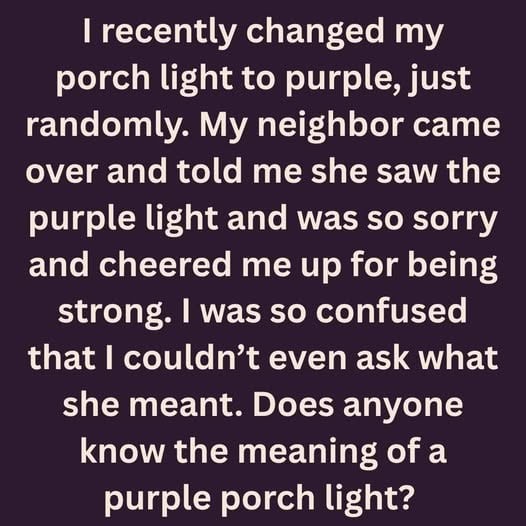
A Small Light Can Carry a Powerful Message
At first glance, a purple porch light might look like an unusual decoration. During the evening, it may stand out among the familiar white, yellow, and warm-colored lights surrounding neighboring homes. Some people might assume it is simply a seasonal decoration or a personal preference. However, in many communities, that small purple glow represents something much deeper: awareness, solidarity, remembrance, and support for people affected by domestic violence.
Behind the doors of ordinary homes, countless individuals experience abuse that their neighbors, friends, and even family members may never notice. Some live with constant fear or emotional pressure. Others have become increasingly isolated from the people they once trusted. Many struggle to explain their experiences because they worry that nobody will believe them, that they will be blamed, or that speaking up could make their circumstances more difficult.
Domestic violence does not always look the way people expect. It is not limited to visible injuries, loud arguments, or incidents that attract public attention. Sometimes, it develops through repeated patterns of intimidation, humiliation, manipulation, and control. A person experiencing abuse may continue going to work, attending social events, caring for children, and maintaining an outward appearance of normality while privately struggling with an unsafe relationship.
This is where the purple porch light becomes meaningful. It offers a visible reminder that domestic violence should not be ignored or treated as a private problem that communities have no responsibility to acknowledge.
For homeowners who participate in awareness campaigns, displaying a purple light is a simple way to communicate an important message: survivors deserve to be heard, supported, respected, and treated with dignity. Although a light cannot solve every problem, it can encourage people to recognize an issue that often remains hidden.
Why Is Purple Associated With Domestic Violence Awareness?
Purple has become one of the most recognizable colors associated with domestic violence awareness in the United States. It is commonly used in awareness campaigns, public events, educational materials, ribbons, clothing, and outdoor lighting displays.
The color represents ideas such as courage, survival, remembrance, dignity, and hope. Wearing purple or displaying a purple ribbon can communicate solidarity with survivors and honor individuals who have lost their lives to domestic violence.
The symbolism is particularly important because abuse can make people feel powerless and alone. Survivors may have experienced situations in which their choices were controlled, their opinions dismissed, or their confidence gradually undermined. An awareness campaign that uses purple creates an opportunity for communities to publicly recognize their experiences and affirm that abuse is never acceptable.
One well-known initiative is Purple Light Nights®, a campaign created by the Covington Domestic Violence Task Force in Washington in 2006. It encourages residents, businesses, organizations, and communities to display purple lights as a way to raise awareness about domestic violence.
The campaign is associated with October, which is recognized as Domestic Violence Awareness Month in the United States. During this period, communities often organize educational events, public discussions, fundraising activities, and other initiatives to encourage prevention and support services.
The purpose is not simply to make neighborhoods look different for a few weeks. It is to make an often-hidden issue more visible and remind people that domestic violence affects individuals across different ages, backgrounds, income levels, and communities.
A purple light may be small, but the message behind it can reach beyond the property where it is displayed. It can encourage a neighbor to learn more, remind a survivor that others care, or inspire someone to become involved in local prevention efforts.
What Does a Purple Porch Light Actually Mean?
A purple porch light is generally a symbolic gesture rather than an official emergency signal or a promise that the homeowner can provide assistance.
Its meaning may vary slightly depending on the local campaign or community organization involved. However, when used for domestic violence awareness, it commonly communicates several important ideas.
Standing against domestic violence
Displaying a purple light shows that the homeowner recognizes domestic violence as a serious social issue. It communicates that abuse should not be normalized, excused, or ignored simply because it happens inside a private home.
This message matters because people experiencing abuse may already feel that speaking up will lead to embarrassment or judgment. Public awareness can help create a culture in which survivors are treated with understanding rather than blame.
Supporting survivors
A purple porch light can serve as a reminder that people affected by abuse deserve compassion and access to meaningful support. It recognizes that leaving an abusive situation can be complicated and that survivors may need time, resources, and professional assistance.
The message is not that every survivor must make the same decision or follow the same path. Instead, it emphasizes that their experiences matter and that they should not have to face difficult circumstances without support.
Remembering those who lost their lives
Domestic violence awareness also involves remembering people whose lives were taken through abuse. Purple lights can serve as a quiet tribute to victims and a reminder of the importance of prevention.
For families and communities affected by such tragedies, remembrance can be an important part of raising awareness and encouraging change.
Encouraging conversations
Perhaps one of the most valuable effects of a purple porch light is that it can make people curious enough to ask questions.
Someone might notice the unusual color and wonder why a neighbor has chosen to display it. That simple question can lead to a conversation about domestic violence, available resources, and the importance of recognizing warning signs.
However, it is important to understand that a purple light does not automatically mean a particular home is a shelter, a crisis center, or a safe place to seek emergency assistance. It is a symbol of awareness and solidarity, not a substitute for professional support.
Why Domestic Violence Often Goes Unnoticed
One reason domestic violence remains difficult to address is that it does not always involve obvious physical injuries.
People often imagine abuse as a series of dramatic incidents involving physical violence. While physical abuse is a serious form of domestic violence, harmful behavior can also take emotional, psychological, sexual, and financial forms.
Understanding these different patterns helps communities recognize that someone may be experiencing abuse even when there are no visible signs.
Physical abuse
Physical abuse involves using force to hurt, intimidate, or control another person. It can include hitting, pushing, choking, restraining, or other forms of physical harm.
Some survivors may attempt to hide injuries because they fear the consequences of telling someone what happened. Others may explain visible marks as accidents because they are not ready or able to discuss their circumstances.
Emotional and psychological abuse
Emotional abuse can be difficult to recognize because it may develop gradually. An abusive partner might repeatedly insult someone, criticize their appearance, undermine their confidence, threaten them, or make them feel responsible for every disagreement.
Over time, these behaviors can affect how a person sees themselves. They may begin questioning their judgment, believing they are responsible for the abuse, or feeling unable to make independent decisions.
Financial abuse
Financial abuse involves controlling another person’s access to money or financial independence. An abusive partner may prevent someone from working, monitor every purchase, take their earnings, create debt in their name, or refuse to provide access to essential household funds.
This type of control can make leaving an unsafe relationship especially difficult. Without independent financial resources, a survivor may struggle to pay for transportation, accommodation, childcare, or other basic needs.
Social isolation and coercive control
Some abusive partners gradually separate their victims from friends, relatives, and support networks. They may discourage social activities, monitor phone calls, criticize friendships, or create conflicts whenever the other person tries to spend time with loved ones.
This isolation can make a survivor feel that they have nobody to turn to.
It can also make the abuse less visible to outsiders because fewer people have opportunities to notice changes in the relationship.
These different forms of abuse demonstrate why awareness is so important. Recognizing domestic violence requires looking beyond visible injuries and understanding the broader patterns of behavior that can undermine another person’s safety, freedom, and well-being.
Why Some Survivors Find It Difficult to Ask for Help
From the outside, people may wonder why someone experiencing abuse does not simply leave. However, this question often overlooks the complicated realities survivors face.
Leaving an abusive relationship can involve significant emotional, financial, practical, and safety challenges. For some people, the decision may require careful planning rather than an immediate departure.
Fear is one important factor. A survivor may worry that an abusive partner will become more aggressive if they attempt to leave. In certain situations, the period surrounding separation can involve increased risks, making professional safety planning particularly important.
Financial dependence can create another obstacle. Someone who has been prevented from working or accessing money may have no immediate way to afford housing, food, transportation, or childcare.
Children can make the situation even more complicated. A parent may worry about their children’s safety, custody arrangements, education, and emotional well-being. They may also fear that leaving will disrupt the family’s stability.
There can also be emotional barriers. Survivors may still love the person who is abusing them, remember happier periods in the relationship, or hope that the behavior will change. They may feel ashamed, confused, or afraid that friends and relatives will judge them.
Cultural expectations and social pressure can add further difficulties, particularly in communities where family matters are expected to remain private.
These circumstances help explain why support must be patient and respectful. Telling someone what they should do without understanding their situation can unintentionally make them feel more isolated.
A better approach is to listen, believe their experiences, avoid judgment, and help them explore appropriate resources when they are ready.
How You Can Participate in Purple Light Nights
You do not need to organize a large public event or belong to a nonprofit organization to support domestic violence awareness. Individuals, families, businesses, schools, and community groups can all contribute in simple ways.
Display a purple porch light
One of the easiest ways to participate is to replace an outdoor bulb with a purple one or place a purple light in a visible window during an awareness campaign.
Some homeowners choose to display purple lights throughout October, while others participate during specific community events.
The important part is understanding the message behind the display and being willing to share accurate information when people ask about it.
Wear purple to show solidarity
A purple shirt, ribbon, bracelet, or other accessory can be a simple way to participate in awareness activities.
Schools, workplaces, and community organizations may also organize purple-themed events to encourage conversations about domestic violence prevention.
Share reliable information on social media
Social media can help awareness messages reach people who might otherwise never encounter information about domestic violence.
Instead of sharing unverified claims or dramatic stories, consider posting information from established domestic violence organizations, shelters, and public health resources.
You can share educational materials about different forms of abuse, warning signs, available support services, and ways to help someone who may be experiencing violence.
Support local organizations
Local shelters and advocacy groups often provide essential services to survivors. Depending on their needs, these organizations may offer emergency accommodation, counseling, legal guidance, safety planning, transportation assistance, and help accessing financial resources.
Donations, volunteering, and community fundraising can help these organizations continue their work.
Before donating goods or money, check the organization’s official website or contact its representatives to understand what support is currently needed.
Encourage respectful conversations
Sometimes, the most meaningful contribution is simply being willing to discuss domestic violence without judgment.
You can help challenge harmful beliefs, such as the idea that abuse is always obvious or that survivors are responsible for their partner’s behavior.
Conversations should focus on respect, safety, and understanding rather than blame or gossip.
How to Support Someone Who May Be Experiencing Domestic Violence
Awareness becomes more meaningful when people know how to respond appropriately to someone who may be experiencing abuse.
If a friend, relative, neighbor, or colleague shares a difficult experience, the first step is to listen.
Avoid interrupting, questioning their decisions, or immediately telling them what they must do. Instead, allow them to explain their circumstances at their own pace.
Simple statements such as “I’m glad you told me,” “You don’t deserve to be treated this way,” and “I’m here to listen” can help communicate compassion without placing additional pressure on them.
It is also important to respect their privacy. Sharing their situation with other people without permission may expose them to further risks or make them less willing to seek help.
If they want assistance, you can help them identify trusted local organizations, professional advocates, legal services, or emergency accommodation options.
Where possible, allow the survivor to remain in control of decisions about their next steps. Taking away someone’s choices, even with good intentions, can unintentionally repeat the experience of losing control that often accompanies abusive relationships.
If there is immediate danger, contact appropriate emergency services rather than relying on a symbolic gesture or attempting to intervene in a potentially dangerous situation yourself.
Above all, remember that supporting a survivor is not about forcing a quick solution. It is about helping them access information, resources, and support while respecting their circumstances.
Real Support Goes Beyond a Symbol
Raising awareness is an important first step, but meaningful change requires more than changing a light bulb.
Survivors may need emergency shelter, legal assistance, medical care, counseling, financial resources, and long-term support as they work toward safety and independence.
Emergency shelters can provide temporary accommodation for people who cannot safely remain in their homes. Advocacy organizations may help survivors understand their options, develop safety plans, and navigate complicated legal or practical situations.
Counseling and mental health support can also be valuable. Experiencing abuse may affect a person’s confidence, sense of security, relationships, and ability to trust others. Recovery is different for everyone, and there is no single timeline that applies to every survivor.
Children who witness domestic violence may also need appropriate emotional support. Even when they are not directly targeted, exposure to ongoing conflict, threats, or violence can affect their sense of safety and well-being.
Communities can make a difference by helping people access these services and creating environments where asking for help does not bring shame.
Businesses can support awareness initiatives through employee education and partnerships with local organizations. Schools can teach age-appropriate lessons about healthy relationships, respect, personal boundaries, and seeking help from trusted adults.
Local authorities and community leaders can also contribute by improving access to prevention programs and survivor services.
The most effective response combines public awareness with practical resources that help people in real situations.
Why Awareness Must Continue Beyond October
Domestic Violence Awareness Month provides an important opportunity to organize campaigns, display purple lights, and encourage public discussion. However, domestic violence does not disappear when October ends.
Survivors may need support throughout the year, and prevention requires consistent attention from families, schools, workplaces, community organizations, and public institutions.
Continuing awareness efforts can help people recognize harmful behaviors earlier, understand the importance of healthy relationships, and become more familiar with local support services.
It can also challenge the stigma that prevents survivors from speaking openly about their experiences.
A community that discusses domestic violence only during one awareness month risks treating it as a temporary topic rather than an ongoing social issue.
Purple porch lights can therefore serve as a starting point for broader conversations that continue throughout the year.
The goal is not simply to display a particular color. It is to build a culture in which people recognize abuse, reject victim-blaming, and understand that survivors deserve meaningful support whenever they need it.
The Light That Reminds People They Are Not Alone
A purple porch light cannot erase the pain caused by domestic violence. It cannot guarantee someone’s safety, replace professional assistance, or solve every difficult situation.
But it can help make an important issue visible.
Every purple light displayed as part of an awareness campaign represents a choice to speak up rather than remain indifferent. It can honor survivors, remember those who have been lost, and encourage communities to create safer environments for everyone.
Behind every awareness message is a reminder that people experiencing abuse are more than the difficult circumstances they face. They deserve respect, independence, compassion, and the opportunity to build lives free from violence and control.
For some, seeing a purple light may simply prompt curiosity. For others, it may serve as a reminder that their experiences matter and that there are people and organizations willing to help.
The most meaningful response, however, happens when that visible symbol is supported by real action: listening without judgment, sharing reliable resources, supporting local services, and challenging attitudes that allow abuse to remain hidden.
Sometimes, a small gesture can open the door to a much bigger conversation.
And that conversation can become the beginning of meaningful support, greater understanding, and lasting change.