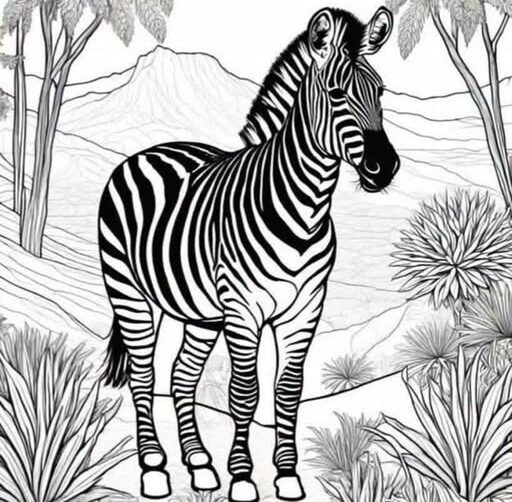
Can You Spot the Hidden Man in This Vintage Zebra Puzzle?
A zebra is the unmistakable center of this vintage visual puzzle. Set against a countryside scene of trees, plants, open ground, and distant mountains, the animal stands out almost immediately. Yet the real challenge is not identifying the zebra. Somewhere within the same drawing, a hidden man is said to be concealed in the lines, contours, and negative spaces of the illustration.
These kinds of picture puzzles are designed to test more than eyesight. They invite viewers to reconsider what they believe they have already seen. At first glance, the scene appears straightforward: an animal in a natural landscape. Once the instruction to find a person is introduced, however, familiar details can begin to look different. A line that seemed to belong to a tree may resemble part of a face. A shadow, plant, or mountain edge may take on a new visual role.
The appeal of the hidden man zebra puzzle lies in this change of perspective. It is not necessarily about speed, and it does not require specialist knowledge. Instead, it encourages careful observation, patience, and a willingness to examine ordinary shapes without immediately assigning them a fixed meaning.
The Zebra Is Easy to See, but the Hidden Man Requires a Different Approach
People often recognize prominent objects in an image rapidly. A zebra’s distinctive striped body provides a strong visual cue, making it the likely first feature to capture attention. This is a useful example of how the brain processes familiar patterns. Humans are generally efficient at recognizing common objects, faces, animals, and outlines, especially when they are presented clearly against a contrasting background.
Once viewers identify the zebra, they may feel they have understood the scene. The trees are trees, the plants are plants, and the distant mountains are simply part of the landscape. But a hidden-object puzzle depends on disrupting that first interpretation. The concealed figure may not appear as a complete, conventional drawing of a man standing in the open. Instead, the human form may be suggested through an arrangement of existing lines or through an area that initially looks like background scenery.
That is why the instruction matters. Without being told that a man is present, many people might never search for one. The puzzle changes from a simple countryside illustration into a visual investigation. The viewer has to reconsider individual features and ask whether they could form something more than the object they first appeared to represent.
Psychologists often describe this process in terms of perception and attention. The visual system constantly sorts large amounts of information, deciding what deserves focus and what can remain in the background. In a complex drawing, attention may settle quickly on the most obvious subject. The harder task is deliberately moving attention away from that subject and inspecting the quieter, less noticeable areas of the image.
Why Hidden Figure Puzzles Can Be So Challenging
Hidden-image puzzles are difficult because they use visual ambiguity. A single line can be interpreted in more than one way depending on what surrounds it and what the viewer expects to see. In an ordinary landscape drawing, curved lines may suggest hills, leaves, branches, shadows, or the edge of a path. In a puzzle, some of those same lines may also contribute to a human profile, a shoulder, a hand, or another part of a figure.
This does not mean that viewers are “missing” obvious information because they are not paying attention. Rather, the illustration encourages the brain to organize information in one particular way before revealing that another interpretation is possible. The image may be understood as a landscape first and a hidden figure second.
A related phenomenon is called figure-ground perception. This refers to the way people distinguish a main object, or “figure,” from the surrounding area, or “ground.” In the zebra puzzle, the zebra is likely to function as the figure at first, while the countryside becomes background. The hidden man may emerge only when a viewer reverses that relationship and treats a previously overlooked area as the possible main subject.
Optical illusions and ambiguous drawings have long been used to illustrate how perception works. Some images can be seen in two distinct ways, with the viewer switching between interpretations. Others conceal an object by blending it into surrounding patterns. While a vintage puzzle may be intended mainly for entertainment, it also provides a simple demonstration of how expectation affects visual awareness.
How to Search for the Hidden Man in the Zebra Puzzle
There is no need to rush. A useful way to approach the puzzle is to begin with the whole scene rather than immediately focusing on a single detail. Look at the zebra, the foreground, the vegetation, and the distant landscape. Notice where your eyes naturally travel. Many people will look at the zebra first, then move toward the most noticeable trees or mountains.
After that first impression, try a more systematic search. Start at one edge of the illustration and move slowly across it. You might scan from left to right, then from top to bottom. This method can reduce the tendency to revisit the same obvious features repeatedly while skipping sections that seem less important.
Pay particular attention to transitions between objects. The hidden figure may not be contained entirely within one tree, one mountain, or one patch of ground. It may be created where several parts of the scene meet. Examine the spaces around plants, the outer edges of branches, and the boundaries between foreground and background. In visual puzzles, these connecting areas often contain the clues that are easiest to overlook.
It can also help to avoid naming every object too quickly. Rather than thinking, “That is a tree,” pause and study the tree’s outline. Follow the line upward, downward, and into nearby shapes. Ask whether the contour could support another interpretation. The goal is not to force every shape into the form of a person, but to remain open to possibilities that may not be apparent at first.
Look at Lines, Negative Space, and Outlines
A hidden man in a vintage illustration may be formed through visible outlines, but it may also depend on negative space. Negative space is the empty or less detailed area around an object. In art and design, negative space can be just as meaningful as the objects drawn directly on the page. A gap between leaves, the blank space beside an animal, or the pale shape between landscape features may suggest a recognizable form.
Try looking at the drawing in sections. Choose a small area and examine how the lines connect. Then step back mentally and consider the area in the context of the whole picture. A shape that seems random in close view may become more meaningful when seen alongside neighboring lines.
Another helpful strategy is to look for proportions rather than searching only for a complete face or full body. The puzzle may not present a detailed human figure in the way a portrait would. Instead, there may be an outline that implies a head, facial profile, torso, or another recognizable feature. Look for curves and angles that appear unusually human compared with the surrounding natural forms.
At the same time, remain cautious. Human brains are especially good at detecting faces and familiar forms, even in random patterns. This tendency is sometimes called pareidolia. It explains why people may see faces in clouds, rock formations, household objects, or shadows. In a hidden figure puzzle, pareidolia can be helpful because it encourages viewers to notice possible human shapes. But it can also lead to false guesses, making it important to check whether the entire outline supports the interpretation.
Why Taking a Break Can Help You See More Clearly
If you have examined the image for several minutes without finding a convincing answer, taking a brief break may be more useful than continuing to stare at the same section. Focused attention can become narrow. After repeatedly studying one area, it may become harder to notice the broader structure of the image.
When you return to the puzzle, begin again with the full landscape. Do not assume the hidden man must be in the area you have already investigated most intensely. A fresh glance can make previously ignored details seem more noticeable. You may find that your eyes now move through the picture in a different order, revealing a shape that did not stand out before.
Changing how you look at the picture may also be useful. View it from a little farther away, then closer. If you are using a screen, avoid excessive zooming at first, since the hidden outline may depend on seeing multiple elements together. A wider view can sometimes make a silhouette easier to recognize than a highly magnified close-up.
Some people also find it helpful to cover part of an image with a hand or sheet of paper, revealing one section at a time. This can reduce distraction from the zebra and other dominant features. However, once a possible answer appears, uncover the full scene again to see whether the suspected human form remains convincing in context.
Compare Observations Without Spoiling the Challenge Too Soon
Hidden-object puzzles can be enjoyable to solve alone, but they can also work well as a shared activity. If several people are viewing the zebra illustration, consider letting everyone search independently before discussing possible answers. Different viewers may begin in different places and notice different visual cues.
One person may focus on the vegetation, while another may spend more time studying the space around the zebra or the outlines of the hills. Comparing observations can be revealing because it demonstrates how individual attention varies. A detail that seems obvious to one viewer may have received almost no attention from another.
When sharing a guess, it is more useful to describe the specific area and the lines that created the impression than simply saying that the hidden man has been found. For example, explain whether the possible figure appears in the foreground, near the animal, among the plants, or within the background. This allows other viewers to revisit the image thoughtfully rather than receiving an immediate, overly simple answer.
The Enduring Appeal of Vintage Optical Puzzles
Vintage visual puzzles remain popular because they combine art, curiosity, and a small but satisfying mental challenge. Unlike many fast-paced digital games, a hidden figure illustration invites a slower form of engagement. It asks viewers to pause, observe, test an idea, and look again.
These puzzles also work across generations. Children and adults can approach the same image, although they may use different search strategies. The activity does not depend on advanced equipment or specialized rules. A printed illustration or a screen is enough to begin.
Beyond entertainment, hidden-object images can prompt conversation about visual attention and interpretation. They remind viewers that seeing is not always the same as noticing. The first impression of an image can be useful, but it may not reveal every layer of information it contains.
Where Do You Think the Man Is Hiding?
Before looking for anyone else’s answer, give the zebra puzzle one final careful scan. Start wherever your attention naturally goes, then deliberately move to the areas you may have skipped. Study the lines around the landscape, the spaces between visible objects, and any shape that seems to suggest more than one meaning.
The hidden man may become clear quickly, or the puzzle may require several passes. Either result is part of the experience. The value of the challenge is not simply in reaching an answer, but in discovering how a familiar scene can change when you slow down and view it from another angle.
Sources
Disclaimer: This content is intended for entertainment purposes only and is not based on real events.