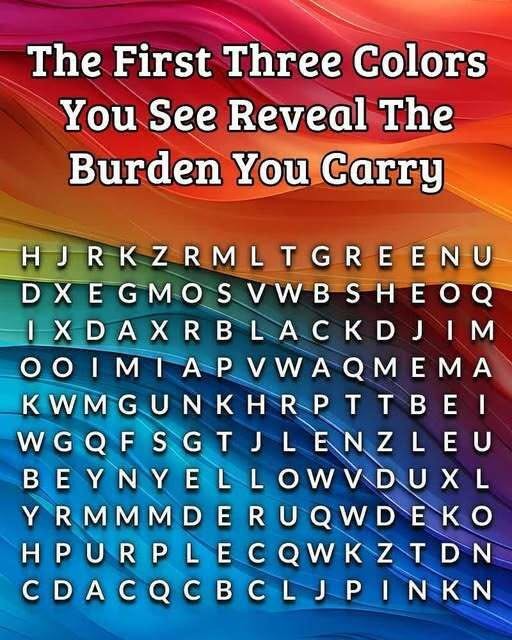
Color Burdens Revealed: What the First Three Colors You Notice Might Say About Your Emotions
Have you ever looked at a group of colors and immediately noticed three shades before anything else? A popular online trend invites people to do exactly that, then asks them to consider what each color might represent in their emotional lives.
The idea is simple: identify the first three colors that catch your attention and reflect on the feelings, memories, or personal experiences you associate with them.
Some interpretations suggest that certain colors represent hidden emotional burdens. Black is sometimes linked to protection, green to personal growth, and white to perfectionism. Red may be associated with anger or passion, while blue is often connected with calmness or responsibility.
These interpretations can be interesting starting points for self-reflection. However, there is an important distinction between exploring what colors mean to you and treating a color-selection exercise as a psychological assessment.
The trend cannot reveal hidden emotional struggles, diagnose mental health conditions, or determine someone’s personality. Its real value may lie in something much simpler: encouraging people to pause and think about feelings they have not fully acknowledged.
What Is the Color Burdens Trend?
The color burdens trend is a simple reflection exercise that has gained attention online.
Participants are usually asked to look at a collection of colors and name the first three shades they notice. They then explore the possible meanings associated with those colors.
Unlike a traditional personality quiz, the exercise does not require complicated questions or detailed answers. Instead, it encourages people to connect visual impressions with their own experiences.
For example, someone who notices blue first might associate it with peace, stability, or the responsibility of keeping everything under control. Another person might connect the same shade with loneliness or a difficult period in their life.
Neither interpretation is automatically more accurate than the other.
Color preferences and emotional associations are highly personal. They can be influenced by memories, cultural background, surroundings, and individual experiences.
What Different Colors May Represent
Although there is no scientifically established system that connects specific colors to hidden emotional burdens, common color associations can provide useful prompts for reflection.
Here are some familiar interpretations and questions you might consider when exploring your own reactions.
Red: Anger, Passion, or the Need to Be Heard
<text></text>
Red is often associated with strong emotions, energy, urgency, and intensity. Depending on someone’s experiences, it may bring to mind affection, excitement, frustration, or anger.
If red is one of the first colors you notice, consider what it means to you personally.
Does it remind you of a relationship filled with strong emotions? Does it represent determination, or perhaps a situation in which you have struggled to express yourself?
Rather than assuming red reveals anger, use it as an opportunity to ask whether there are feelings you have been holding back.
Blue: Calmness, Responsibility, or Emotional Distance
Blue is commonly connected with peace, stability, trust, and reliability.
For some people, it represents a safe and familiar place. For others, it may bring back memories of loneliness, sadness, or emotional distance.
If blue catches your attention, think about how you experience responsibility and calmness.
Do you feel that you always have to remain composed, even when things become difficult? Do others depend on you to solve problems while you rarely give yourself time to rest?
These questions may help you recognize whether you are carrying responsibilities that deserve closer attention.
Black: Protection, Strength, or the Desire to Withdraw
Black is often associated with mystery, elegance, authority, and protection. In certain contexts, it can also represent grief, uncertainty, or emotional distance.
Some interpretations of the trend describe black as a symbol of emotional protection.
You might reflect on whether you have created boundaries to protect yourself from disappointment or difficult experiences.
There is nothing inherently negative about wanting privacy or personal space. Healthy boundaries can be important. The question is whether those boundaries help you feel secure or leave you feeling isolated.
Green: Growth, Healing, and New Beginnings
Green is frequently associated with nature, renewal, balance, and personal development.
It may remind someone of a peaceful landscape, a fresh beginning, or a period of change.
If green is among your first three choices, you could ask yourself whether you are ready for something new.
Perhaps you are trying to move beyond an old disappointment, develop a healthier routine, or make a decision that supports your future.
Growth does not always happen quickly. Sometimes it simply means recognizing what no longer works and allowing yourself to take a different direction.
White: Peace, Clarity, or Perfectionism
White is commonly linked to simplicity, cleanliness, openness, and fresh starts.
Some viral interpretations associate it with perfectionism or the pressure to keep everything under control. However, that connection is not a psychological rule.
If white stands out to you, consider whether you value order and clarity because they make you feel comfortable.
Do you sometimes place unrealistic expectations on yourself? Do you feel uncomfortable when things are uncertain or imperfect?
These questions can help you explore your relationship with expectations without assuming that choosing white means you have a particular emotional struggle.
Why the Same Color Can Mean Different Things to Different People
One reason the color burdens trend can feel personal is that colors often carry memories.
A particular shade of yellow might remind one person of childhood summers, while another associates it with a difficult school experience. Purple might represent creativity to one individual and sadness to someone else.
Cultural traditions also influence how people interpret colors. A color used to represent celebration in one setting may carry a completely different meaning in another.
Personal experiences matter just as much.
Someone who has spent years surrounded by blue in a peaceful home may develop a positive association with it. Another person may connect that same color with a hospital room or a difficult memory.
This is why familiar color interpretations should be treated as possibilities rather than definitive explanations.
The most meaningful question is not what a color supposedly says about everyone, but what it brings to mind for you.
How to Use the Color Exercise for Self-Reflection
You do not need to believe every interpretation circulating online to benefit from the exercise.
Instead of treating the first three colors as a test with hidden answers, try using them as prompts for a short personal reflection.
Step 1: Choose your first three colors.
Look at a color selection without overthinking your choices. Write down the first three shades that attract your attention.
Step 2: Notice your immediate reaction.
Before reading any suggested meanings, ask yourself what each color makes you feel. Does it bring comfort, excitement, sadness, or something harder to describe?
Step 3: Connect each color with a memory.
Think about whether the shade reminds you of a person, place, relationship, or period in your life.
Step 4: Write one honest sentence about each color.
For example, you might write, “Blue reminds me of how much responsibility I feel at work,” or “Green makes me think about the changes I want to make in my life.”
Step 5: Consider what you need right now.
After reflecting, ask yourself whether there is something you need more of, such as rest, personal space, meaningful conversation, or support from someone you trust.
The purpose is not to discover a secret emotional score. It is to make room for thoughts and feelings that everyday routines sometimes push aside.
Can Color Choices Reveal Hidden Emotional Burdens?
This is where it is important to approach the trend with a little caution.
There is no reliable scientific basis for claiming that the first three colors someone notices can identify specific emotional burdens or diagnose a mental health condition.
Color psychology is a broad area of research that explores how people respond to colors in different situations. However, emotional reactions are influenced by many factors, and findings about color preferences cannot be simplified into a universal personality-reading system.
For example, noticing black does not prove that someone is emotionally guarded. Choosing green does not establish that a person is healing from a difficult experience. Likewise, selecting white does not mean someone struggles with perfectionism.
If you are experiencing persistent stress, sadness, anxiety, or emotional exhaustion, a color exercise cannot replace meaningful support or professional guidance.
It can, however, encourage you to recognize that something deserves attention.
Sometimes, the first step toward understanding an emotion is simply finding a way to describe it.
What Your Three Colors Can Teach You About Yourself
The appeal of the color burdens trend may come from its simplicity. It gives people a small opportunity to step away from their daily responsibilities and think about their inner experiences.
You may discover that a particular shade reminds you of a relationship you miss, a responsibility that feels overwhelming, or a change you have been postponing.
You may also discover something positive: a color that represents hope, comfort, confidence, or a memory that still makes you smile.
There is no correct combination, and no color choice should be treated as a judgment about who you are.
The most useful interpretation is the one that helps you understand your own experiences more clearly.
Colors cannot remove every burden, solve every problem, or tell you exactly what you need. But a moment of honest reflection can sometimes help you recognize when it is time to slow down, make a change, set a boundary, or ask for support.
So, what were the first three colors you noticed? More importantly, what memories or feelings did they bring to mind?