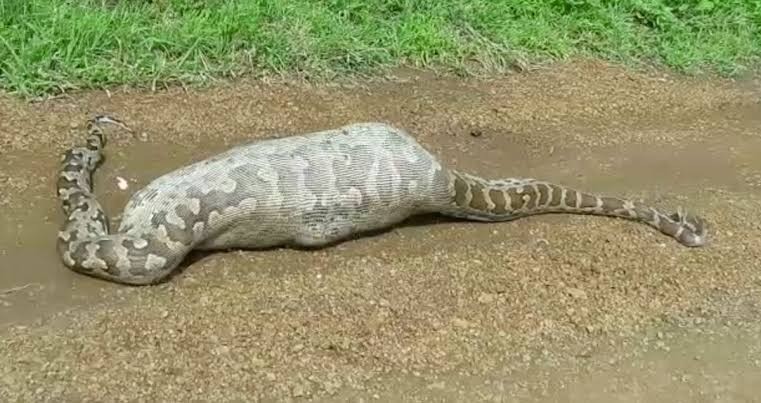
An ordinary yard can become the setting for an extraordinary wildlife encounter. One moment, everything appears quiet. The next, a large python resting in the grass draws attention from neighbors, attracts cameras, and raises questions that are difficult to ignore.
That is what reportedly happened in a video that quickly circulated across social media. The snake appeared unusually large, with a visibly swollen section of its body. As viewers watched the footage, speculation spread about what the python might have eaten and whether a missing animal could be connected to the sighting.
Some people feared that a family pet had become its prey. Others wondered whether the snake had recently swallowed another wild animal. But without a professional examination, the appearance of its belly could not provide a definite answer.
The encounter offered a reminder that large wildlife can sometimes appear surprisingly close to human homes—and that curiosity should never replace caution.
A Giant Snake Becomes the Center of Attention
According to the online account, the python was spotted resting in a grassy area near a residential property. Its size immediately attracted attention, while its unusually enlarged midsection became the main subject of discussion.
The snake appeared relatively still, remaining coiled in the grass as people watched and recorded it.
Footage of the encounter reportedly spread quickly online. As more viewers saw the images, theories about the animal’s condition began to circulate.
One popular suggestion was that the python had swallowed a domestic animal, possibly a cat or another small pet. This possibility understandably worried people, especially those living in areas where large snakes and household pets may share the same environment.
However, a swollen belly alone cannot identify what a snake has eaten. Without a reliable examination or direct evidence, claims about a missing pet or a particular prey animal remain speculation.
The distinction matters because viral wildlife videos often encourage people to reach conclusions before all the facts are known.
Why Would a Python Have Such a Swollen Belly?
A visibly enlarged section of a python’s body can have a natural explanation: the snake may have recently eaten a large meal.
Unlike humans, pythons do not chew their food into smaller pieces. They swallow prey whole, allowing their flexible jaws and specialized skull structure to accommodate animals that may appear surprisingly large compared with the snake’s head.
Pythons are constrictors. They generally capture prey by biting and wrapping their bodies around it before swallowing it. Depending on the species and the size of the snake, their diet can include rodents, birds, and other mammals.
After feeding, the outline of the swallowed animal may remain visible as a large bulge along the snake’s body.
The Smithsonian’s National Zoo explains that Burmese pythons swallow their prey whole and may spend several days or even weeks digesting a meal. Their feeding patterns are also different from those of animals that eat small portions throughout the day.
This helps explain why a python may appear unusually bulky while resting after a successful hunt.
However, not every swollen appearance confirms that the snake has recently eaten. A photograph or short video cannot establish the cause with certainty. The animal may need to be assessed by trained wildlife professionals.

Why a Python May Remain Still After Eating
A large python resting in one place may look unusual, particularly to someone who has never seen one up close.
But inactivity after feeding is a normal part of the digestive process for many snakes.
Digestion requires energy, and large meals can take considerable time to process. Environmental temperature also plays an important role because pythons are ectothermic animals. Their body temperature depends largely on the surrounding environment, which affects their activity and digestive processes.
Research discussed by the U.S. Geological Survey has documented how scientists monitor visible food bulges in Burmese pythons to study feeding and digestion. In one unusual observation published in August 2025, researchers described a python that regurgitated a large meal following a sudden drop in temperature.
The observation illustrates how digestion in large snakes can be affected by environmental conditions.
A python that remains still after eating is therefore not necessarily injured or harmless. Its behavior should be interpreted cautiously, especially when people do not know whether it is resting, stressed, or responding to nearby activity.
Could the Python Have Eaten a Family Pet?
This was one of the most concerning questions raised by viewers of the viral footage.
Large pythons are capable of eating a wide range of prey, including mammals and birds. Depending on the species and its size, domestic animals may also be vulnerable if they are accessible.
The Animal and Veterinary Service in Singapore explains that reticulated pythons can adapt to urban environments. They may enter residential areas while searching for food, including rodents and other small animals.
This does not mean that every python found near a home has eaten a pet.
In fact, the exact contents of the snake’s stomach cannot be determined simply by looking at its body. Even if the animal has recently fed, identifying its prey would require reliable evidence.
For pet owners, the practical lesson is to avoid leaving small animals unattended in areas where large snakes may be present. Dogs and cats should be supervised outdoors, particularly near long grass, drains, waterways, and places where wildlife may find shelter.
Keeping food waste and other potential sources of rodents under control can also help make residential properties less attractive to some wildlife.
Why Large Pythons Sometimes Appear Near Homes
Many people assume that large snakes live only in remote forests or deep wilderness. In reality, some species can adapt to environments influenced by human activity.
Residential areas may provide access to food, water, shelter, and suitable hiding places. Gardens, drainage systems, canals, and areas with dense vegetation can sometimes create conditions that attract snakes.
Singapore’s Animal and Veterinary Service notes that snakes may enter urban environments because of available prey, including rodents, birds, reptiles, and amphibians.
This does not mean that snakes are deliberately seeking contact with people. Many species generally avoid humans and will move away when given the opportunity.
A snake appearing in a garden may simply be passing through or searching for food and shelter.
Understanding this behavior can help residents respond more calmly. A wildlife encounter does not automatically mean that the animal is hunting people or behaving aggressively.
What Should You Do If You Find a Large Python?
The most important rule is simple: keep your distance.
Even a python that appears sluggish or inactive should never be approached, touched, cornered, or handled without appropriate training and equipment.
Large constrictors are powerful animals. Although they are generally not looking for conflict with humans, they may bite or defend themselves if they feel threatened.
The U.S. Geological Survey advises people who encounter a python in the wild to avoid interacting with or approaching it.
If you find a large snake in your yard, consider these precautions:
1. Move away calmly. Do not attempt to get closer for a better photograph. Give the animal space to move away.
2. Keep children and pets indoors. Curious children and animals may approach the snake without recognizing the danger.
3. Do not try to capture it. Avoid using sticks, tools, or improvised equipment to move the animal. Handling a large snake requires professional knowledge and appropriate equipment.
4. Contact trained wildlife responders. Local animal control services, wildlife rescue organizations, or relevant authorities can advise on the appropriate response.
5. Observe only from a safe distance. If you can do so without approaching the snake, note its location and general appearance. This information may help professionals identify and locate it.
These precautions protect both people and the animal. Attempting to kill or capture a python without training can create unnecessary risks and may also violate local wildlife regulations.
Are Pythons Dangerous to Humans?
The size of a large python can understandably make people nervous. These snakes are powerful predators, and some species can grow to several meters in length.
However, it is important to distinguish between their ability to capture large prey and the actual likelihood of an attack on a person.
According to the U.S. Geological Survey, human fatalities involving non-venomous snakes are very rare worldwide. Its assessment also notes that attacks by wild Burmese pythons on people in Florida have not resulted in reported human deaths.
That does not mean large constrictors should be treated casually. Their strength makes close interaction unsafe, particularly if someone attempts to handle, restrain, or provoke them.
The safest response is to respect their space and allow trained professionals to manage the situation.
In many cases, a snake would prefer to avoid people rather than engage with them. Giving it a clear opportunity to move away can help prevent an otherwise avoidable confrontation.
Pythons Also Play a Role in the Natural Environment
Although large snakes can create concern when they appear near homes, they are also part of the ecosystems in which they live.
Pythons help regulate populations of rodents and other prey animals. As predators, they contribute to food-web relationships and influence the balance of local wildlife populations.
The National Parks Board of Singapore describes snakes as important components of the food web. Pythons, in particular, can help control rodent populations.
Their presence in an ecosystem is therefore not automatically a problem. The challenge is managing encounters when wildlife and residential areas overlap.
In some regions, introduced python populations have also become an ecological concern. The U.S. National Park Service identifies Burmese pythons in Florida’s Everglades as a serious threat to native wildlife because of their broad diet and impact on local mammal populations.
This demonstrates why the same animal can have different ecological implications depending on where it is found.
A native python living in its natural habitat plays a different role from an invasive population established outside its original range.
The Mystery Behind the Swollen Belly Remains Unanswered
The video described in the online account left viewers with more questions than answers.
Had the python recently swallowed a large animal? Was a missing pet connected to the sighting? Or was there another explanation for the snake’s unusual appearance?
Without a confirmed location, an identified species, and an examination by wildlife experts, those questions cannot be answered reliably.
What the encounter does demonstrate is how quickly an ordinary residential setting can become the scene of an unexpected wildlife discovery.
A large python resting quietly in the grass may look frightening, especially when its body appears unusually swollen. But sensational speculation does not help determine what happened.
The best response is to remain calm, protect children and pets, keep a safe distance, and contact professionals when necessary.
Nature does not always remain far away from human homes. Sometimes, the most responsible thing people can do is observe from a distance, respect the animal, and let trained experts handle the situation.