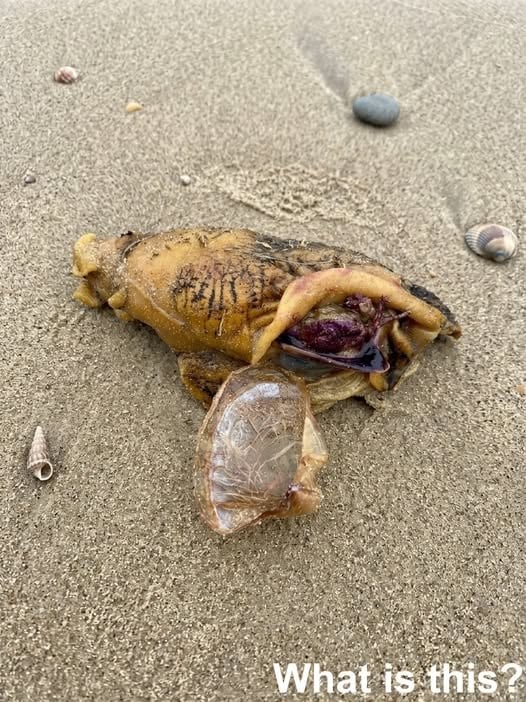
A quiet walk along the beach can sometimes lead to an unexpected discovery. Between the shells, seaweed, and pieces of driftwood, an unfamiliar object may catch someone’s attention. At first glance, it might look like an unusual rock, a piece of damaged marine equipment, or something that has come from deep beneath the ocean.
That was the experience of someone who noticed a strange, partially buried object along the shoreline. Its swollen appearance and unusual surface made it difficult to identify. A hard, shell-like section lay nearby, adding to the mystery.
The discovery initially raised questions about what could have washed ashore. But after taking a closer look, the explanation became clear: it was the remains of a sea turtle that had died and undergone an advanced stage of natural decomposition.
Although the sight was unsettling, it revealed an important part of the natural world. The ocean is full of life, but it is also an environment where natural processes continue long after an animal’s life has ended.
Why a Decomposing Sea Turtle Can Look Unrecognizable
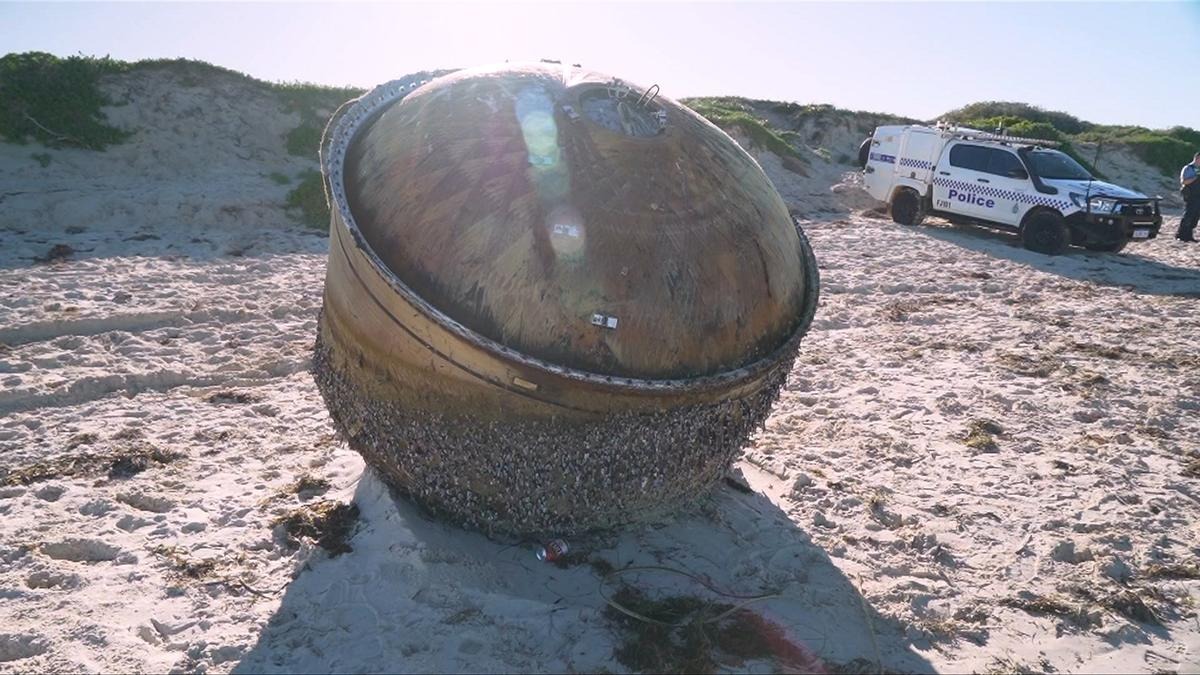
Sea turtles are easily recognized by their distinctive shells, flippers, and streamlined bodies. However, when a turtle dies and its body remains exposed to the natural environment, its appearance can change significantly.
Decomposition is a biological process in which microorganisms and other natural agents break down organic material. It begins after an animal dies and continues through several overlapping stages.
During the early stages, bacteria already present inside the body begin breaking down tissues. As microorganisms become active, gases can accumulate within body cavities, sometimes causing the body to swell.
The skin and other soft tissues gradually lose their normal structure. Exposure to sunlight, changing temperatures, moisture, and contact with sand can further alter the animal’s appearance.
As decomposition progresses, different parts of the body may become separated or displaced. The result can look very different from the living animal people are familiar with.
This explains why a sea turtle found on a beach may initially be difficult to recognize, especially when it has been exposed to the elements for an extended period.
What Happens During the Natural Decomposition Process?
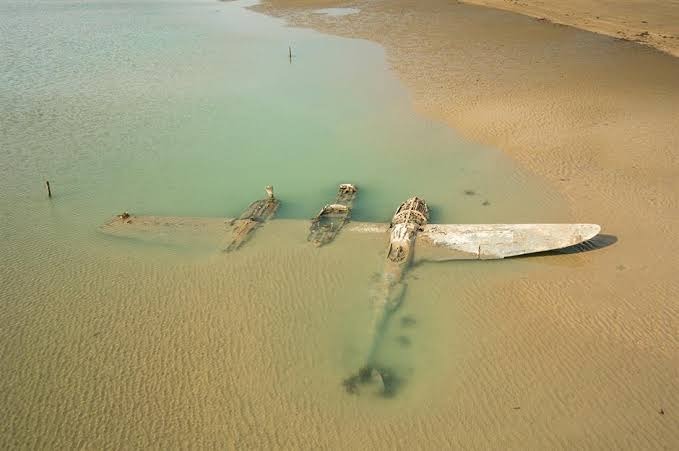
Decomposition does not happen at exactly the same speed in every environment. Temperature, moisture, exposure, the animal’s size, and the activity of microorganisms can all influence the process.
Several changes commonly occur as organic material breaks down.
1. Bacteria Begin Breaking Down Tissues
Microorganisms play a central role in decomposition. Bacteria already present in an animal’s digestive system and surrounding tissues continue their biological activity after death.
They break down organic compounds and produce various by-products. Some of these processes can generate gases, contributing to the swelling sometimes observed in decomposing animal remains.
2. Soft Tissues Gradually Change
As the process continues, skin and other soft tissues become increasingly fragile. Their original structure weakens, and different sections may loosen or separate.
This can make the animal’s body appear distorted. Features that would normally help identify the species may become difficult to recognize.
3. The Environment Continues to Influence the Remains
A body exposed on a beach experiences changing environmental conditions throughout the day.
Sunlight and warmth can influence microbial activity, while moisture from seawater and rainfall affects the surrounding material. Waves, wind, sand movement, and scavenging organisms may also alter the remains.
These factors help explain why two sea turtles found on different beaches may look very different even if they have been exposed for similar periods.
Why Does the Shell Sometimes Appear Separated?
One of the most recognizable features of a sea turtle is its shell. Unlike the removable shells of some other animals, a sea turtle’s shell is an integrated part of its skeleton.
It consists of several connected bony structures covered by a protective outer layer. The shell is closely associated with the turtle’s ribs and backbone.
During decomposition, the surrounding soft tissues deteriorate. Natural movement, environmental exposure, and the activity of other organisms can also affect how the remains are positioned.
Consequently, parts of the shell may appear separated from the surrounding tissues or displaced in the sand.
However, a detached-looking section does not necessarily reveal exactly what happened to the animal. Without examining the remains, it is impossible to determine whether the shell was damaged before or after death, or how long the turtle had been on the beach.
This is an important distinction: an unusual appearance alone cannot establish the cause of death.
Why Do Dead Sea Turtles Sometimes Wash Ashore?
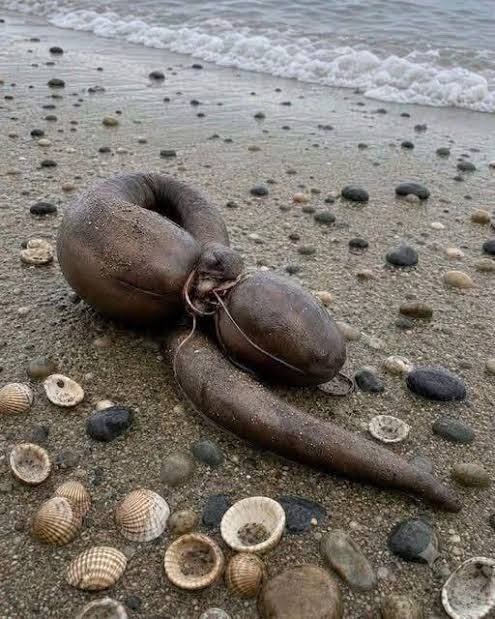
Sea turtles spend much of their lives in the ocean, but their bodies can occasionally be carried toward land by currents, tides, and waves.
There are several possible reasons why a dead turtle might appear along a shoreline.
Ocean currents can transport floating or partially submerged remains over considerable distances. Wind and changing tidal conditions may then move them into shallow water or onto the beach.
In other situations, a turtle may die close to the coast and later be carried ashore.
The discovery of a dead sea turtle does not automatically mean that an environmental disaster has occurred. However, it can be important information for wildlife authorities, especially when several animals are found in the same area.
Possible causes of sea turtle mortality include entanglement in fishing equipment, accidental capture, collisions with boats, ingestion of marine debris, disease, and natural causes. The actual reason can only be established through appropriate investigation.
The Important Role of Sea Turtles in Marine Ecosystems
Although finding a dead sea turtle can be upsetting, it is worth remembering how important these animals are to ocean ecosystems.
Sea turtles belong to several different species, and each has its own feeding habits and ecological role.
Green sea turtles, for example, often feed on seagrasses and algae as adults. Their grazing activity can help maintain healthy seagrass habitats.
Hawksbill turtles feed on sponges and other organisms associated with coral reef environments. Their feeding behavior can influence the structure of reef communities.
Leatherback turtles primarily consume jellyfish and other soft-bodied marine organisms. Their feeding habits connect them to different parts of the ocean food web.
These roles demonstrate that sea turtles are not simply beautiful animals that occasionally appear near beaches. They are part of complex marine ecosystems.
Their survival is closely connected to the condition of the habitats where they feed, migrate, and reproduce.
What Should You Do If You Find a Dead Sea Turtle?
Discovering a dead sea turtle can be surprising, particularly for someone who has never encountered one outside photographs or documentaries.
The most responsible response is to observe from a safe distance and contact the appropriate local authority.
Here are several practical steps to follow:
Keep your distance. Avoid touching, moving, or attempting to examine the animal. Decomposing remains may carry microorganisms, and the surrounding area may contain other hazards.
Take photographs from a safe distance. If it is safe and permitted, photographs can help authorities identify the animal and assess its condition.
Record the location. Note the beach name, approximate position, and time of discovery. This information can help wildlife responders locate the remains.
Contact local wildlife or environmental authorities. In areas where sea turtles are protected, trained personnel may need to document the discovery or arrange appropriate handling.
Keep children and pets away. This helps prevent accidental contact and avoids disturbing the remains.
It is also important not to assume that a turtle is dead simply because it is lying motionless. A living turtle may be weak, injured, or resting. If there is any uncertainty, contact a qualified wildlife responder rather than attempting to handle it.
A Reminder of the Ocean’s Hidden Stories
Beaches are often associated with peaceful holidays, beautiful sunsets, and the sound of waves. Yet the shoreline is also a place where the natural processes of the ocean become visible.
The strange object found in the sand was not an unknown creature or evidence of something mysterious beneath the water. It was the remains of a sea turtle undergoing a natural biological process.
The discovery may have been uncomfortable, but it offered an opportunity to understand how life and decomposition are connected.
In nature, the end of an animal’s life does not mean that all biological activity stops. Microorganisms, environmental conditions, and other organisms continue to interact with the remains as part of the broader ecosystem.
The ocean gives life to countless species, but it also carries the evidence of natural cycles back to shore. Sometimes, an unexpected discovery is a reminder that the natural world is far more complex than the peaceful scenery we usually see.