Why Are There So Many Bright Red Bugs Around My Tree?
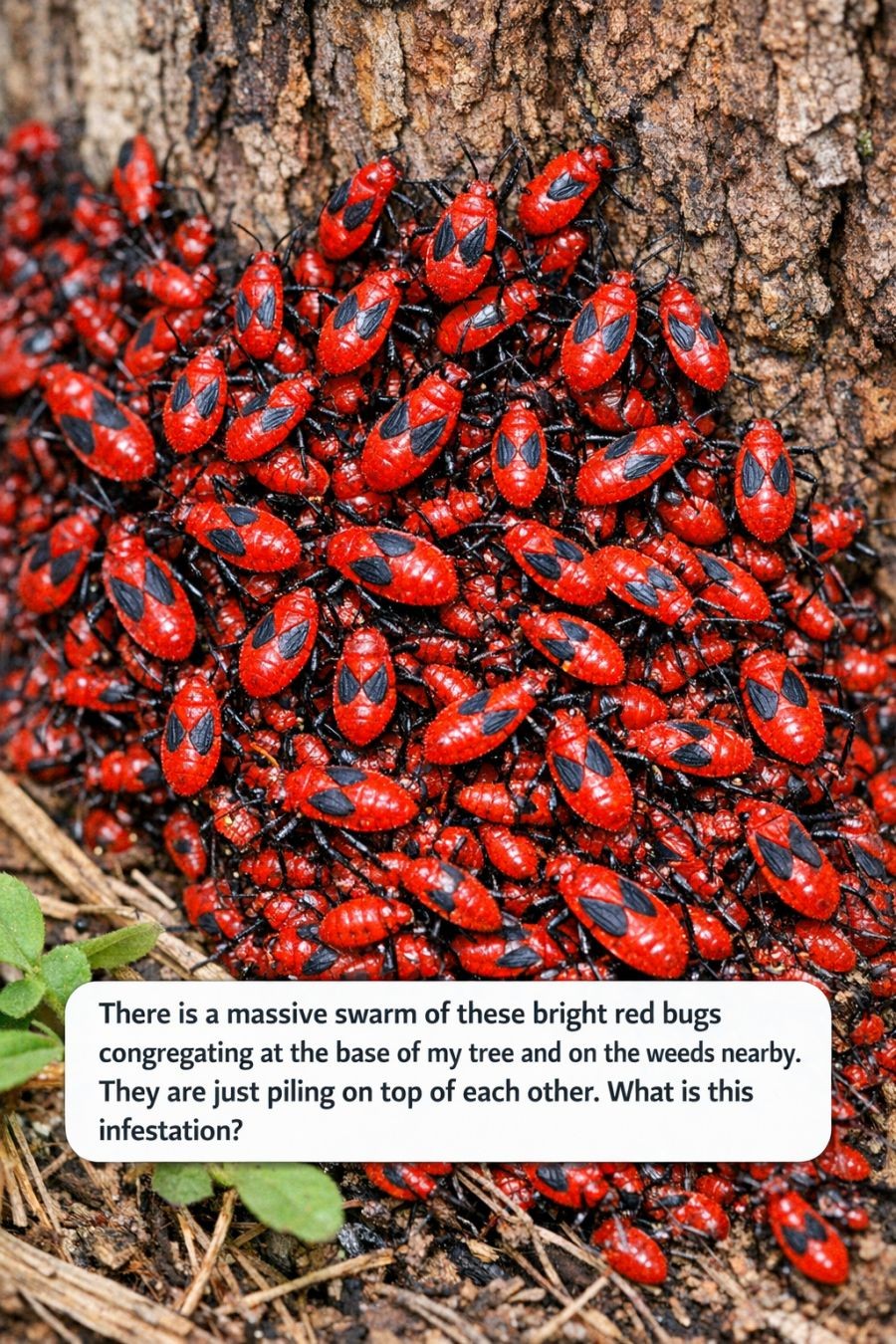
Seeing hundreds of small, bright red insects gathered around a tree trunk, garden weeds, foundation, or sunny wall can be alarming. They may form dense clusters that appear to move as one mass, especially on warm days. In much of North America, this sight is commonly linked to boxelder bug nymphs, the immature form of the boxelder bug (Boisea trivittata).
Although their appearance and numbers can be unsettling, boxelder bugs are usually more of a seasonal nuisance than a serious threat. They do not sting, are not known to spread disease, and rarely cause meaningful damage to healthy landscape plants. Understanding their life cycle, preferred host trees, and behavior can help homeowners decide when simple prevention is enough and when it may be helpful to contact a licensed pest-management professional.
Why Bright Red Bugs Gather Around Trees and Weeds
Large groups of red-and-black insects often appear because a yard offers the food, warmth, and shelter they need. Boxelder bugs are especially associated with boxelder trees, a type of maple native to North America. They also commonly occur around other maples and related plants. Their feeding activity is strongly linked to seeds, developing fruits, leaves, and tender plant tissues on their host plants.
During spring and summer, eggs hatch and the young insects, called nymphs, feed and develop outdoors. Nymphs frequently gather on trunks, branches, seed pods, fallen plant material, nearby weeds, and sun-warmed surfaces. Their bright color makes them highly visible, particularly when many individuals occupy the same small area.
Warm, dry, sunlit locations can encourage clustering. South- and west-facing tree trunks, exterior walls, fences, patios, and foundations may become gathering points because they retain heat. A large number of insects in one location does not necessarily mean the tree is dying or that the property is unsanitary. It often reflects the presence of a suitable host tree and favorable seasonal weather.
Meet the Likely Culprit: Boxelder Bug Nymphs
Boxelder bugs are true bugs in the family Rhopalidae. Adults are generally dark gray or black with thin red or orange lines along the wings and body. They are usually about one-half inch long and have an elongated, flattened shape.
The immature stages look quite different. Boxelder bug nymphs are usually bright red or reddish-orange with black legs, black wing pads, and dark markings that become more noticeable as they grow. Young nymphs are small and wingless. As they pass through several developmental stages, known as instars, their wing pads gradually enlarge and their overall coloring becomes more similar to that of adults.
These insects are widespread across the United States and parts of Canada. Despite the name, they are not limited to boxelder trees. They may also be found on maple trees, including silver maple, and occasionally near other vegetation. However, the presence of seed-producing boxelder or maple trees is one of the most reliable clues when identifying the source of a recurring population.
How to Identify Boxelder Bug Nymphs Correctly
Color alone is not always enough for identification, because several harmless insects have red-and-black patterns. A closer look at body shape, markings, location, and season can provide a more reliable answer.
- Color: Nymphs are vivid red or orange-red, with black legs and developing black wing pads.
- Body shape: They have an oval-to-elongated body and long, slender antennae.
- Grouping behavior: They often occur in conspicuous groups on host trees, seeds, walls, and warm foundations.
- Nearby plants: Boxelder, maple, and seed-bearing vegetation can support populations.
- Season: Nymphs are most noticeable from late spring through summer, while adults are often seen seeking sheltered locations in late summer and autumn.
Photographs from a university extension service or a local cooperative extension office can help confirm an identification. Correct identification matters because an outdoor population of boxelder bugs generally requires a different response than insects that damage vegetables, ornamental plants, or structures.
Why Boxelder Bugs Form Large Clusters
Boxelder bugs can be highly noticeable because they aggregate, or gather in groups. Aggregation may occur where food is concentrated, such as around fallen seeds or developing seed pods. It can also occur on warm surfaces that provide favorable temperatures for activity and development.
The behavior changes as seasons change. During the warmer months, nymphs gather near feeding sites. In autumn, mature adults are more likely to congregate on sun-exposed buildings, rocks, trees, and other protected areas before moving into cracks and crevices for winter shelter. This distinction is important: adult boxelder bugs overwinter, while nymphs develop into adults during the growing season.
Clustering itself is not a sign that the insects are attacking one another, breeding in a dangerous way, or preparing to damage a home. It is a normal behavioral response to available food, warmth, and shelter. However, clusters near doors, windows, siding, or foundations can indicate that adults may eventually try to enter a building through small gaps.
What Trees and Plants Attract Boxelder Bugs?
Boxelder bugs are most closely associated with boxelder trees (Acer negundo). Female, seed-producing boxelder trees are often linked with larger populations because the insects feed on the tree’s seeds. Maples can also support boxelder bugs, particularly where seeds are abundant.
Weeds, leaf litter, fallen samaras, and dense ground cover may make an area more attractive by providing shelter and retaining moisture near the soil surface. However, weeds are not necessarily the original cause of an infestation. The main driver is usually the presence of nearby host trees and a seasonal increase in the insect population.
Homeowners should avoid removing healthy trees solely because boxelder bugs are present. Trees provide shade, habitat, stormwater benefits, and other ecological value. Removing a mature host tree may reduce recurring numbers in some circumstances, but it is a major landscape decision that should be weighed against the tree’s condition, location, and benefits. Consultation with a certified arborist can be useful when a tree is unhealthy or when replacement is already being considered.
Are Boxelder Bug Nymphs Harmful to Trees or Gardens?
For most homeowners, boxelder bugs are primarily a nuisance rather than a destructive garden pest. They use piercing-sucking mouthparts to feed on plant material, especially seeds. In normal landscape conditions, this feeding rarely causes serious injury to established boxelder or maple trees.
Large populations can occasionally be found on fruit, ornamental plants, or garden vegetation, but significant plant damage is uncommon. Healthy, established trees are generally able to tolerate their presence. If a plant shows wilting, heavy discoloration, dieback, or other substantial symptoms, it is wise not to assume boxelder bugs are the cause. Drought stress, disease, nutrient problems, and other insects may be responsible.
The more common issue is staining. Boxelder bugs can leave reddish or dark marks when crushed, and their waste may stain light-colored exterior surfaces, fabrics, curtains, or walls. For that reason, vacuuming or gently sweeping them up is generally preferable to crushing them indoors.
Do Boxelder Bugs Bite, Sting, or Endanger Pets?
Boxelder bugs are not considered dangerous to people or pets. They do not sting and are not known to bite humans in the way that mosquitoes, fleas, bed bugs, or certain other pests do. They are not venomous, and public health agencies do not identify them as disease vectors.
They may still be bothersome when they enter a home in large numbers. Their presence around windows, light fixtures, curtains, attics, or wall voids can be frustrating, and their odor may be unpleasant if they are handled or crushed. Pets that investigate an insect may show brief irritation or digestive upset after eating one, but boxelder bugs are not generally regarded as toxic. Pet owners with concerns about unusual symptoms should contact a veterinarian.
Natural and Practical Ways to Reduce Boxelder Bugs
The most effective boxelder bug management focuses on exclusion and habitat maintenance rather than routine pesticide use. Since these insects are mainly an annoyance, prevention is often more useful than trying to eliminate every bug outdoors.
Seal Entry Points Before Autumn
Preventing access to the home is the most important step. Inspect exterior areas before adults seek winter shelter. Seal cracks around windows, doors, utility lines, vents, siding, foundations, and rooflines. Replace worn weatherstripping, repair damaged window screens, and ensure door sweeps fit tightly. Caulking gaps can reduce access not only for boxelder bugs but also for other nuisance pests.
Remove Bugs Without Crushing Them
Indoors, a vacuum cleaner is often the simplest method for removing visible bugs. Empty the vacuum canister or dispose of the bag promptly in an outdoor trash container. Outdoors, a garden hose can dislodge clusters from siding or other hard surfaces, although this may not prevent them from returning if host trees remain nearby.
Manage Fallen Seeds and Yard Debris
Raking fallen boxelder or maple seeds, removing leaf piles near the foundation, and keeping vegetation trimmed away from exterior walls can reduce sheltered resting areas. These steps will not always eliminate a population, but they can make the immediate area less favorable for insects gathering near the house.
Use Outdoor Lighting Thoughtfully
While boxelder bugs are not among the insects most strongly drawn to every type of light, reducing unnecessary exterior lighting near doors and windows can be part of a broader strategy for limiting insect activity around entrances. Use fixtures that direct light downward and keep doors closed when practical.
When Professional Pest Control May Be Helpful
Most boxelder bug sightings do not require professional treatment. However, a licensed pest-management professional may be useful when large numbers repeatedly enter living spaces, when sealing exterior gaps is difficult, or when homeowners need guidance on a targeted treatment plan.
Professionals can inspect the exterior for likely entry points and advise on integrated pest management. If a pesticide is recommended, it should be used according to the product label and local regulations. Broad, repeated outdoor insecticide applications are often less effective than exclusion because boxelder bugs can return from nearby trees and surrounding properties.
A professional may also help distinguish boxelder bugs from other insects. This is especially valuable if there is concern about a pest that may damage stored food, wood, textiles, or garden crops.
Common Red-and-Black Look-Alikes
Several insects may be confused with boxelder bug nymphs. Milkweed bugs, for example, are often orange, red, and black and are associated with milkweed plants. Red-shouldered bugs and some scentless plant bugs can also have similar patterns. In many cases, these insects are harmless and play ordinary roles in local ecosystems.
Location offers an important clue. A red-and-black insect on milkweed may be a milkweed bug, while a large gathering on a boxelder or maple tree is more likely to involve boxelder bugs. If identification remains uncertain, local extension services can provide region-specific information and may accept clear photographs for evaluation.
Preventing Future Boxelder Bug Swarms
A long-term plan should combine realistic expectations with practical prevention. Boxelder bugs are native insects and may remain present in neighborhoods with suitable trees. The goal is usually to keep them outdoors and reduce their impact on the home.
Maintain exterior seals, clean up fallen seeds and debris, keep plants from pressing directly against siding, and inspect screens and weatherstripping annually. Start these steps before late summer and autumn, when adults begin looking for protected places to overwinter. If a recurring issue is centered on a particular tree, consider seeking advice from an arborist or extension professional before making major pruning or removal decisions.
In most cases, bright red bugs around a tree are a temporary seasonal phenomenon. Once correctly identified as boxelder bug nymphs, they can be managed calmly with exclusion, cleaning, and sensible yard maintenance. Their dramatic appearance may be memorable, but they are usually far less threatening than they first appear.
Sources
Disclaimer: This content is intended for entertainment purposes only and is not based on real events.