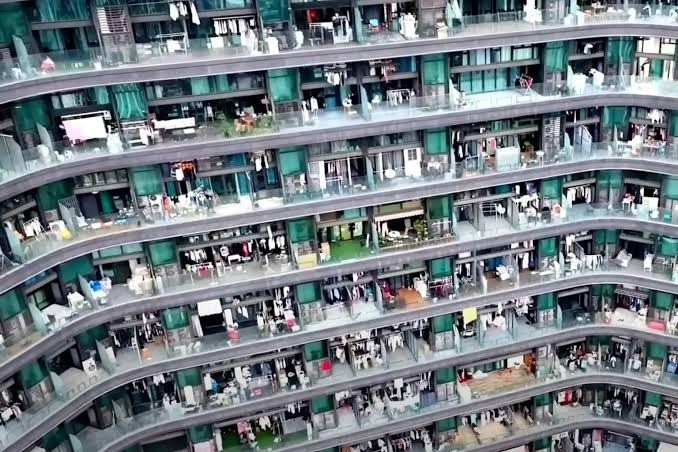
China’s “Dystopian Apartment” Goes Viral on TikTok
A huge residential complex in Hangzhou, China, has drawn international attention after drone footage of the building circulated widely on TikTok and other social-media platforms. Online posts have called Regent International a “dystopian apartment,” largely because of its immense scale, dense population and wide range of services available close to residents’ homes.
The label is attention-grabbing, but it does not fully capture the reality of the building or the urban challenges it represents. Regent International is a large mixed-use housing development in one of China’s rapidly growing cities. For many residents, particularly students, young workers and people seeking access to Hangzhou’s business districts, its appeal is practical: comparatively compact homes, nearby shops and services, and convenient transport connections.
Viral videos have claimed that as many as 30,000 people could live in the complex. Publicly reported estimates differ, and the precise number of residents can change over time as units are sold, rented and occupied. Frequently cited accounts put the number of people living there at around 20,000, while higher figures are often described as the building’s potential capacity rather than a verified day-to-day population. Whatever the exact total, Regent International illustrates the remarkable density possible in modern high-rise housing.

Why Regent International Has Captured Global Attention
Social-media footage tends to emphasize Regent International’s distinctive shape and its apparently endless rows of windows and balconies. From above, the complex appears much larger than a conventional apartment tower. Its visual impact has encouraged comparisons with futuristic films and dystopian fiction, where vast buildings sometimes symbolize anonymity, crowded cities or highly controlled environments.
However, describing a real residential community as “dystopian” can be misleading. The word is a cultural interpretation rather than an architectural classification. Residents are not confined to the building, and Hangzhou is a major, modern metropolitan area with public transport, parks, workplaces, universities, retail districts and public services. Like people living in other dense urban neighborhoods, residents can choose how much time they spend at home, in shared spaces or elsewhere in the city.
The online debate is nevertheless useful because it highlights a question facing cities around the world: how can urban areas provide homes for large populations while land, infrastructure and housing costs remain under pressure? High-density development is one response, especially in cities where jobs and educational opportunities attract new residents each year.

Where Is Regent International Located?
Regent International is located in Qianjiang Century City, an important business and urban-development area in Hangzhou, the capital of Zhejiang province in eastern China. Hangzhou is widely known as a technology, e-commerce, tourism and cultural center. It is also part of the wider Yangtze River Delta economic region, one of the country’s most economically active areas.
The city has experienced substantial urban development over recent decades, alongside broader migration from smaller towns and rural areas into China’s major urban centers. In such settings, apartment living is not unusual. Large residential compounds, towers and mixed-use developments are common features of urban growth, particularly near commercial districts and transport routes.
Reports about Regent International describe a large S-shaped structure with sections of differing heights. It opened during the early 2010s and includes thousands of residential units. Some reports have listed different floor totals and dimensions, reflecting the complexity of the development and variations among its sections. The most important fact is its scale: it is designed as a very high-density residential environment rather than a single conventional apartment block.
Its location also helps explain its popularity. Living near employment centers can reduce commuting time and provide easier access to daily services. This convenience is particularly valuable to young professionals and students, whose housing budgets may not stretch to larger apartments in central locations.

A Self-Contained Community, Not a Closed City
One reason Regent International fascinates viewers is the range of businesses and services associated with the complex and its surrounding neighborhood. Residents may have access to restaurants, convenience stores, beauty services, delivery options, small retail businesses and other everyday amenities nearby. This pattern is familiar in dense Asian cities, where shops and services are often integrated into or located directly beside residential developments.
Convenient access to daily needs can make high-density living more manageable. A resident may be able to buy groceries, collect deliveries, eat out or use personal services without making a long journey. For people with demanding work schedules, the ability to meet ordinary needs close to home can be a meaningful advantage.
At the same time, a building with numerous amenities should not be portrayed as a place where people never leave. Regent International is part of an urban district, not an isolated settlement. Residents travel for work, education, recreation, family obligations and social life. Hangzhou’s streets, transit systems, public spaces and commercial areas remain central to daily life.
Urban planners often use the term “mixed use” to describe neighborhoods that combine homes with retail, offices, services and public facilities. Well-planned mixed-use development can support walkability and reduce dependence on long car trips. Its benefits, however, depend on the quality of public transport, access to green areas, safe pedestrian routes, building maintenance and the availability of community facilities.
Affordability and the Appeal of Compact Housing
Rental prices reported online for units at Regent International have varied widely, as they do in most large housing markets. Costs depend on a unit’s size, condition, furnishings, floor level, lease terms and location within the development. Older viral reports have suggested rents ranging from relatively modest sums to substantially higher monthly payments, but these figures should not be treated as fixed current prices.
What is clear is that compact housing can offer an entry point for people who want to live near employment and commercial centers. In fast-growing cities, larger apartments in highly desirable districts may be beyond the reach of students and early-career workers. Smaller units can therefore serve an important role in the housing market, provided they meet safety, ventilation, sanitation and building-management standards.
Housing affordability is not a challenge unique to China. The United Nations has warned that rapid urbanization requires sustained investment in adequate, safe and affordable housing. Many cities across North America, Europe, Asia and Africa face shortages of homes that are affordable to workers with low or moderate incomes. High-rise development can add homes where land is scarce, but it is not a complete solution by itself.

Can Dense High-Rise Living Be Sustainable?
Supporters of dense urban housing argue that building upward can use land more efficiently than spreading housing outward over large suburban areas. When homes are close to workplaces, transit stations, shops and services, residents may be able to walk, cycle or use public transportation more often. This can potentially reduce travel distances and limit pressure to expand cities into undeveloped land.
But density is not automatically sustainable. A large residential complex requires reliable water supply, waste collection, electricity, elevators, fire-safety systems, maintenance and management. It also needs adequate daylight, ventilation, access to outdoor space and routes for emergency services. The quality of life within dense housing depends less on the number of people alone than on planning, construction standards, public infrastructure and responsive property management.
Experts in urban development generally emphasize that housing should be evaluated through multiple measures. Affordability matters, but so do safety, accessibility, social connection, nearby schools and health services, public transport and access to parks. A very large building can be efficient and convenient for some residents while feeling impersonal or restrictive to others.
The debate around Regent International reflects these competing perspectives. Some viewers see an innovative response to the realities of urban population growth. Others are uncomfortable with the small private spaces and the visual scale of a building that houses so many people. Both reactions point to the importance of giving residents meaningful choices in housing.

Lessons for Cities Facing Housing Pressure
Comparisons have been made between Regent International and the Begich Towers condominium building in Whittier, Alaska. Begich Towers is well known because many of Whittier’s residents live in or near the same structure, which is connected to essential local services. Yet the comparison has limits. Whittier is a small, remote community with a very different climate, population and geographic setting from Hangzhou, a major Chinese city with millions of residents.
Still, both examples demonstrate how buildings can become important social and functional centers. In places where weather, land availability, distance or infrastructure constraints shape everyday life, combining homes with services can be practical. The key issue is whether this arrangement serves residents’ needs and preserves their ability to participate fully in community life beyond the building.
For cities confronting housing shortages, there is no universal model. High-rise housing can be part of a broader strategy that includes renovation of existing homes, construction of affordable rental units, investment in public transit, protection of tenants, improvements to neighborhood infrastructure and expansion of public green spaces. Different communities need different combinations of these measures.
Why the “Dystopian” Description Misses Important Context
The popularity of videos about Regent International shows how easily a single image can shape global perceptions of a place. A drone view of a giant residential building may look unfamiliar or overwhelming to people accustomed to detached homes, private yards and lower-density neighborhoods. But visual surprise should not be confused with evidence that residents lack freedom, comfort or community.
High-density living has trade-offs. Residents may have less private indoor space and may live closer to neighbors than people in suburban homes. Noise, elevator wait times, crowded common areas and limited access to private outdoor space can all be concerns. At the same time, residents may benefit from lower housing costs than nearby alternatives, shorter commutes, walkable services and proximity to other people.
Regent International is best understood as an example of contemporary urban housing at an extraordinary scale. It is neither a simple blueprint for the future nor proof of a bleak one. Its viral fame has created an opportunity to discuss how cities can grow in ways that are affordable, safe, connected and respectful of residents’ well-being.
As urban populations continue to rise globally, the questions raised by this Hangzhou complex will remain relevant. How much density is appropriate? What services should be available near homes? How can policymakers ensure that compact housing remains healthy and dignified? And how can cities create neighborhoods where people have both convenience and access to public space? The answers will vary, but the need for thoughtful housing policy is shared across borders.
Sources
- United Nations Department of Economic and Social Affairs — global urbanization and population data.
- UN-Habitat — information on adequate and affordable housing.
- World Bank — urban development research and policy context.
- Reuters — reporting on China and economic developments.
- BBC News — background reporting on China.
- City of Whittier, Alaska — official local information about Whittier.
Disclaimer: This content is intended for entertainment purposes only and is not based on real events.