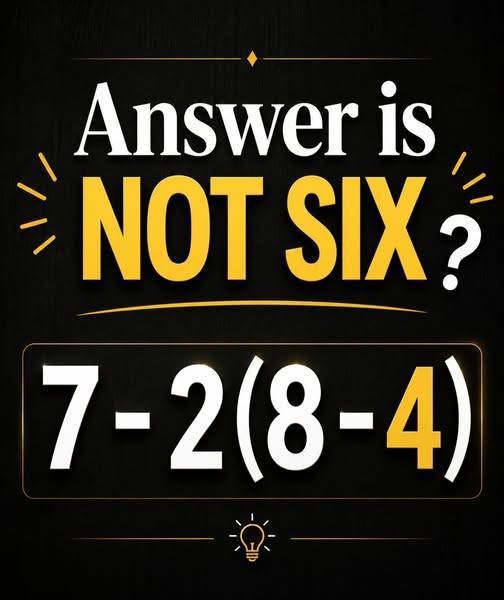
Answer is NOT SIX?
“Answer is NOT SIX?” may sound like the caption of a viral math puzzle, but the expression at the center of the discussion is a straightforward example of the standard order of operations. The calculation is:
7 − 2(8 − 4)
Online discussions about expressions like this often produce several proposed answers, including 20, 6, and −1. While disagreement can make the problem appear more complicated than it is, conventional mathematical notation provides a clear method for evaluating it. When the accepted order of operations is followed correctly, the result is −1.
This type of question is useful because it highlights an important principle in arithmetic: numbers and symbols cannot always be calculated simply from left to right. Parentheses, multiplication, division, addition, and subtraction have established priorities. Understanding those priorities helps students, educators, and everyday problem-solvers avoid common mistakes.
What Is the Correct Answer to 7 − 2(8 − 4)?
The correct answer is:
7 − 2(8 − 4) = −1
To reach that result, first solve the operation inside the parentheses. Then perform the multiplication represented by the number next to the parentheses. Finally, complete the subtraction.
The steps are:
- Calculate the parentheses: 8 − 4 = 4.
- Rewrite the expression as: 7 − 2(4).
- Interpret 2(4) as multiplication: 2 × 4 = 8.
- Complete the remaining subtraction: 7 − 8 = −1.
The final answer is therefore −1, not 6.
Why the Order of Operations Matters
The order of operations is a shared set of conventions that makes mathematical expressions understandable to everyone. Without these conventions, an expression such as 7 − 2(8 − 4) could be interpreted in several inconsistent ways. Mathematics depends on agreed notation so that a calculation written in one classroom, textbook, scientific paper, financial spreadsheet, or computer program can be evaluated reliably.
In many English-language schools, students learn the acronym PEMDAS:
- Parentheses
- Exponents
- Multiplication and Division
- Addition and Subtraction
Another widely used memory aid is BODMAS, which stands for Brackets, Orders, Division and Multiplication, Addition and Subtraction. The labels differ slightly by region and educational system, but the underlying principle is the same: evaluate grouped expressions first, then powers, then multiplication or division, and finally addition or subtraction.
One important detail is that multiplication and division have equal priority. When both appear in an expression, they are generally evaluated from left to right. Addition and subtraction also have equal priority and are handled from left to right after higher-priority operations are complete. In the expression under discussion, however, there is no conflict between multiplication and division or between addition and subtraction. The parentheses and multiplication make the sequence especially clear.
Step 1: Solve the Parentheses First
The expression contains the grouped calculation (8 − 4). Parentheses, also called brackets in many countries, indicate that the enclosed operation must be evaluated before the surrounding operations.
8 − 4 = 4
Once this calculation has been completed, substitute 4 back into the original expression:
7 − 2(4)
At this stage, it would be incorrect to subtract 7 minus 2 before dealing with the 2(4). The parentheses have already established a group, and the number immediately before that group has a specific mathematical meaning.
Step 2: Understand Implied Multiplication
The notation 2(4) is called implied multiplication. It means exactly the same thing as 2 × 4. A number placed directly beside parentheses indicates multiplication, even when a multiplication sign is not printed.
Therefore:
2(4) = 2 × 4 = 8
Now the expression becomes:
7 − 8
This convention appears throughout mathematics. For example, 3(x + 2) means 3 multiplied by the entire quantity inside the parentheses. In algebra, writing multiplication this way is often cleaner than repeatedly using the × symbol. The same principle applies to ordinary arithmetic.
Step 3: Complete the Subtraction
The final operation is:
7 − 8 = −1
A negative result is entirely valid. It means that 8 is one unit greater than 7, so subtracting 8 from 7 leaves a value one unit below zero. Number lines offer a simple visual explanation: starting at 7 and moving eight spaces to the left lands at −1.
This is why the correct evaluation of 7 − 2(8 − 4) is −1.
Why Some People Get 6, 20, or Other Answers
Different answers usually result from changing the order of operations, often without realizing it. A common error is to read the expression strictly from left to right after solving the parentheses. Someone might calculate 7 − 2 first, producing 5, and then multiply by 4 to get 20. But that changes the structure of the original expression.
The expression 7 − 2(4) does not mean (7 − 2) × 4. If that were intended, the expression would need parentheses around 7 − 2. Written mathematical notation matters because parentheses determine which values form a group.
Another possible error is to overlook implied multiplication and treat 2(4) as though it had no priority over subtraction. Under standard arithmetic conventions, however, multiplication is performed before subtraction. This is not a matter of personal preference; it is the standard interpretation taught in formal mathematics.
The answer 6 may arise from an unrelated mental shortcut, an accidental transcription error, or a misunderstanding of the symbols. It does not follow from the expression as written when standard order-of-operations rules are applied.
Can a Calculator Give a Different Result?
Most reliable scientific calculators, graphing calculators, spreadsheet programs, and computer algebra systems evaluate the expression as −1 when it is entered correctly. However, calculator input can create confusion if parentheses are omitted or if a device uses a different input format.
For example, entering 7 − 2 × (8 − 4) clearly communicates the intended calculation to nearly all digital tools. The multiplication symbol can be helpful when using a calculator keyboard, even though it is optional in handwritten mathematical notation.
A basic calculator that processes operations sequentially rather than using algebraic precedence may behave differently, especially if it does not display the full expression. That does not change the mathematical convention. It simply shows why users should understand the calculation rather than relying solely on a device’s displayed result.
Order of Operations in Education and Daily Life
Order of operations is often introduced in elementary or middle-school mathematics, but its importance extends far beyond classroom exercises. It is used in budgeting, engineering, science, coding, accounting, medicine, statistics, and many other fields where calculations must be repeatable and transparent.
In programming, operators are also evaluated according to precedence rules. While specific programming languages can have their own syntax, developers commonly use parentheses to make calculations explicit and reduce the risk of errors. In scientific work, carefully written formulas help researchers communicate methods that other experts can test and verify.
Mathematics education specialists frequently emphasize that memorizing PEMDAS or BODMAS is most helpful when students also understand the meaning behind the rules. Rather than viewing the acronym as a rigid sequence of letters, learners benefit from recognizing that parentheses define grouped quantities and that multiplication connects values before addition or subtraction is considered.
A Clearer Way to Write the Expression
Although 7 − 2(8 − 4) is standard notation, it can be rewritten to make the multiplication more visible:
7 − 2 × (8 − 4)
This version has exactly the same value. Solving it still gives:
- 8 − 4 = 4
- 2 × 4 = 8
- 7 − 8 = −1
Using an explicit multiplication sign may be especially useful in online posts, worksheets for beginners, and calculator instructions. It reduces visual ambiguity while preserving the original meaning.
Key Takeaway: The Answer Is −1
The expression 7 − 2(8 − 4) has one standard answer under conventional mathematical notation: −1. First solve the parentheses, then multiply, then subtract. The complete calculation is:
7 − 2(8 − 4) = 7 − 2(4) = 7 − 8 = −1
The discussion surrounding the problem is a useful reminder that arithmetic symbols carry meaning beyond their appearance. Parentheses establish a group, a number adjacent to parentheses means multiplication, and multiplication takes priority over subtraction. Once those principles are applied consistently, there is no ambiguity in the result.

Sources
Disclaimer: This content is intended for entertainment purposes only and is not based on real events.