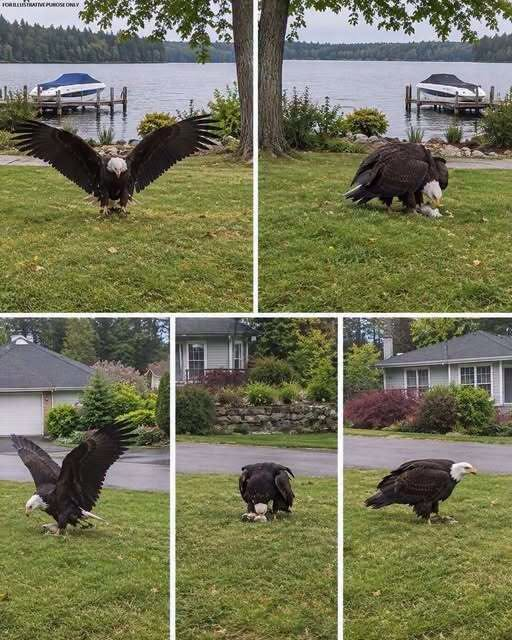
Giant Eagle Report Draws Attention to Wildlife Research and Conservation
A report describing a supposedly giant eagle has attracted attention among wildlife readers, bird enthusiasts, and social-media audiences. Large birds of prey naturally inspire fascination: eagles are among the most recognizable animals in the world, valued for their size, flight, hunting ability, and cultural importance. However, the available description raises an important question. Without a confirmed location, independently verified photographs, measurements, identified researchers, or a published scientific assessment, it is not possible to determine what bird was seen or whether the claim is accurate.
Extraordinary wildlife reports are not automatically false. New observations can contribute to scientific knowledge, especially in remote areas where surveys remain limited. Yet an observation is not the same as a verified discovery. Responsible wildlife reporting requires evidence that other experts can examine, compare, and evaluate. Until those details are available, the reported giant eagle should be treated as unconfirmed rather than presented as a newly identified species, a record-breaking individual, or evidence of an unknown population.
Why Verification Matters in Wildlife Reporting
Verification is central to ornithology, the scientific study of birds. When researchers document an unusual bird, they generally record the date, exact or approximate location, habitat, weather conditions, behavior, photographs or video, and physical features that distinguish the animal from known species. In some cases, researchers may collect non-invasive evidence such as feathers that have naturally fallen, environmental DNA samples, or high-resolution images. Any biological sampling must follow local laws and animal-welfare standards.
For a report involving an unusually large eagle, basic measurements would be especially important. Wing span, body length, mass, foot size, beak shape, plumage pattern, age, sex, and flight silhouette can all help specialists identify a bird. These details also need context. A bird viewed from a distance can appear much larger than it really is, particularly when photographed without a familiar object nearby for scale. Perspective, lens compression, shadows, and the angle of flight may all alter apparent size.
Named experts and institutions also matter. A credible report normally identifies the people or organizations involved, allowing readers to assess their qualifications and review their methods. Peer-reviewed research is not the only valid form of evidence, but it remains an important standard because it enables other specialists to scrutinize findings before broad conclusions are made.
Known Eagles Already Include Remarkably Large Species
Claims about a “giant eagle” should be considered alongside the diversity of known raptors. The word “eagle” covers many species found across several continents, and their size varies greatly. The harpy eagle of Central and South America is widely recognized as one of the world’s most powerful forest raptors. Its broad wings, large talons, and muscular build are adaptations for hunting in dense tropical forests.
The Steller’s sea eagle, found in northeastern Asia, is among the heaviest eagles. It is notable for its large yellow bill, contrasting plumage, and association with coastal and river environments. The white-tailed eagle, found across much of Europe and Asia, also has an impressive wing span and is increasingly visible in areas where conservation and legal protection have supported population recovery.
The Philippine eagle is another exceptional species. It is a large forest eagle endemic to the Philippines and is recognized by the International Union for Conservation of Nature as critically endangered. Habitat loss, fragmentation, and human pressures remain serious concerns for the species. Its conservation status is a reminder that public interest in spectacular birds can be useful when it leads to support for habitat protection, responsible tourism, and science-based conservation.
Historical species add another dimension to public imagination. Haast’s eagle, once found in New Zealand, was an exceptionally large extinct eagle. Scientific evidence indicates that it disappeared after major ecological changes associated with human settlement, including the loss of its principal prey. The existence of large extinct eagles does not confirm modern claims, but it shows why the subject captures attention and why precise scientific language is essential.
How Misidentification Can Happen
Bird identification can be difficult even for experienced observers. Many raptors are seen briefly, at a distance, or in changing light. Juvenile birds may have plumage that differs significantly from adults, while individual variation can make a familiar species look unusual. A large bird may also be confused with another bird of prey, such as a vulture, kite, condor, osprey, or large owl, depending on where the sighting occurred.
Visual scale is one of the most common sources of misunderstanding. A bird flying low near a camera may look dramatically larger than a distant landscape behind it. Conversely, an eagle perched high in a tree can be difficult to compare with surrounding objects. Digital editing, artificial intelligence-generated imagery, and reposted images stripped of their original context have added further challenges for audiences trying to judge online wildlife material.
This does not mean every unusual image is deceptive. It means that a single image, especially one lacking a date, location, original file, and scale reference, is usually insufficient to establish a major biological claim. Conservation organizations and scientific institutions often encourage observers to preserve original files and report sightings through recognized local bird-recording networks.
What Credible Evidence Would Look Like
If a genuinely unusual eagle were documented, researchers would likely begin by comparing it with known species in the relevant region. They would examine visible characteristics including wing shape, tail length, coloration, head profile, leg feathering, and bill structure. Audio recordings could be useful if calls were heard. Repeated observations from multiple people would strengthen a case, particularly if they were made at different times and supported by clear documentation.
Modern wildlife research also uses tools that minimize disturbance. Camera traps, remote cameras, satellite tracking, drones operated under appropriate regulations, and genetic analysis can help scientists study elusive birds. Satellite telemetry has transformed understanding of migration routes and habitat use for some large raptors. However, these methods require careful planning, permits, technical expertise, and safeguards to avoid stressing animals or exposing nest locations to disturbance.
Any potential identification of a new species would require much more than an eye-catching claim. Taxonomy, the science of naming and classifying organisms, relies on comparisons with existing museum collections, published descriptions, genetic data where appropriate, and the work of qualified specialists. In many cases, researchers also consult local and Indigenous knowledge, which can provide important long-term observations about wildlife distributions and seasonal behavior.
The Conservation Value of Public Curiosity
Even when a viral wildlife claim cannot be verified, public interest can create an opportunity to discuss real conservation needs. Eagles and other birds of prey are often indicators of ecosystem health. Because many occupy high positions in food webs, their populations can be affected by habitat degradation, declining prey, poisoning, collisions with infrastructure, illegal persecution, and environmental contamination.
Conservation outcomes can improve when governments, scientists, landowners, and local communities work together. Protected nesting areas, restoration of forests and wetlands, regulation of harmful chemicals, safer power infrastructure, and education campaigns have all been used in different regions to help raptor populations. The success of these measures depends on local conditions and sustained monitoring rather than a single announcement or viral story.
International agreements also play a role. The Convention on International Trade in Endangered Species of Wild Fauna and Flora, commonly known as CITES, regulates international trade in listed wildlife species to help ensure that trade does not threaten their survival. Meanwhile, organizations such as BirdLife International and the IUCN provide widely used assessments of bird conservation status and threats.
Responsible Ways to Share Wildlife Sightings
Members of the public can make meaningful contributions to wildlife knowledge by recording observations carefully. A useful sighting report includes the location, date, time, habitat, estimated distance, behavior, and photographs taken without approaching or disturbing the animal. Observers should avoid revealing the precise location of nests or rare species publicly, as this can increase the risk of disturbance or illegal activity.
Citizen-science platforms can help researchers understand bird distribution and migration, but users should follow platform guidance and local wildlife laws. When sharing an unusual sighting online, it is wise to describe it as an observation rather than a confirmed identification unless it has been reviewed by qualified experts. Phrases such as “reported,” “unconfirmed,” and “possible” are not signs of uncertainty to avoid; they are accurate descriptions of the available evidence.
Readers should also be cautious about posts that make sweeping claims without supporting information. Warning signs include a lack of place names, no original photographer or observer, no dates, exaggerated size comparisons, absent scientific affiliations, and language claiming that experts are concealing a discovery. Reliable science welcomes independent examination. A claim becomes stronger when evidence can be checked, not when it relies only on mystery or urgency.
A Careful Conclusion on the Reported Giant Eagle
The reported giant eagle remains an intriguing but unverified wildlife story. The absence of a confirmed location, named researchers, measurements, original documentation, and expert analysis means that no firm conclusion can be drawn about the bird’s identity. It may represent a known large raptor seen under unusual conditions, an incorrectly interpreted image, or an observation that requires far more evidence before it can be assessed.
Curiosity about wildlife is valuable, and unusual reports can encourage people to learn more about birds, ecosystems, and conservation. The most constructive response is neither immediate belief nor automatic dismissal. It is careful attention to evidence, respect for wildlife, and support for the researchers and communities working to protect real species whose futures are already well documented.
Sources
Disclaimer: This content is intended for entertainment purposes only and is not based on real events.