Can You Solve the Woman in a Boat Puzzle? The Answer Is Hidden in the Wording
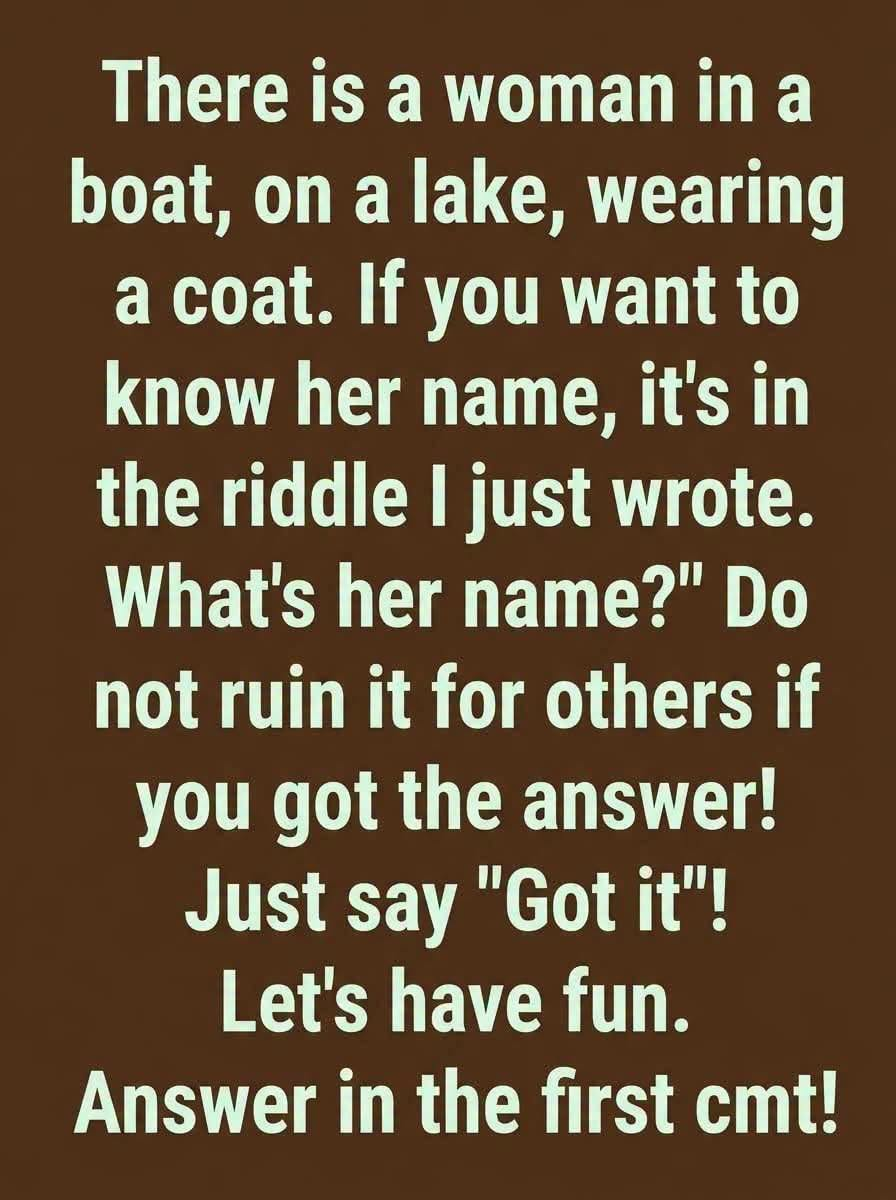
A woman sits quietly in a boat on a lake, wearing a coat. The water is still, the scene appears ordinary, and there seems to be no clue explaining who she is. Then comes the question: what is her name?
At first, the woman in a boat puzzle can feel impossible. There is no visible name tag, no dialogue that supplies an answer, and no realistic way to identify a stranger from such limited information. That reaction is exactly what makes the riddle effective. The answer is not meant to be discovered by studying the boat, the lake, or the woman’s clothing. It is hidden in the wording of the puzzle itself.
This kind of riddle is a classic example of a language-based puzzle. Rather than testing general knowledge, mathematics, or observation alone, it asks readers to notice how a sentence has been written. The key is often a word that looks unimportant on the first reading.
The Answer to the Woman in a Boat Puzzle
In the best-known version of the riddle, the woman’s name is There.
The clue appears in wording such as: “There is a woman sitting in a boat on a lake.” Because the puzzle says that her name is contained within the riddle, readers are expected to look back at the opening sentence. The word “There” is presented as part of the description, but it can also function as the woman’s name.
This answer depends on the exact phrasing. Different online versions may use slightly different wording, add details about a coat or calm water, or ask the question in another way. In some variants, the hidden name may be a different word. That is why the precise text matters more than the setting. If a puzzle has been shortened, rewritten, or copied without its original wording, its intended answer may become unclear.
The central lesson is simple: do not search only for clues inside the fictional scene. Search the language used to create the scene.
Why This Riddle Is So Easy to Overthink
Most people naturally approach the puzzle as if it were a real-world mystery. They may wonder whether the lake is famous, whether the boat contains a hidden symbol, or whether the coat has some special meaning. These are reasonable instincts because the description encourages visual imagination.
However, the riddle is not asking readers to identify a real person. It is using ordinary details to direct attention away from the actual clue. The boat, lake, and coat create a vivid image, but they are usually not essential to the solution. They give the puzzle a story-like quality while concealing the fact that the answer is located in plain text.
Language puzzles often rely on this mismatch between expectation and method. A reader expects a logical deduction from the fictional situation, while the puzzle requires a closer reading of grammar, repetition, punctuation, or word choice. The moment of recognition can feel satisfying because the clue was visible from the beginning.
How Hidden-Word Riddles Work
The woman in a boat puzzle belongs to a broad category of wordplay riddles. These puzzles use language as both the subject and the source of the answer. Instead of asking, “What happened?” they quietly ask, “What does this wording allow you to notice?”
Common methods used in hidden-word riddles include:
- Words used as names: An ordinary word, such as “There,” may also be treated as a person’s name.
- Double meanings: A word may have one meaning in the story and another meaning that points to the answer.
- Letter patterns: The answer may be formed from first letters, last letters, or a sequence of characters.
- Sound-based clues: A phrase may reveal the solution when spoken aloud.
- Question wording: The way a question is asked may be more important than the information in the story.
In this particular riddle, the answer is generally based on the first method. “There” is an ordinary adverb in the sentence, but it also works as a plausible name. The solution is not a statement about a real woman; it is a playful shift in how the word is interpreted.
The Importance of Exact Wording in Word Puzzles
Word riddles can be fragile. A small edit may remove the clue entirely. For example, changing “There is a woman in a boat” to “A woman is in a boat” may make the expected answer “There” much harder to justify. The story remains almost identical, but the linguistic mechanism has changed.
This is one reason puzzles can become confusing when they spread through social media posts, content aggregators, screenshots, and short-form videos. A copied version may leave out a sentence, alter punctuation, or replace a word to sound more natural. Readers may then receive a riddle that has lost the feature needed to solve it.
When facing a confusing puzzle, it helps to return to the original wording whenever possible. Read the text slowly and ask a few practical questions:
- Does the puzzle explicitly say that the answer is “in the question” or “in the riddle”?
- Which words seem unusually placed or repeated?
- Could an ordinary word also be a name, object, or action?
- Does the answer depend on reading the sentence differently?
- Has the riddle been reposted in a shortened or edited form?
These questions can prevent readers from spending too much time searching for clues that were never intended to matter.
What the Boat, Lake, and Coat Add to the Puzzle
Although the setting is not usually the answer, it still serves a purpose. A woman in a boat on a quiet lake is easy to picture. The image is calm, specific, and memorable. Mentioning a coat adds another detail that can prompt readers to look for symbolism or a hidden connection.
That visual richness is part of the puzzle’s design. A sparse question such as “There is a woman. What is her name?” would reveal the wordplay too quickly. By adding a boat, water, and clothing, the riddle creates enough narrative detail to make readers focus on the imaginary scene rather than the sentence structure.
In other words, the description acts as a form of misdirection. It does not deceive readers with false facts; instead, it encourages an understandable but unproductive line of reasoning. The answer becomes clear only when the reader shifts attention from the scene to the text.
Language, Attention, and Problem-Solving
Riddles like this can be entertaining because they reward flexible thinking. A person may initially assume that every detail has a literal meaning. Once that assumption is reconsidered, the problem becomes easier. This is a useful habit beyond puzzles: sometimes the framing of a question shapes the kind of answer people search for.
Educational researchers and language specialists often emphasize that reading comprehension involves more than recognizing individual words. Readers also interpret context, notice ambiguity, understand figurative language, and identify the author’s purpose. A short riddle can exercise these skills in a light and accessible way.
The woman in a boat puzzle also shows why ambiguity is important in language. Many English words can perform more than one role depending on context. “There,” for instance, is usually used to indicate place or introduce a statement. Yet names do not follow the same grammatical restrictions as ordinary words. A word can shift from one category to another when it is used as a name.
This flexibility is common in English and in many other languages. People’s names can originate from places, occupations, plants, virtues, colors, and familiar words. That does not mean every word in a sentence is secretly a name, but it explains why the riddle’s solution is linguistically possible.
Why Riddles Remain Popular Online
Simple puzzles are widely shared because they are easy to read, quick to discuss, and suitable for many age groups. A short riddle can create a pause in a busy online feed. Readers may try to solve it independently, compare answers with friends, or revisit the wording after learning the solution.
The most successful riddles are often not the most complicated. They are the ones that make people say, “I should have noticed that.” The woman in a boat puzzle works because its answer feels obvious in hindsight, even if it is not obvious at first.
Still, it is helpful to approach viral puzzles with modest expectations. A riddle may have several circulating versions, and comments may suggest answers that do not match the wording. The strongest solution is usually the one that can be clearly explained using the exact text of the puzzle, without adding facts that are not present.
How to Solve Similar Wordplay Puzzles
If you enjoy this type of challenge, a structured approach can make hidden-word riddles easier to solve.
- Read the puzzle twice. The first reading creates the story. The second should focus on individual words and phrasing.
- Identify the instruction. If the riddle says the answer is hidden, contained, or obvious, treat that as a direct clue.
- Ignore decorative details temporarily. Set aside information that makes the story vivid but does not affect the wording.
- Look for alternative meanings. Consider whether a word can be used as a name, sound, object, or verb.
- Test the answer against the text. A good solution should explain why the puzzle was worded in that particular way.
For the woman in a boat puzzle, this process leads back to the opening word: “There.” Once recognized, the answer explains why the riddle says the name should be obvious and why looking closely at the wording is necessary.
Final Thoughts on the Woman in a Boat Riddle
The woman in a boat puzzle is less about a mysterious lake and more about the hidden possibilities of everyday language. Its intended answer, commonly “There,” is not found through detective work or outside research. It is found by rereading the sentence and allowing one ordinary word to take on a second role.
That is the lasting appeal of this kind of riddle. It reminds readers that words can do more than describe a scene. They can conceal a clue, change the direction of a question, and turn a simple sentence into a small puzzle. The next time a riddle seems impossible, the answer may not be somewhere beyond the story. It may already be sitting in the words.
Sources
Disclaimer: This content is intended for entertainment purposes only and is not based on real events.