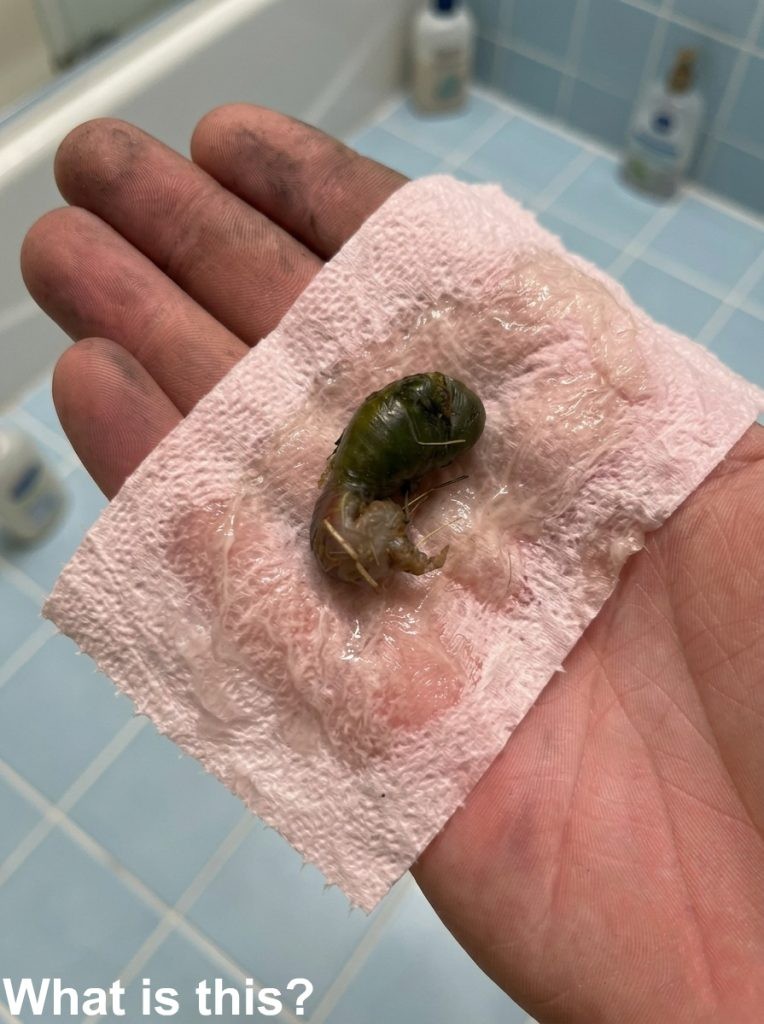
Understanding a Beetle Pupa Found in the Bathroom
What began as an ordinary day at home turned into a small but memorable nature discovery. While cleaning the bathroom, we noticed an unusual green, segmented object on the floor. Its shape did not immediately resemble a familiar household item, and its textured appearance made it difficult to identify at a glance.
Finding an unfamiliar insect or insect-like object indoors can understandably raise questions. Bathrooms are enclosed spaces, and people may be concerned about hygiene, household pests, or whether an object could pose a risk to children or pets. In many cases, however, an unfamiliar object is simply part of an insect’s natural life cycle. After taking a closer look and comparing its features with reliable online information, the object appeared to be a beetle pupa.
A beetle pupa is an important developmental stage between the larval and adult forms of a beetle. Although pupae can look strange because they are often pale, greenish, segmented, or immobile, they are a normal part of complete insect metamorphosis. Learning more about this stage can turn an initially unsettling household encounter into an opportunity to understand the diversity of the natural world.
What Is a Beetle Pupa?
Beetles belong to the insect order Coleoptera, one of the largest and most diverse groups of animals on Earth. Scientists have described hundreds of thousands of beetle species, with many more believed to exist. Beetles occupy a wide range of habitats, including gardens, forests, freshwater environments, agricultural areas, and sometimes human homes.
Like butterflies, moths, flies, and many other insects, beetles undergo complete metamorphosis. This means their development happens in four distinct stages: egg, larva, pupa, and adult. Each stage has a different role.
- Egg: The life cycle begins when an adult female beetle lays eggs in a location suitable for the species.
- Larva: The larva hatches and usually spends much of its time feeding and growing. Beetle larvae vary greatly in appearance and may resemble grubs, worms, or small caterpillar-like insects.
- Pupa: The larva enters a resting and transforming phase. During this period, the insect develops the structures it will need as an adult, including legs, wing covers, wings, and other features.
- Adult beetle: The adult eventually emerges from the pupal stage and may feed, reproduce, disperse, or overwinter depending on the species.
The pupal stage is not a period of inactivity in the biological sense. Although a pupa may remain still, major internal changes are taking place. In some beetles, the developing adult body can be visible through the pupal casing. Depending on the species, a beetle pupa may have recognizable legs, wing pads, antennae, and body segments.
Why a Beetle Pupa May Look Green or Segmented
Not all beetle pupae look alike. Their color, size, texture, and shape depend on the species and the stage of development. Some are creamy white or pale yellow when newly formed. Others may appear greenish, brown, tan, or darker as they mature. A pupa may also become more visibly defined shortly before the adult beetle emerges.
Segmented body sections are common in insects. Beetles, like other insects, have bodies divided into major regions, including the head, thorax, and abdomen. The abdomen is made up of visible segments, which can make a pupa appear unusual to someone who has not encountered one before.
Some pupae are enclosed in cocoons, protective chambers, soil, plant material, wood, or other concealed locations. Others are more exposed. This variation is one reason that visual identification can be challenging. A green, segmented object may resemble a pupa, but a precise identification should not be made from appearance alone, especially when the source image, species, and location are unknown.
Can Beetle Pupae Be Found Indoors?
Most beetles do not intentionally seek bathrooms as places to complete their life cycle. Still, insects and their immature stages can occasionally be found indoors for several ordinary reasons. An adult insect may have entered through an open door, window, vent, gap, or damaged screen. A larva may have been carried inside on potted plants, flowers, produce, firewood, shoes, outdoor equipment, or clothing.
Bathrooms may also attract some small insects because they offer moisture, shelter, and low foot traffic in corners or behind fixtures. However, the presence of a single insect pupa does not automatically indicate an infestation or a sanitation problem. Many household discoveries are isolated events involving an insect that entered accidentally or was moved indoors from another environment.
It is also important to avoid assuming that every small segmented object is a beetle pupa. Depending on its appearance and surroundings, it could be another insect life stage, a shed skin, a seed, a piece of plant material, or an unrelated household item. If several similar objects appear repeatedly, or if insects are emerging in large numbers, a local pest-management professional, extension service, or entomologist may be able to help identify the source.
How to Safely Examine an Unfamiliar Insect Object
When an unfamiliar object is found indoors, a calm and practical approach is usually best. There is no need to panic, but it is sensible to avoid direct handling until the object has been assessed. Using a tissue, disposable gloves, a small container, or a clear jar can allow closer observation while maintaining basic hygiene.
Photographs are often more useful than prolonged handling. Clear images taken from several angles can help with identification. If possible, include an ordinary item, such as a coin or ruler, for scale. Note where the object was found, whether it was moving, whether there were nearby plants or stored materials, and whether similar objects have appeared elsewhere in the home.
Reliable identification resources can include university extension services, natural history museums, government agriculture departments, and established entomology organizations. Community identification forums may offer useful suggestions, but their conclusions should be treated cautiously unless supported by a qualified expert or an authoritative reference.
For a single suspected pupa, one option is to place it gently in a ventilated container and contact a local nature center, extension office, or insect specialist for guidance. If it is clearly an insect and there is no reason to retain it, it can often be moved outdoors to a sheltered area away from heavy foot traffic. The appropriate location depends on the species, so minimizing disturbance is generally preferable.
Do Beetle Pupae Pose a Health Risk?
Most beetle pupae are not harmful to people. They do not bite, sting, or spread disease in the way some other household pests can. A pupa is typically not feeding and has limited movement while it develops into an adult insect.
Nevertheless, ordinary hygiene practices remain sensible after handling any unknown object found on a bathroom floor or other household surface. Wash hands with soap and water after disposal or examination, and clean the surrounding area if needed. If a person has allergies, a compromised immune system, or concerns involving a child or pet, avoiding direct contact is a reasonable precaution.
It is also worth distinguishing between a single pupa and evidence of an ongoing pest issue. Repeated sightings of larvae, pupae, or adult insects near stored food, fabrics, wood, houseplants, drains, or damp areas may indicate a specific species has found suitable conditions indoors. In that case, identifying the insect correctly is more useful than applying broad treatments. Removing the food source, reducing moisture, sealing entry points, and cleaning affected areas are often the first steps recommended in integrated pest management.
The Importance of Accurate Insect Identification
Online image searches can be helpful, but they have limitations. Many insect species look similar during their immature stages, and lighting can significantly change the apparent color of a photograph. A greenish pupa in one image may appear yellow, brown, or white in another. In addition, beetle pupae can resemble pupae from other insect groups.
Accurate identification often depends on details that are difficult to see without close examination. These may include the arrangement of legs and wing pads, the presence of hairs or spines, body proportions, the material around the pupa, and the geographical location where it was found. Experts may also consider the season, nearby vegetation, and the type of building or habitat.
For this reason, it is best to describe a household discovery carefully: it may be a beetle pupa rather than stating with certainty that it belongs to a particular species without confirmation. This approach is both scientifically responsible and more useful for readers who may encounter similar objects in different locations.
Beetles and Their Role in Nature
Although people may think of beetles mainly as garden visitors or occasional household intruders, they play essential roles in ecosystems. Different beetle species pollinate flowers, break down decaying plant material, recycle nutrients, control other insect populations, and provide food for birds, reptiles, amphibians, and mammals.
Some beetles are also important in agriculture and forestry. Ground beetles, for example, can help control certain pests by feeding on insects and their eggs. Other species decompose dead wood and organic matter, supporting soil health and nutrient cycling. At the same time, some beetles can damage crops, stored products, timber, or plants, which is why correct identification remains important.
The wide variety of beetle life histories is one reason an unexpected pupa can be so interesting. What appears to be a small, unfamiliar object may represent a transitional stage in an insect’s complex development. It is a reminder that nature is not limited to parks, gardens, and wilderness areas; it can occasionally appear in the quiet corners of everyday homes.
What to Do If You Find a Similar Object in Your Home
If you find a green, segmented, or unfamiliar object indoors, begin by observing rather than making assumptions. Take a photograph, avoid unnecessary contact, and look for signs that it is part of a larger pattern. A single object may simply be an accidental visitor. Multiple larvae, pupae, or adult insects may warrant further investigation.
Check nearby houseplants, window areas, stored dry goods, fabrics, pet food, and damp spaces, depending on where the object was discovered. Keep screens in good repair, close gaps around windows and doors, and avoid leaving organic debris in areas where insects may shelter. These simple measures can reduce the chance of insects entering or remaining indoors.
Above all, approach an unfamiliar insect discovery with curiosity and care. The object found in the bathroom may have seemed alarming at first, but learning about insect metamorphosis offered a more reassuring explanation. Many unusual things found in the home are not dangerous; they are simply unfamiliar examples of the natural world adapting, moving, and developing around us.
Sources
Disclaimer: This content is intended for entertainment purposes only and is not based on real events.