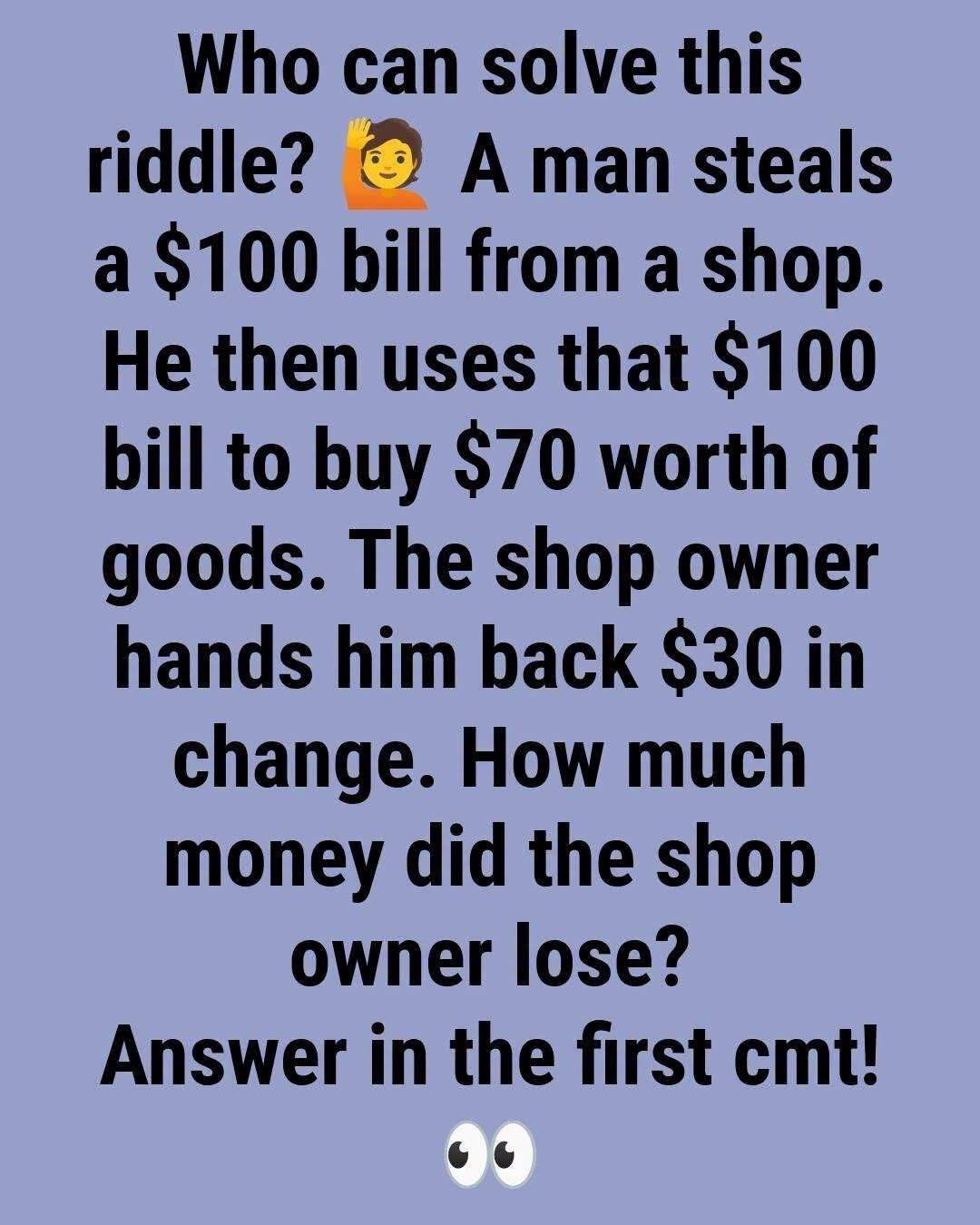
This classic cash-register puzzle looks simple at first, but it often produces several different answers. The confusion comes from following the same $100 bill through multiple steps and accidentally counting it more than once. A careful accounting of what remains with the shop owner and what leaves with the customer reveals the answer clearly.
The Shop Owner Loss Puzzle
Imagine a man enters a shop and takes a $100 bill from the cash register. He later uses that same $100 bill to purchase $70 worth of merchandise. The shop owner accepts the bill, not realizing it is the same cash that was taken earlier, and gives the customer $30 in change.
The question is: how much does the shop owner lose in total?
People commonly answer $170, $200, or $130 because they combine several numbers from the story. However, the correct answer is $100. The shop owner ultimately loses $70 worth of goods and $30 in cash. Those two losses add up to $100.
The key is not to count the original $100 bill twice. It was taken initially, but it later returned to the register during the purchase. Although it was not a legitimate payment from the customer, the bill itself is back in the owner’s possession by the end of the transaction.
The Correct Answer: A Total Loss of $100
At the end of the scenario, the customer leaves with two things that belonged to the shop:
- $70 worth of merchandise
- $30 in cash change
The total value that has left the store is therefore $100. The merchandise represents $70 in retail value under the terms of the puzzle, while the cash change represents another $30. Together, they equal $100.
The original $100 bill does not need to be added as a separate final loss because it is returned to the cash register when the customer makes the purchase. The shop owner has possession of the bill again, even though the transaction was based on money that had originally come from the register.
This conclusion is easiest to see by asking a single practical question: What does the customer have when he leaves, and what does the shop owner no longer have? The answer is $70 in goods and $30 in cash. That is the full loss.
Step-by-Step Breakdown of the Transaction
Breaking the puzzle into stages can make the logic easier to follow. The first stage is the removal of the $100 bill from the register. At that moment, the shop is short $100 in cash.
In the second stage, the customer brings the same $100 bill back and uses it to obtain merchandise. The register receives the $100 bill again. This cancels the earlier cash shortage, at least in terms of physical cash held in the drawer.
However, the shop owner then gives out $30 in change and hands over $70 worth of merchandise. The customer leaves with both. From the shop owner’s perspective, the final position is straightforward: the store has the original $100 bill back, but it has lost $30 in cash and $70 worth of merchandise.
A useful final-balance view looks like this:
- Original $100 bill: returned to the register
- Cash paid out as change: minus $30
- Merchandise handed to the customer: minus $70
- Total value lost: $100
This method focuses on the end result instead of becoming distracted by the number of times the same bill appears in the story.
Why $170 Is Not the Right Answer
A frequent incorrect answer is $170. This usually comes from adding the initial $100 taken from the register to the $70 worth of merchandise. The problem with that calculation is that the $100 bill is later returned to the register. Counting it as a final loss and then also counting the goods effectively treats one event as two separate losses.
It is true that the shop owner temporarily loses the $100 bill. But temporary possession is not the same as the final financial outcome. Once the customer uses that bill for the purchase, the money is back in the till. The lasting losses are the cash change and the merchandise.
Another way to test the $170 answer is to inventory the store at the end. The owner has the $100 bill, so it cannot still be missing. What is missing? The $30 given as change and the $70 in merchandise. Those items have a combined value of $100, not $170.
Why $200 Is Also Incorrect
Some people reach $200 by adding the original $100 bill, the $70 in goods, and the $30 in change. This approach counts every number mentioned in the puzzle, but it does not account for the fact that the initial $100 bill comes back.
The puzzle is designed to test whether a person can distinguish between a movement of money and a final loss of value. The same bill changes hands twice: first it leaves the register, then it returns. Adding it at both stages creates double counting.
In simple accounting terms, a final loss should be measured by comparing the owner’s position before the event with the owner’s position afterward. At the end, the owner is down $100 in total value. The route taken by the $100 bill may be unusual, but it does not change that calculation.
Using Net Loss to Solve Money Puzzles
The most reliable strategy for puzzles involving cash, purchases, change, or mistaken payments is to calculate the net loss. Net loss means the value that is gone after all parts of a transaction have been completed.
Rather than adding every figure mentioned in a word problem, identify the assets that have permanently left the person or business involved. Assets can include cash, products, services, or other items with measurable value. Then identify anything that was returned or received in exchange.
For this shop owner puzzle, the relevant ending assets are easy to identify. The shop retains the $100 bill. The customer retains the $70 in merchandise and $30 in change. Since the store has not received a legitimate additional asset that offsets those items, the net loss is $100.
This approach also helps with everyday financial reasoning. Consumers may use it when comparing refunds and discounts, while small business owners may use it when reviewing inventory differences, customer returns, or cash drawer balances. The details can vary, but the basic principle remains the same: evaluate the final position, not merely the sequence of movements.
The Difference Between Retail Value and Cost
In the standard version of this riddle, the merchandise is described as being worth $70. The intended answer treats that amount as the value lost by the shop owner. In real business accounting, the owner’s direct cost of obtaining inventory may be lower than its retail selling price. A product sold for $70 may have cost the store less to purchase from a supplier.
That distinction is important outside of a puzzle. Businesses track revenue, inventory cost, gross margin, cash flow, and operating expenses separately. A retail transaction can affect each category differently. For example, receiving $70 from a customer is sales revenue, while the cost of the item sold is recorded as an inventory-related expense.
However, the puzzle uses simple stated values rather than a full business ledger. Under its own terms, the merchandise has a value of $70, and that is the figure used in the solution. The educational lesson is about avoiding double counting, not calculating a retailer’s actual profit margin.
A Simple Visual Method for Finding the Answer
Many readers find it helpful to imagine two columns: one for the shop owner and one for the customer. At the conclusion of the scenario, list what each side holds.
The shop owner has the $100 bill in the register. The customer has $30 in cash and $70 worth of goods. Because the customer’s final possessions came from the shop, their total value represents the owner’s loss.
There is no need to include the returned $100 bill in the customer’s final possessions because the customer no longer has it. That is the central detail that resolves the apparent contradiction.
This visual approach is especially useful for students, families, and anyone who prefers concrete examples over formulas. It converts a complicated-looking story into a simple inventory question: what is still present, and what is missing?
Common Lessons From This Brain Teaser
The shop owner loss question remains popular because it highlights several useful reasoning habits. First, it encourages readers to slow down before calculating. Fast arithmetic can produce an incorrect result when the same amount is included more than once.
Second, it demonstrates the value of tracking individual items. The $100 bill is not a new $100 payment entering the scenario; it is the exact bill that had been removed from the register earlier. Following that specific item prevents an error.
Third, the riddle shows why final balances matter. In finance, bookkeeping, and daily decision-making, the end position often provides more useful information than a list of intermediate movements. A person may transfer money between accounts many times, but the net change is what determines whether their overall balance increased or decreased.
Finally, the puzzle is a reminder that word problems often test interpretation as much as arithmetic. The numbers are simple. The challenge lies in recognizing which numbers should be combined and which have already been accounted for.
Final Answer to the Shop Owner Loss Riddle
The shop owner loses $100 in total.
The customer leaves with $70 worth of merchandise and $30 in cash change. The original $100 bill is returned to the cash register during the purchase, so it should not be added again as a separate final loss.
Once the situation is viewed from the final outcome, the answer becomes clear. The store is missing $100 in combined cash and merchandise value. This is why the correct result is $100 rather than $170 or $200.
Sources
Disclaimer: This content is intended for entertainment purposes only and is not based on real events.