Bedroom Puzzle: Can You Find the Hidden Objects?
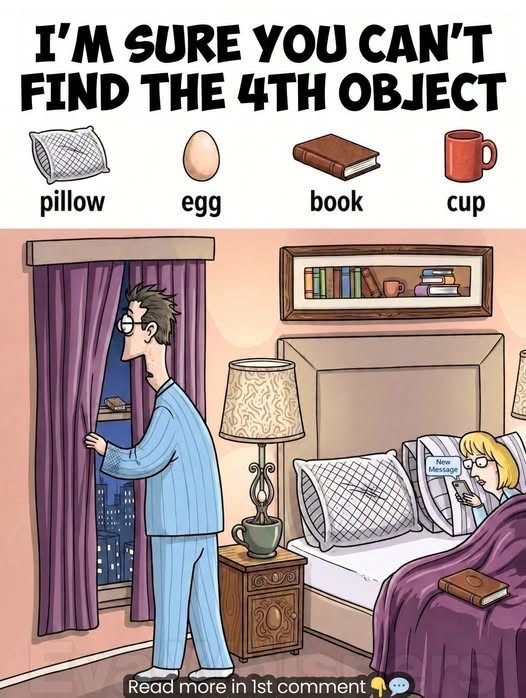
A bedroom-themed visual puzzle may look simple at first: find a pillow, a book, a cup, and an egg. Yet these familiar objects can become surprisingly difficult to identify when they are blended into a busy illustrated scene. A quick glance may reveal the most obvious answers, but the final object often requires a slower, more flexible way of looking.
This type of hidden-object challenge is designed to test visual attention rather than knowledge. The room contains everyday furnishings, bold colors, patterns, shelves, and decorative details. Each of these elements competes for attention. As a result, viewers may initially focus on objects that look exactly like the requested item while overlooking shapes that resemble it more subtly.
The bedroom puzzle is especially interesting because some answers appear relatively clear, while the possible location of the egg is open to interpretation. That uncertainty is part of what makes visual puzzles engaging. They encourage people to compare details, reconsider first impressions, and recognize that more than one visual clue may seem plausible.
Why Bedroom Hidden-Object Puzzles Are So Engaging
Hidden-object puzzles are a familiar form of visual entertainment. They invite players to scan an image for named items, often mixing obvious objects with ones that are camouflaged by color, shape, placement, or surrounding decorations. A bedroom scene is particularly effective for this format because it naturally includes many small household items: bedding, lamps, books, cups, furniture, ornaments, and window displays.
At first, the task seems straightforward. People know what a pillow, book, cup, and egg usually look like. However, the brain does not inspect every portion of a picture with equal attention. Instead, it often prioritizes prominent colors, recognizable outlines, and areas that appear important. This can make a puzzle feel easy until one requested object cannot be found.
When that happens, the challenge shifts. Rather than searching only for a literal representation of the item, a viewer may need to look for an outline, a decorative motif, or an object whose shape resembles the target. In many visual puzzles, the answer is not always a standalone item placed in plain sight. It may be incorporated into an accessory, an ornament, or part of a larger design.
Finding the Pillow in the Bedroom Scene
The pillow is among the more straightforward objects in the scene. Striped pillows placed on the bed provide an immediate match for the requested item. Their position is intuitive because pillows are expected to be near bedding, and their soft rectangular shape is easy to recognize.
This is an example of how context helps guide visual search. When people look for a pillow in an illustrated bedroom, they are likely to begin with the bed. That expectation is usually helpful. It reduces the number of areas that need to be examined and allows the viewer to identify a likely answer quickly.
However, the ease of finding the pillow can also create a false sense of completion. Once several objects have been spotted, it is tempting to assume the remaining item will be equally obvious. The puzzle becomes harder when the final clue does not follow the same familiar pattern.
Where to Look for the Books
Books appear in several parts of the bedroom illustration. They can be seen on the purple blanket, on a wall shelf, and on the windowsill. Because the puzzle asks viewers to find a book rather than identify a single specific title or color, these locations offer clear matches.
The presence of multiple books demonstrates another common feature of visual search games: some target objects are repeated. Repetition can make a puzzle easier, but it can also distract players. After finding one book, a person may continue scanning for another even when the task only requires a single valid example.
In a bedroom setting, books are also naturally distributed across different surfaces. They may be left on a bed, arranged on shelving, or placed near a window for reading. This realistic placement helps the illustration feel coherent while giving puzzle creators multiple opportunities to include the target object.
The Cup Requires a More Careful Comparison
The cup is more complicated than the pillow or book because the scene may contain more than one mug-like object. A green mug appears near the bed, but a red-brown handled mug positioned on the shelf above it may more closely match the reference object in the puzzle.
This distinction matters because hidden-object games often depend on specific visual characteristics. A player may notice an item that belongs to the right category but differs in color, proportions, handle placement, or overall design. When a puzzle provides a reference image, the best approach is to compare the requested object with each possible match instead of accepting the first item that seems broadly similar.
Looking at color can be useful, but color alone is not always decisive. Lighting, illustration style, and surrounding shades may alter how an object appears. Shape and structure can offer stronger clues. For a cup, viewers can examine the body of the mug, the handle, the rim, and whether it resembles the object shown in the puzzle prompt.
The Hidden Egg Is the Most Ambiguous Clue
The egg is the object most likely to cause disagreement. Unlike the pillows, books, and mugs, there may not be a clearly illustrated egg sitting on a visible surface. Instead, possible answers appear to involve decorative oval forms integrated into other items in the room.
One possible candidate is an elongated oval shape in the lamp stand. Another is an oval ornament on the bedside cabinet. Both forms may suggest an egg-like outline, but neither can be confirmed as the definitive answer without an official solution from the original puzzle publisher.
This ambiguity should be treated carefully. It would be misleading to state that one decorative detail is unquestionably the hidden egg when the image can reasonably support more than one interpretation. The more accurate conclusion is that the puzzle appears to rely on shape recognition. The egg may be represented as an oval decorative element rather than as a conventional egg with a distinct shell, color, or setting.
For viewers still searching, it helps to stop looking only for an object that would normally be found in a kitchen or on a plate. Instead, inspect rounded features in furniture, lighting, ornaments, and patterns. A hidden-object puzzle can use visual resemblance as its central clue.
How Visual Attention Affects Puzzle Solving
The difficulty of this bedroom puzzle reflects well-established features of human visual attention. People do not process every detail in a complex scene at the same time. Attention is selective: it is influenced by goals, expectations, contrast, movement, color, and familiarity.
When someone is told to find an egg, their mind may automatically picture a familiar egg shape in a typical context. That expectation can speed up recognition if the egg is drawn plainly. But if the intended answer is hidden in a lamp, cabinet, or decorative feature, the same expectation can make the answer harder to see.
This is sometimes described as a form of perceptual set. In simple terms, what people expect to find influences what they notice. A person looking for a literal egg may pass over an oval ornament because it is categorized as part of the furniture rather than as a potential puzzle answer.
Changing the search strategy can help. Instead of asking, “Where is the egg?” try asking, “Where are the oval shapes?” This small adjustment broadens the search and makes it easier to notice details that were initially treated as background decoration.
Practical Tips for Solving Hidden-Object Challenges
Whether a visual puzzle is designed for entertainment, classroom activity, or a social media challenge, a few simple methods can make the search more systematic.
- Start with the reference object. Notice its main features, including shape, color, and distinctive details.
- Search in sections. Scan from left to right or from top to bottom instead of moving randomly around the image.
- Use context first. Look for a pillow near the bed or books near shelves before examining less likely areas.
- Check for duplicates. More than one similar object may be present, so compare potential answers carefully.
- Look for silhouettes. If an item is difficult to find, focus on its outline rather than its usual color or function.
- Take a short break. Looking away briefly can make it easier to spot a missed detail when returning to the image.
- Allow for ambiguity. Some illustrated puzzles are not designed with a single perfectly unambiguous answer.
Why Different Viewers May Reach Different Answers
Disagreement about the hidden egg does not necessarily mean that one viewer is inattentive. Different people may focus on different parts of the image, interpret decorative shapes differently, or use different standards for what counts as a match. One person may prioritize the object’s outline, while another may expect a more literal depiction.
Illustrated puzzles can also vary in precision. Some are created with a clearly marked intended answer, while others are shared online without an official explanation or with low-resolution images that make small details difficult to assess. In those cases, it is reasonable to describe likely possibilities rather than present speculation as fact.
Discussing alternative answers can be part of the enjoyment. A puzzle becomes a shared observation exercise, encouraging viewers to explain why a particular object seems to match the clue. The key is to distinguish between an official solution and a plausible interpretation.
A Reminder to Look Beyond the Obvious
The main lesson from this bedroom visual puzzle is not simply where the pillow, book, cup, or egg may be located. It is that perception is shaped by expectation. The most obvious answer may be correct for some clues, but the most difficult clue can require a different perspective.
The striped pillows on the bed and the books around the room are easy starting points. The cup requires closer comparison between similar mugs. The egg appears to demand the greatest flexibility, with oval decorative details offering possible matches rather than an immediately recognizable object.
That is what makes a seemingly innocent bedroom puzzle memorable. It turns a familiar room into an exercise in attention, comparison, and interpretation. Before deciding that every object has been found, take another look at the details that initially seemed unimportant. The answer may be hidden in something that first appeared to be only decoration.

Sources
- National Eye Institute — Information on how vision and the visual system process what people see.
- American Psychological Association — Educational reporting on attention and the limits of human focus.
- National Institute of Neurological Disorders and Stroke — Background information on visual processing.
Disclaimer: This content is intended for entertainment purposes only and is not based on real events.