I Only Went Grocery Shopping for My Recovering Mother
Editor’s note: The following is a fictional, values-based narrative. It is presented as a story rather than a report of verified events. Broader information about food insecurity and community food assistance is supported by the official sources listed below.
I only intended to make a routine grocery trip for my recovering mother. Instead, I found myself thinking more deeply about food affordability, the dignity of people who need assistance, and the responsibility that individuals and businesses can have toward their communities.
My name is Rachel, and I am 38 years old. I work as an event planner, although my professional life had changed significantly after my mother underwent surgery. Before then, I organized corporate galas, fundraisers, and large private events. After her operation, I chose to take on fewer contracts and focus more of my time on supporting her recovery at home.
My mother did not want to feel like a burden. She regularly encouraged me to return to a fuller workload, reminding me that I had worked hard to build my career. Yet caregiving often requires families to make difficult adjustments. A person recovering from surgery may need help with meals, transportation, medication schedules, household tasks, and emotional support. These responsibilities can be demanding, particularly when they arrive alongside reduced income or uncertainty about future work.
That morning, my mother gave me a short grocery list. It included soup ingredients, vegetables, bread, fruit, and a turkey that was being offered at a reduced price. As I looked at the list, she spoke about the years when our family had to plan every purchase carefully. We had known what it meant to compare prices, postpone nonessential expenses, and make a small amount of food stretch across several meals.
Her words stayed with me as I drove to the supermarket.
A Grocery Store Encounter and the Meaning of Food Dignity
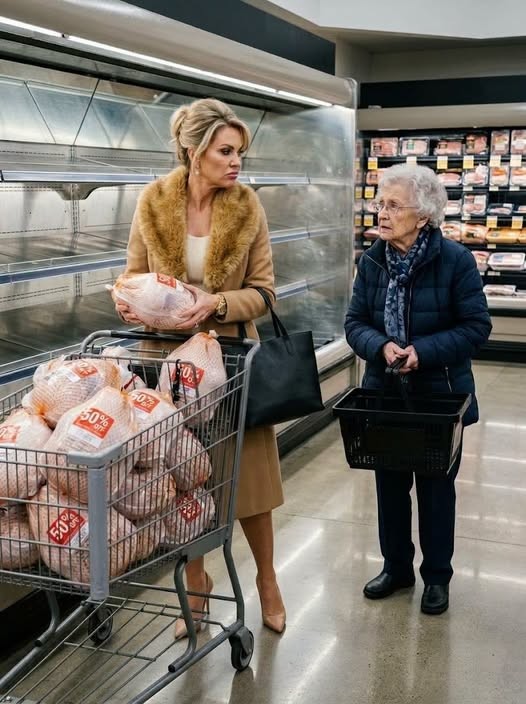
At the supermarket, a holiday promotion had drawn a large crowd. A limited number of discounted turkeys were available, and shoppers gathered around the refrigerated section. While waiting, I noticed an older woman speaking quietly with another customer, whom I will call Beatrice.
The older woman explained that she hoped to buy one turkey to make meals for her grandson, who was unwell. Beatrice’s cart already contained numerous discounted turkeys. In the fictional scene, Beatrice refused to set one aside and spoke dismissively about the woman’s situation.
It was an uncomfortable moment. Public conversations about money, illness, and food needs can be deeply personal. For people facing hardship, asking for help may already feel difficult. A harsh response can make that experience more isolating.
I intervened because the interaction seemed unfair. My frustration was not only about a single discounted item. It was about the idea that a person’s worth could be measured by what they could afford at a checkout counter. Financial pressure does not reduce someone’s right to courtesy, privacy, or respect.
Food insecurity is a real and widely documented issue in many countries. It does not always look the way people expect. Families experiencing food insecurity may be employed, caring for relatives, managing medical bills, living on fixed incomes, or coping with sudden changes in housing and work. Older adults, children, people with disabilities, and caregivers can face particular challenges when food costs rise faster than household resources.
Organizations such as the U.S. Department of Agriculture and the World Food Programme have documented how economic conditions, inflation, conflict, climate events, public health emergencies, and disruptions to supply chains can affect access to nutritious food. Local circumstances vary, but the basic principle is universal: reliable access to safe, affordable, and nutritious food is essential to health and human dignity.
Why Affordable Food Access Matters for Families
The fictional disagreement over a discounted turkey highlights a practical issue: promotions and reduced-price items can matter greatly to households with tight budgets. A discounted staple can become several meals. Poultry, beans, eggs, lentils, vegetables, whole grains, and other nutritious foods may help families prepare balanced meals, depending on dietary needs, cultural preferences, and local availability.
For caregivers, grocery planning often involves more than choosing the lowest price. They may need to account for a loved one’s recovery, food allergies, mobility limitations, prescribed diets, or the time needed to prepare meals. When someone is recovering from surgery or illness, family members should follow guidance from qualified health professionals about nutrition, medication interactions, food safety, and any individual dietary restrictions.
Food assistance programs can help bridge difficult periods. Community pantries, school meal programs, senior meal services, faith-based groups, mutual-aid networks, and government nutrition programs all play different roles. Their success depends not only on donations but also on respectful operations. Assistance should be organized in ways that protect privacy, reduce stigma, and give people meaningful choices whenever possible.
In practical terms, a welcoming food assistance program may offer clear information about hours and eligibility, provide culturally appropriate options, make facilities accessible, and connect visitors with other services such as housing support, employment resources, or healthcare navigation. These measures recognize that food insecurity is often connected to larger financial and social pressures.
A Fictional Turning Point: From Conflict to Community Service
In this story, the supermarket owner, Walter, arrives after hearing about the dispute. He is also Beatrice’s father-in-law. Rather than treating the scene as a private family embarrassment, he focuses on the larger issue: how the available food could serve people in the community.
Walter decides that the turkeys in Beatrice’s cart should be redirected to a community food pantry. He also questions whether charitable leadership should be based on family status or social standing. The fictional scenario presents a useful idea: charitable organizations are most credible when their leaders demonstrate accountability, humility, and a real understanding of the people they aim to serve.
Philanthropy can fund important work, but effective community support requires more than a donation or a public event. It benefits from listening to local organizations, consulting people with lived experience, measuring outcomes, and sustaining support beyond a single holiday season. Food needs do not disappear after a seasonal campaign ends.
Walter asks me to help organize a charity banquet, drawing on my experience as an event planner. At first, the guests expect a conventional evening of formal dining and speeches. Instead, the event becomes a volunteer service project. Guests assemble grocery packages, prepare appropriate meal supplies, and learn about local food-access initiatives.
This approach changes the purpose of the gathering. Rather than positioning community members in need as distant recipients of generosity, it asks people with resources to contribute time, attention, and practical effort. Volunteering cannot replace long-term policy solutions or stable funding, but it can build awareness and create stronger local connections.
Respect Is Essential in Food Assistance Programs
During the fictional banquet, the older woman from the supermarket, Margaret, speaks to the guests. Her message is simple: needing help does not make a person less deserving of respect.
That principle is central to effective food assistance. Individuals may seek support because of a temporary setback, a health emergency, job loss, caregiving duties, high housing costs, or a longer-term financial challenge. Their circumstances are not a moral failing. Communities are stronger when they respond with practical help and without humiliation.
Experts and service organizations often emphasize the importance of treating participants as partners rather than stereotypes. This can mean asking what foods are useful, offering accessible pickup times, respecting dietary practices, and avoiding assumptions about why someone needs assistance. It can also mean recognizing that people who receive help today may volunteer, donate, or support others when their circumstances improve.
The story’s shift from a tense supermarket scene to a shared service project is not meant to suggest that every social problem can be solved through one emotional encounter. Food insecurity is complex. It requires coordinated action by governments, nonprofit organizations, food producers, retailers, schools, health systems, and local residents. Still, individual interactions matter. Courtesy can preserve dignity, while indifference can deepen hardship.
Building a Community Food Assistance Program
After the event, Walter offers Rachel the opportunity to develop a community food assistance program. In the fictional narrative, the program eventually supports more than 100 families each week. While that number belongs to the story, real-world food programs often depend on careful planning and partnerships.
A sustainable local food initiative may begin by working with established food banks and public agencies rather than duplicating existing services. Leaders can assess neighborhood needs, identify transportation barriers, review storage requirements, and create clear food-safety procedures. Perishable products need reliable refrigeration, while shelf-stable goods require organized inventory management.
Programs also benefit from a diverse supply of food. Donations of canned goods are valuable, but fresh produce, proteins, infant supplies, and culturally familiar staples may be equally important. Partnerships with grocery stores, farms, restaurants, and wholesalers can sometimes reduce food waste while helping distribute usable items to people who need them. Such arrangements should follow local health regulations and food-safety standards.
Volunteers are essential, but dependable service also requires training. Volunteers should understand respectful communication, confidentiality, accessibility, food handling, and referral procedures. A person visiting a pantry should not have to explain their circumstances repeatedly or feel judged for requesting support.
Data can also improve services when collected ethically. Programs may track the number of households served, food categories distributed, peak-demand periods, and unmet needs. However, personal information should be protected, and data collection should never create unnecessary barriers for people seeking basic assistance.
Personal Accountability and the Possibility of Change
Beatrice’s fictional character represents someone who has been insulated from the consequences of financial hardship. Walter stops covering her expenses without accountability and encourages her to participate directly in community work. This is not portrayed as punishment alone. It is an opportunity to develop perspective through consistent service.
Several weeks later, Beatrice arrives at the food program in jeans and sneakers, prepared to volunteer. Rachel gives her an apron and directs her to the supplies. “Let’s start with the turkeys,” she says. This time, Beatrice does not argue.
The ending does not claim that a single volunteer shift transforms a person completely. Meaningful change is usually gradual and demonstrated through repeated action. But it suggests that empathy can be learned when people are willing to listen, participate, and recognize the realities faced by others.
Lessons About Grocery Affordability, Compassion, and Community
The central lesson of this fictional grocery store story is not about one turkey or one argument. It is about how communities respond when people need help. Food affordability is a public concern with consequences for health, education, family stability, and social participation. Community food programs are most effective when they offer practical support alongside respect.
Individuals who want to help can begin locally. They can donate food or funds to established organizations, volunteer their professional skills, advocate for accessible nutrition programs, support fair workplace policies, and treat neighbors with dignity. Before donating items, it is often helpful to ask local food organizations what they need most. Financial contributions may allow them to purchase food efficiently, while specific supplies may be needed during seasonal or emergency periods.
For families seeking assistance, local food banks, municipal social services, healthcare providers, schools, and nonprofit directories may be able to identify available programs. Asking for help is not a failure. It is a practical step during a difficult time, and communities function best when people can access support without shame.
Sources
Disclaimer: This content is intended for entertainment purposes only and is not based on real events.