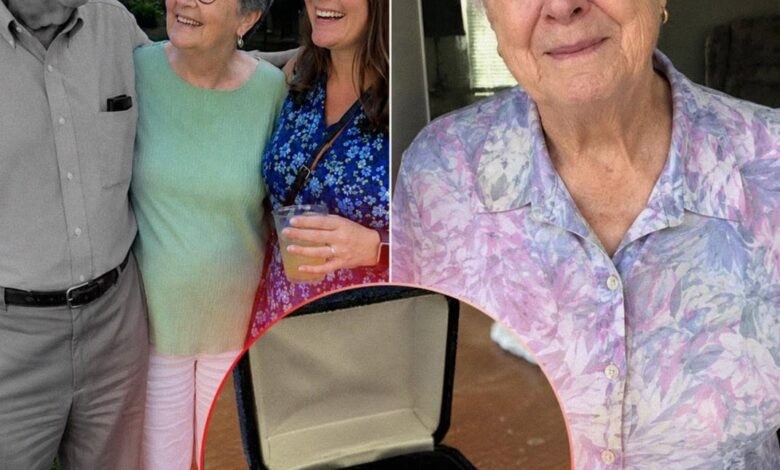
After My Father Died, I Found a Wedding Ring in His Safe-Deposit Box—and Uncovered a Secret He Had Kept for 40 Years
Some secrets remain hidden for so long that they begin to look like ordinary parts of a person’s life. But sometimes, after someone dies, a forgotten letter or an old keepsake can reveal a side of them that their own family never knew existed.
When my 82-year-old father passed away, I expected to find the usual remnants of a carefully organized life: old documents, war medals, perhaps a few pieces of jewelry he had kept for sentimental reasons. What I never expected was a worn gold wedding ring, a mysterious handwritten note, and a story that would change the way I remembered him forever.
For decades, my father had carried a burden that no one in our family fully understood. And the truth waiting inside that small bank box would lead me to a woman whose life had been shaped by an old business failure, a broken promise, and a mistake that had never truly been put to rest.
A Quiet Man Who Never Spoke About His Past
My father was a man of routine. He labeled electrical cords, saved spare screws in old coffee tins, and paid his bills with almost religious consistency. He believed in being prepared, keeping his affairs in order, and avoiding unnecessary complications.
Emotional conversations were not his strength. He rarely spoke openly about his feelings, and he preferred practical solutions to long discussions about the past.
That was why the bank’s call initially seemed so ordinary.
An employee informed me that my father had maintained a safe-deposit box since 1978 and that I was listed as its beneficiary. I assumed it contained documents or valuables that he had simply forgotten to mention.
When I finally opened the box, however, I found a small velvet pouch tucked among the papers.
Inside lay a thin gold wedding ring. It showed obvious signs of age, and a small nick near the stone suggested that it had been worn for many years.
Beside it was a handwritten note containing just six words:
“Return this to Sarah. I’ve waited too long.”
I read the sentence several times, hoping that some detail would make the meaning clearer. It did not.
Who was Sarah? Why had my father kept her wedding ring for so many years? And what had he been waiting for?
The questions followed me home.
My Mother’s Reaction Raised More Questions
I showed the ring to my mother, expecting her to recognize it immediately or at least offer an explanation.
Instead, she went unusually quiet.
When I asked whether she knew anyone named Sarah, she said she did not. Her answer was brief, but something about her reaction unsettled me. She seemed to be choosing her words carefully, as though the subject had touched a painful memory she had spent years avoiding.
My parents had been married for decades. They were not an overly demonstrative couple, but they had built a stable life together through hard work, careful spending, and a shared commitment to their family.
I had always believed I understood the foundations of their marriage.
Now I wondered whether my father had kept an entire chapter of his life separate from the people closest to him.
I did not want to accuse him of anything without evidence. He was no longer alive to answer my questions, and grief had already made every memory feel more complicated.
Still, I could not ignore the note.
I decided to look through his old financial records.
Four Decades of Payments Revealed a Hidden Responsibility
My parents had maintained separate bank accounts since the early years of their marriage. At the time, I had regarded this arrangement as another example of their practical approach to money.
Now it gave me a place to begin.
As I examined the records, I noticed a pattern of recurring payments stretching back many years. The amounts and methods varied, and some transactions passed through different accounts or were made using cashier’s checks.
The records did not immediately explain who had received the money or why. But the consistency suggested that these were not random transactions.
Someone had been receiving financial assistance for a very long time.
Eventually, an old business tax document provided a possible connection. The name Sarah appeared alongside information related to a small business from the late 1970s. The paperwork also referred to an apartment above a hardware store that had long since closed.
For the first time, I had a lead that connected the ring, the note, and the payments.
I began searching for Sarah.
A week later, I found myself standing outside a modest white house in a quiet neighborhood.
I had rehearsed several ways to introduce myself during the drive. None of them seemed appropriate when an elderly woman opened the door.
When I showed her the gold ring, her expression changed instantly.
She turned pale and lowered herself onto the doorstep, visibly shaken.
I told her that my father had died and explained how I had found the ring.
For a few moments, she said nothing.
Then she looked at me and spoke a sentence I had not expected.
“I promised never to explain unless he came himself.”
Sarah Finally Explained What Had Happened in the 1970s
Sarah’s story was not what I had imagined.
There was no dramatic revelation of a secret romance, no hidden second family, and no evidence that the ring represented an affair. Instead, she described a business failure that had devastated her life and left my father carrying a sense of responsibility for decades.
In the late 1970s, my father had entered a business partnership with a man named Tom. Tom was persuasive, confident, and skilled at making risky ventures sound like guaranteed successes.
My father, who believed that honest work and a firm handshake were the foundations of a good business, trusted him.
That trust would prove costly.
According to Sarah’s account, my father signed numerous documents without fully understanding the obligations they created. Tom made increasingly risky financial decisions, using business assets and the apartment above the hardware store as security.
When the venture collapsed, the consequences extended far beyond the failed business.
Sarah lost the property and much of the stability she had worked to build. Tom disappeared, leaving behind financial problems and unanswered questions. My father was left facing obligations he could not easily escape.
The most painful part, Sarah explained, was that he believed he should have recognized what was happening sooner.
He had not set out to ruin anyone’s life. But by trusting the wrong person and failing to examine the documents carefully, he had become part of a chain of decisions that caused serious harm.
For my father, that distinction did not make the guilt disappear.
The Wedding Ring Was a Reminder of a Promise
Sarah then explained the meaning of the ring.
On the night the hardware store closed, she had handed it to my father. Her life had been turned upside down, and she wanted him to understand the depth of what had been lost.
She told him to keep the ring until he could return the life that had been taken from her.
It was a statement made in the midst of heartbreak, not a practical agreement that could easily be fulfilled.
But my father had never been good at letting go of unfinished responsibilities.
He kept the ring.
Over the years, he continued sending money to Sarah, apparently treating the payments as a personal obligation that remained unpaid no matter how much time passed. The financial assistance could not restore everything she had lost, but it gave him a way to do something when he could not undo the past.
His actions did not erase the original damage, and they could not guarantee that Sarah felt fully compensated. Yet the payments revealed a side of him I had never seen: a man who had spent much of his life trying to make amends for a mistake he believed he should have prevented.
I began to understand why the note had been so short.
“Return this to Sarah. I’ve waited too long.”
Perhaps my father had finally accepted that the ring belonged with the woman whose life it represented. Perhaps he had wanted someone else to finish what he had been unable to complete.
Whatever his intention, the message had brought me to Sarah’s door.
But one question remained.
What had happened to Tom?
Finding the Man Who Had Disappeared
Tracking down Tom took time.
Eventually, I located him in a modest senior apartment several towns away. The confident businessman Sarah had described belonged to a distant past. The man I encountered was older, quieter, and apparently living with the consequences of choices he had made decades earlier.
When I confronted him about the failed business, he did not deny his involvement.
He admitted that shame had kept him away from Sarah and from the people who had suffered because of his decisions. He had allowed the years to pass, perhaps believing that silence would make the past less painful or that there was no point in returning once so much damage had been done.
But time had not erased the consequences.
I asked him to meet Sarah.
Two days later, I drove her to see him.
I could not know what either of them expected from the encounter. After so many years, no apology could restore the life Sarah had once known, and no conversation could return the lost decades.
When they finally stood in the same room, the atmosphere was heavy with memories that had remained unresolved for far too long.
Tom apologized.
His words could not undo what had happened, and Sarah did not suddenly receive everything she had lost. Yet the conversation gave both of them an opportunity to face a past that had remained unfinished.
For the first time, the people connected to the collapse of the old business were speaking openly about it.
Sometimes, the truth arrives too late to repair the damage. But it can still offer a measure of understanding that years of silence never could.
Sarah Asked Me to Stop the Payments
After the meeting, I expected Sarah to ask about the money my father had been sending her.
Instead, she made a different request.
She wanted the payments to stop.
She had spent years living with the consequences of the failed business, and she no longer wanted her life to revolve around the debt my father believed he owed her. She did not want his children to inherit that burden, either.
Then she told me what she wanted to do instead.
The old hardware store had once been a central part of her life. Its sign had disappeared after the business closed, leaving little behind to mark what had existed there.
Sarah wanted the original sign restored and displayed one last time.
For her, the sign represented more than a business. It was a reminder of the life she had built, the plans she had made, and the painful moment when everything changed.
Restoring it would not bring back the past. But it would allow her to remember that period of her life without allowing it to define everything that came afterward.
A month later, the old business name shone once again beneath the morning sun.
It was a small gesture compared with everything Sarah had lost. Yet it marked a change in the way she could carry those memories.
The ring had finally been returned. The truth had been spoken. And a promise that had weighed on my father for decades no longer needed to be passed down to the next generation.
My Mother’s Words Changed How I Remembered My Father
When I returned home, I told my mother everything.
I explained what I had discovered in the safe-deposit box, what Sarah had told me, and how the old business had collapsed. I told her about the payments and the meeting with Tom.
My mother listened quietly.
I had worried that the discovery would make her feel betrayed or cause her to question the life she had shared with my father. Instead, she responded with a calmness that surprised me.
She did not excuse his mistakes, nor did she pretend that the past had been simple.
She reminded me that my father had lived a life before their marriage, one that included decisions, failures, and experiences she could not have known about. His past did not automatically cancel the years of love and commitment they had shared.
“He was allowed to have done harm before he met me,” she said, “and he loved me through it all.”
Her words stayed with me.
I had spent weeks trying to fit my father into one of two categories: the dependable man I thought I knew or the stranger who had hidden a painful secret for forty years.
My mother helped me see that neither description told the whole story.
People can make serious mistakes and still spend years trying to take responsibility for them. They can love their families while carrying regrets they struggle to explain. And they can do good things without ever becoming entirely free of the harm they once caused.
My father had not been perfect.
But the discovery of his secret did not erase every good memory I had of him. Instead, it added another layer to the person I was still learning to understand, even after his death.
What a Forgotten Wedding Ring Taught Me About Regret
I had opened the safe-deposit box expecting to find objects that explained my father’s practical life. Instead, I found a reminder that the most important parts of a person are not always visible to their family.
For forty years, a gold wedding ring had connected my father to a painful chapter of the past. The yearly payments suggested that he had never entirely stopped thinking about what happened to Sarah. Whether he saw the money as restitution, an apology, or a way of easing his own conscience, the responsibility had remained with him long after the business disappeared.
His actions could not reverse history. They could not give Sarah back the years she had lost or make the original decisions disappear.
But they showed that he had not simply forgotten.
Returning the ring gave Sarah the opportunity to decide what came next. It also allowed my family to stop carrying a mystery that had never been ours to solve in the first place.
I still wish my father had told me the truth while he was alive. I wish he had trusted someone enough to explain the burden he carried, rather than leaving a few cryptic words for his family to decipher after his death.
Yet I understand now that some people struggle to speak about their failures. They try to repair what they can through quiet actions, hoping that one day the people they hurt will understand.
My father left behind a secret, but he also left behind a lesson I will not forget: a mistake can shape a person’s life, but what they choose to do afterward matters, too.
The ring was never just a piece of gold. It was a symbol of a promise that had remained unfinished for far too long.
And when it finally returned to Sarah, I discovered that understanding someone does not require believing they were always right. Sometimes, it simply means accepting that the people we love are complicated, imperfect, and capable of carrying regrets we may never fully see.
Editorial note: This article is based on the narrative provided. The people, events, financial records, and historical details have not been independently verified.