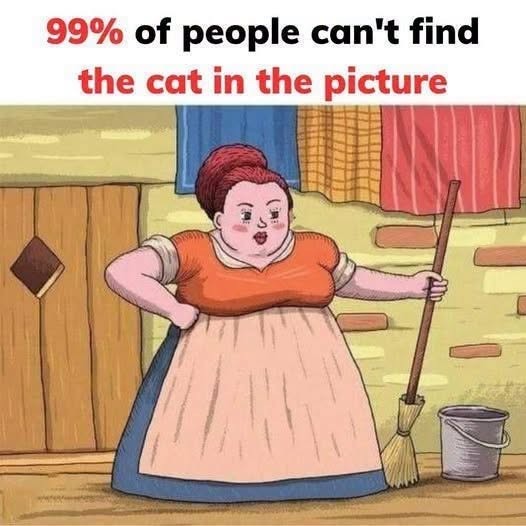
That tiny red circle can make you question everything you see
Introduction: The Mystery of Hidden-Picture Puzzles
Hidden-picture puzzles have captivated audiences for generations, blending fun with the perplexity of visual illusions. A seemingly simple image, often marked by a tiny red circle, can spark a wave of curiosity—sometimes escalating into frustration—when the concealed solution is hard to discern. This phenomenon raises questions about how we perceive our surroundings, trust our senses, and respond to ambiguity.
The Challenge of Visual Perception and Pattern Recognition
Our brains are wired to recognize patterns, a feature integral to survival and social interaction. When confronted by hidden-picture puzzles, the challenge is to locate familiar shapes or objects, such as a cat, camouflaged within a complex background. Despite careful scrutiny of shadows, lines, and patches of color, the answer may remain elusive. This difficulty is not a reflection of one’s abilities, but rather highlights the limits of human perception.
According to cognitive psychologists, our expectations play a pivotal role in shaping what we see. When the outline of the sought-after object blends seamlessly into its environment, our pattern recognition filters may overlook shapes that do not conform to pre-existing mental templates. Staring harder or zooming in rarely improves our odds, as these efforts often reinforce our initial, biased expectations rather than open us to novel visual possibilities.
The Role of Ambiguity and the Influence of Social Pressure
Hidden-picture puzzles like the “spot the cat” often create a unique social dynamic. When everyone insists the answer is obvious, the pressure mounts. The tiny red circle, intended as a guide, can instead amplify the sense of urgency and doubt. As you search with increasing desperation, the inability to identify the solution may trigger self-reflection and challenge your belief in your own observation skills.
This social aspect is well-documented within the field of psychology. People tend to conform to group opinions, sometimes doubting their own perceptions when others disagree. The notorious “Asch conformity experiments” demonstrated that many individuals would choose incorrect answers just to align with the majority. In the context of hidden-picture puzzles, this conformity pressure can turn a recreational activity into a test of confidence and resilience.
Hidden-Picture Design: The Balance Between Fun and Frustration
The effectiveness of any hidden-picture puzzle depends largely on its design. A well-designed puzzle offers a balance between challenge and clarity. If the solution is genuinely impossible to spot, frustration supersedes fun. Some puzzles may lack clear presentation, and the promised answer might not be as obvious as claimed, leaving the audience at odds with the creator’s intent.
Game designers and visual artists often aim to strike a balance by providing subtle yet discernible clues. The red circle, for instance, can serve as a helpful pointer or, conversely, mislead those who interpret its placement too rigidly. Not all puzzles achieve this equilibrium, resulting in mixed experiences and reactions among users.
The Complexities of Visual Illusions
Visual illusions, including hidden-picture puzzles, exploit the limitations and quirks of the human visual system. Our brains often make educated guesses, filling in missing information and interpreting ambiguous shapes based on context and previous experiences. Studies in neuroscience reveal that the visual cortex processes information in stages, from basic color and motion detection to pattern recognition and object identification.
This layered processing sometimes leads to “blind spots”—areas within an image that the eye fails to register as meaningful until prompted appropriately. These blind spots explain why sometimes, even after multiple attempts, the hidden cat remains invisible. The interplay between bottom-up sensory input and top-down cognitive expectations often determines whether the object finally “pops” into view or remains hidden indefinitely.
Why Doubt Arises: Psychological Impacts of Not Seeing What Others See
Failing to spot the answer in a hidden-picture puzzle is not merely a matter of vision—it involves a cascade of psychological responses. Self-doubt can emerge when others claim the solution is easy and obvious. This phenomenon has broader implications, touching on how individuals handle uncertainty and group dynamics in other areas of life.
Psychologists suggest that the feeling of “missing something” often triggers introspection and, in some cases, anxiety. However, this response is not entirely negative. It can foster humility and a willingness to question one’s assumptions, which are valuable traits in problem-solving and lifelong learning. When faced with ambiguity, stepping back, taking a breath, and approaching the issue freshly can be the wisest course.
Lessons from the Hidden Cat Puzzle
The hidden cat puzzle teaches us more than just observational skill—it invites reflection on the nature of perception, the influence of social pressures, and the importance of resisting unwarranted self-doubt. The main lesson is not about finding a concealed animal, but about maintaining confidence even when others claim a solution is evident.
In a world saturated with information, visual puzzles serve as reminders that ambiguity is part of life. The challenge to spot a hidden cat, or any object, mirrors larger questions about how we evaluate evidence, trust our senses, and engage with group opinions. Admitting “I don’t see it” is not a failure—it is an honest acknowledgment of the limits of perception, which can foster growth and resilience.
Expert Views on Perception and Confidence
Vision scientists and cognitive psychologists have studied hidden-picture puzzles and visual illusions extensively. Dr. Richard Gregory, a renowned expert in perception, argued that seeing is an active process, shaped by both incoming data and our internal expectations. He noted that visual ambiguity is a tool for understanding how the brain constructs reality from incomplete information.
Leading institutions such as the Mayo Clinic encourage individuals to be mindful of their sensory limitations and to seek professional evaluation if persistent vision issues arise. However, in the context of games and puzzles, struggling to find a hidden image is entirely normal, reflecting the diverse capabilities of human cognition.
Global Appeal and Societal Reactions
The appeal of hidden-picture puzzles spans cultures and generations. From ancient “find the object” motifs in art to modern brain teasers shared across social media, these challenges captivate diverse audiences. Online platforms often host debates and discussions when a popular puzzle stumps many users, reinforcing the social aspect discussed earlier.
Teachers incorporate such puzzles into educational curricula to strengthen visual literacy and critical thinking. Meanwhile, mental health advocates appreciate puzzles for their potential to foster mindfulness and relaxation, provided frustration does not escalate.
Conclusion: Embracing Ambiguity and Self-Trust
The tiny red circle represents more than a simple clue—it embodies the tension between expectation, perception, and reality. Hidden-picture puzzles challenge us to trust our own eyes, handle ambiguity, and resist self-doubt fueled by group pressure. In a broader sense, these puzzles remind us that the quest for clarity is ongoing, and that confidence grows not from always having the answer, but from learning to accept uncertainty.
Next time a hidden cat defies detection, remember that stepping back and admitting “I still don’t see it” is not only acceptable—it is often the wisest response.
Disclaimer: This content is intended for entertainment purposes only and is not based on real events.