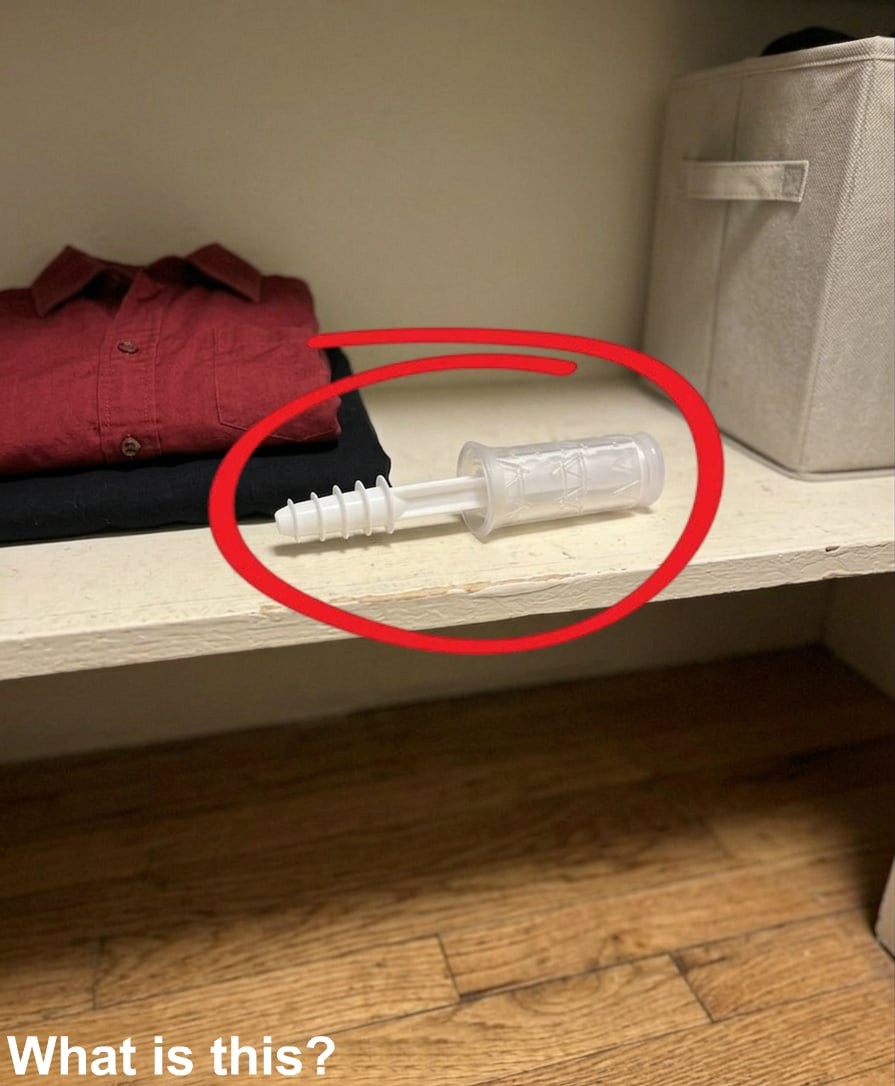
Sometimes, the smallest discoveries can lead to the biggest misunderstandings. An unfamiliar object tucked away in a closet, an unusual shape on a shelf, or something hidden among everyday household supplies can spark a thousand questions before we understand what we are actually looking at.
That was exactly what happened in this curious story. At first, the object seemed strange enough to raise suspicions. Its shape was unfamiliar, its purpose was unclear, and its unexpected location made it seem more mysterious than it really was.
For a brief moment, imagination filled the gaps left by missing information. Ordinary memories began to look different, and innocent details suddenly seemed to suggest something more complicated.
But the truth turned out to be surprisingly simple. The mysterious item was an applicator nozzle designed for silicone sealant, a common tool used in home improvement and repair projects.
What began as a moment of uncertainty became a valuable reminder about human psychology, everyday objects, and the importance of understanding a situation before reaching conclusions.
H2: When an Ordinary Object Looks Unfamiliar
Most people are familiar with the feeling of finding something they cannot immediately identify.
Perhaps it is an unfamiliar attachment inside a toolbox, a small plastic component tucked behind cleaning supplies, or a strangely shaped accessory left over from a home renovation project.
Without context, even an ordinary object can look unusual.
In this story, the item’s unfamiliar appearance encouraged the imagination to take over. Instead of recognizing it as a practical household accessory, the observer began considering possibilities that had little connection to its actual purpose.
This reaction is understandable. The human brain constantly tries to interpret unfamiliar information by comparing it with existing memories and experiences.
When the available evidence is incomplete, the mind may generate several explanations, including possibilities that are unlikely or inaccurate.
The challenge is that an explanation can feel convincing even before it has been verified.
H2: What Is a Silicone Sealant Applicator Nozzle?
The mysterious object was an applicator nozzle used with silicone sealant.
Silicone sealant is a flexible material commonly used to seal gaps and joints around household fixtures. It can help prevent water from entering spaces around sinks, bathtubs, showers, windows, and other surfaces.
Sealant is frequently supplied in cartridges that fit into a caulking gun. A nozzle attaches to the cartridge and directs the material toward the area being sealed.
Depending on the design, the nozzle may be long, narrow, tapered, or made from durable plastic.
These features help users apply the material more precisely, especially when working in narrow gaps or along edges.
Because different repair tasks require different levels of precision, some nozzles can be trimmed to adjust the opening size. Others are designed for particular cartridge systems or application requirements.
For someone who regularly performs home repairs, such an accessory is perfectly ordinary. For someone unfamiliar with construction tools, however, its shape may be difficult to recognize.
That difference in experience can explain why the object initially appeared so mysterious.
H2: Why the Human Brain Sometimes Jumps to Conclusions
The story also illustrates a well-known psychological tendency: people often try to make sense of uncertainty as quickly as possible.
When information is missing, the brain uses previous experiences, expectations, and emotional reactions to construct a possible explanation.
Psychologists often discuss this process in relation to cognitive biases.
One relevant example is confirmation bias, which occurs when people pay greater attention to information that appears to support an existing belief while overlooking evidence that challenges it.
In an emotionally charged situation, a person who already feels uncertain may interpret an unfamiliar discovery through that uncertainty.
An ordinary object can then seem like evidence for a much larger story, even when no meaningful connection exists.
This does not mean that people are irrational by nature. It reflects the fact that human thinking relies on mental shortcuts, which are useful in many situations but can sometimes produce mistakes.
The practical lesson is simple: an initial impression is not necessarily an accurate conclusion.
H2: How Curiosity Helped Reveal the Truth
The turning point came when the observer decided to search for information.
Rather than relying entirely on imagination, they used a phone to investigate the object’s appearance and possible purpose.
The answer was straightforward: it was a silicone sealant applicator nozzle.
This small discovery changed the entire interpretation of the situation.
The object had not suddenly become different. Its physical features remained exactly the same. What changed was the information available to the person examining it.
This is one of the most useful aspects of curiosity. Asking questions and looking for evidence can help replace speculation with understanding.
Modern search engines and visual search tools make this process particularly accessible. A photograph, a description of an item’s shape, or a few identifying words may be enough to locate a similar product.
Of course, online search results are not always accurate, so important conclusions should be checked against reliable sources. Nevertheless, research is often a better starting point than assuming the worst.
H2: The Connection Between Misunderstandings and Trust
Beyond the object’s identity, the story raises a broader question about relationships: how can uncertainty influence the way people interpret one another’s actions?
Trust depends partly on communication and the ability to interpret situations fairly.
When something unexpected happens, people may try to connect it with previous experiences. If they already feel uncertain about a relationship, an unexplained detail can seem more significant than it actually is.
However, an unfamiliar object by itself cannot establish another person’s intentions.
It may have been purchased for a practical task, left behind after a repair, or stored for future use. Without additional information, there may be no reasonable basis for drawing personal conclusions.
The story’s resolution demonstrates why it is important to separate observations from interpretations.
The observation was that an unfamiliar object had been found. The interpretation was that it might indicate something troubling. The evidence eventually revealed a much more ordinary explanation.
Recognizing this distinction can help people approach uncertain situations with greater patience.
H2: Why Everyday Objects Can Become Sources of Confusion
Households contain countless objects whose purposes are not immediately obvious to everyone.
Tools, plumbing accessories, electrical components, gardening supplies, and repair materials often have specialized shapes that reflect their intended functions.
A person who regularly works with these items may identify them instantly. Someone without the same experience may have difficulty understanding what they are designed to do.
This is especially true of small accessories, which are often separated from their original packaging or stored alongside unrelated household supplies.
A nozzle from a sealant cartridge, for example, may look unusual when it is no longer attached to the cartridge itself.
The same principle applies to many other everyday items. An unfamiliar tool is not necessarily unusual, and an unusual appearance does not automatically imply an unusual purpose.
Sometimes, the missing piece of information is simply practical knowledge.
H2: A Better Way to Handle Unexpected Discoveries
When you encounter an unfamiliar object, a few simple steps can help prevent unnecessary confusion.
First, examine the object carefully without assuming what it means. Look for recognizable features, printed labels, brand names, or markings that might reveal its purpose.
Second, consider the context in which it was found. Was it near cleaning supplies, renovation materials, gardening equipment, or other household tools?
Third, use reliable search resources to compare its appearance with known products. Reverse image search and manufacturer websites can be particularly useful when identifying unfamiliar accessories.
Finally, if the discovery raises a genuine concern involving another person, consider asking a calm, direct question rather than allowing speculation to determine the conversation.
These steps do not guarantee that every mystery will have a simple answer. They do, however, create more opportunities to understand a situation before reacting to it.
H2: The Unexpected Value of Being Wrong
There is something revealing about the moment when a worrying assumption turns out to be mistaken.
Relief may arrive alongside embarrassment, but the experience can also provide an opportunity to learn.
People cannot eliminate every misunderstanding. Everyone occasionally misidentifies an object, misinterprets a comment, or draws an incorrect conclusion from incomplete information.
What matters is how they respond when new evidence becomes available.
Being willing to revise an assumption is an important part of critical thinking. It allows people to distinguish between what they initially suspected and what they can actually establish.
In this case, a quick search transformed a seemingly mysterious discovery into a routine explanation involving a household repair tool.
The outcome was humorous precisely because the imagination had traveled so much farther than the evidence justified.
Conclusion: Sometimes, the Simplest Explanation Is the Right Place to Start
The story of the mysterious object in the closet is a reminder that appearances can be misleading, especially when information is incomplete.
An unfamiliar shape sparked uncertainty, and uncertainty encouraged the imagination to create possibilities that were far removed from reality. A simple online search eventually revealed that the object was an applicator nozzle for silicone sealant.
The experience offers a lesson that extends beyond household tools.
When something surprises us, our first interpretation may be influenced by emotion, past experiences, or expectations. Taking a moment to investigate can help us understand what we are actually seeing.
Curiosity is valuable not because it confirms our assumptions, but because it gives us the opportunity to question them.
Sometimes, the truth is complicated. Other times, the mystery turns out to be nothing more than a small piece of plastic designed to help someone repair a bathroom.
And occasionally, the most important discovery is not what an unfamiliar object does, but how easily the human mind can turn uncertainty into a story.