The True Cost of an Unnoticed Store Theft: Breaking Down the Real Losses
Introduction: A Deceptively Simple Crime
Incidents of theft in retail settings are a global challenge with significant financial impact on businesses, both large and small. One common misconception is that losses are always straightforward and confined to the initial amount stolen. However, when theft is executed in subtle and deceptive ways, as demonstrated in the scenario below, the true financial and operational losses can be more complex and far-reaching than expected. This article explores a real-world inspired scenario involving a seemingly simple theft—a man who discreetly takes money from a cash register and uses it to make a purchase at the same store. Through a thorough analysis of this event, we reveal how such incidents can lead to hidden losses and why robust measures are essential to safeguard businesses.
The Incident: How the Theft Unfolded
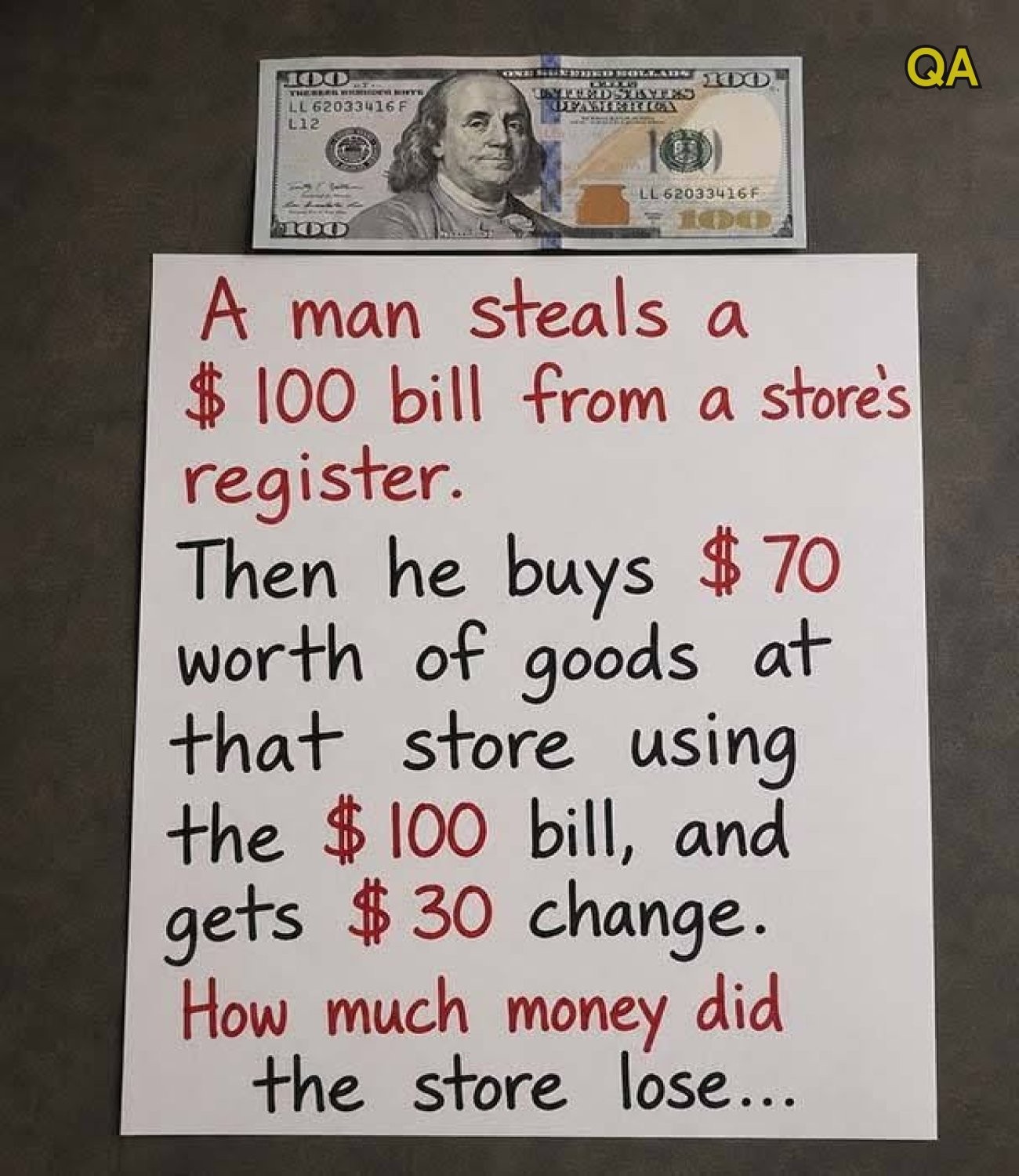
Imagine an ordinary day at a busy shop. Amidst the routine transactions, a man seizes a moment when the cash register is unmonitored. Without drawing attention, he takes a $100 bill from the register. No security alarms sound, and the man faces no confrontation. The act is swift, unremarkable, and seemingly inconsequential—at least to the casual observer.
Minutes after this theft, the same individual returns to the store, blending in as a regular customer. He selects $70 worth of merchandise, walks to the counter, and offers the very same $100 bill he had just stolen as payment. The cashier, unaware of what transpired earlier, processes the purchase as usual, hands him $30 in change, and the customer leaves the store.
Analyzing the Financial Losses
On the surface, this event appears to result in a theft of a $100 bill. But a precise examination exposes the intricacies of the loss:
- The Initial Theft: The man removes $100 from the register, resulting in a direct cash loss for the store.
- The Return: Using the stolen money, he purchases $70 in goods, and receives $30 in genuine change.
Now, let’s break this down step by step.
Step 1: The Cash Register Loss
The cashier was not aware the $100 bill had been stolen. From an accounting perspective, the till is instantly short by $100 the moment it is taken.
Step 2: The Purchase Transaction
The thief uses the stolen $100 bill to pay for $70 of goods. The cashier accepts this payment in good faith, records the sale, and provides $30 in change. In essence, the store gives away goods and real money in exchange for the same bill that originated from their own funds.
Step 3: The Net Loss Breakdown
- Goods Value: The store parts with $70 in merchandise, for which it receives no new, external money.
- Cash Change: An additional $30 in cash is given to the thief as change.
- The Stolen $100 Bill: This bill simply returns to the register, offsetting the initial shortage but not compensating for the goods and additional cash lost.
Therefore, the store’s total loss is $100: $70 in goods and $30 in real cash.

Why This Scenario Is Confusing
At first glance, such a case can appear like a simple, one-step theft of $100, but the true mathematics is counterintuitive. Many might initially believe the loss should be larger, since the stolen $100 bill left the register twice. However, it is the movement of value—goods and additional change—that creates the compounding effect.
The retail mathematics hinges on whether the transaction brought in external money and whether value left the store uncompensated. In this store’s case, the goods and cash are both lost, and the internal movement of the $100 bill doesn’t offset these losses in any meaningful sense.
The Broader Implications for Businesses
Retail theft in its various forms is a problem faced by storeowners worldwide. While shoplifting is an obvious concern, more sophisticated or subtle methods of theft—such as the scenario described—can have far-reaching consequences. Losses extend beyond the visible cash value and can impact operational processes, inventory management, and staff trust.
Inventory Discrepancies
Beyond the monetary loss, the store now must account for the missing goods, leading to inventory discrepancies. These discrepancies can erode profit margins and make it difficult to maintain accurate records. Over time, small but repeated incidents can aggregate into significant losses.
Cash Handling and Staff Protocols
This scenario highlights the importance of detailed protocols for cash handling and till supervision. Retail experts recommend regular cash register audits, close supervision, and frequent reconciliation of sales to detect inconsistencies early. Involving multiple employees in cash monitoring or using technologies such as surveillance cameras and alarmed registers can make a significant difference.
Expert Opinions: Understanding Retail Theft and Prevention
According to loss prevention experts, theft schemes that manipulate standard processes—like this deliberate switch of stolen money—are designed to exploit routine procedures. Natasha Adams, a retail security analyst, notes that “it is essential for businesses to focus not only on traditional shoplifting but also on schemes that take advantage of moments of distraction or lack of oversight.” The goal is to plug gaps in procedures as well as in technology to minimize such vulnerabilities.
The National Association for Shoplifting Prevention (NASP) underscores the importance of staff training. Employees who are well-versed in security awareness, policies, and swift anomaly detection can significantly reduce the risk of losses—whether through direct theft, fraud, or errors in handling cash and merchandise.
Societal and Legal Reactions to Retail Theft
Globally, lawmakers, retail associations, and businesses regularly review strategies to address theft. Legislative solutions often revolve around instituting stricter penalties for theft, investing in more advanced security technologies, and fostering public awareness about the impacts of retail crime.
In many countries, retail theft not only affects business owners but also exerts an economic pressure felt by consumers through increased prices and reduced profit margins for small businesses. Community policing efforts and partnerships between law enforcement and retailers aim to create safer shopping environments and deter offenders from targeting local businesses.
International Context: Comparing Retail Security Around the World
Retail security varies greatly from country to country. For instance, in parts of Europe and North America, electronic surveillance, point-of-sale analytics, and anti-theft tags are standard. By contrast, in smaller shops or less technologically equipped regions, staff vigilance and manual auditing form the backbone of security. The adaptability of thieves means that prevention strategies must continuously evolve.
In response to ongoing losses, many international chains invest in artificial intelligence tools that track purchase patterns and flag suspicious activity—a growing trend outlined in reports by The Guardian and Reuters. Nonetheless, experts agree that no technological solution is foolproof without well-trained, attentive staff.
Lessons Learned and Moving Forward
The simple act of a customer paying with stolen money may seem trivial, but as this analysis shows, the implications can be much larger for business operations and profitability. This case underscores the importance of vigilance, effective staff training, and the implementation of technologies and policies designed to deter, detect, and respond to theft.
Store owners should ensure frequent cash reconciliations, empower employees through education, and adapt security strategies in light of evolving risks. Ultimately, awareness—among staff and customers alike—is one of the strongest tools against both overt and subtle forms of theft.
Conclusion
Incidents like the one described are a powerful reminder that the losses caused by retail theft can be multidimensional, extending well beyond just the value of money physically taken from the register. The combination of lost goods, lost cash, and the administrative burdens of resolving such incidents underscores the need for comprehensive anti-theft measures. As retail environments become more complex, continual investment in prevention, education, and procedural rigor is crucial in protecting businesses from both simple and sophisticated schemes.
Sources
- Reuters
- BBC News – Business
- The Guardian – Retail
- National Retail Federation
- National Association for Shoplifting Prevention
Disclaimer: This content is intended for entertainment purposes only and is not based on real events.