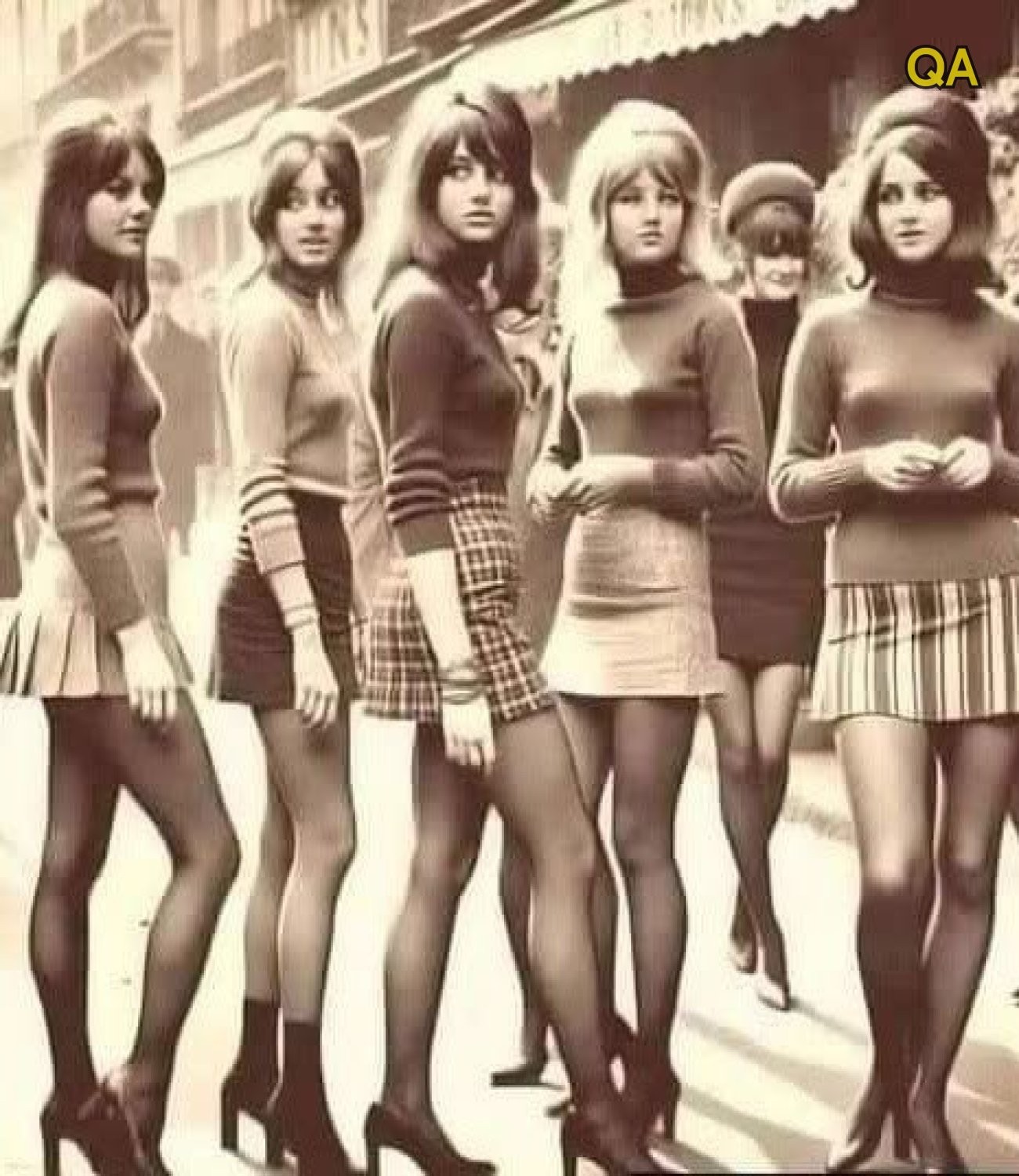
At first glance, this looks like a simple vintage street photo
Introduction: The Power of First Impressions in Photography
Photography has long captivated the public with its power to freeze moments and preserve history. In particular, vintage photos possess a certain allure, often transporting viewers into decades past and evoking nostalgia. Yet, some images do more than simply document a bygone era—they challenge the very way we perceive visual information. One such photograph, at first glance, appears to be a straightforward street scene from mid-20th-century Europe: a group of young women, stylishly dressed, pose confidently for a camera. Their fashionable hairstyles and attire set the scene, but look deeper and a remarkable visual puzzle begins to emerge.
A Seemingly Ordinary Scene
At its surface, the photo seems to capture a carefree moment from a distant decade. The setting—a city street with cobblestones and classic façades—frames a group of women standing side by side. The confidence in their posture and the cut of their clothing reflect a social climate in flux, when ideas about fashion, freedom, and femininity were rapidly evolving. At first, most viewers are drawn to the meticulously arranged legs, marveling at the apparent synchronicity of their stance.
The Subtle Uncanny: A Closer Look at Visual Details
What initially impresses as retro elegance soon becomes subtly unsettling upon closer examination. It’s not just the legs—although their remarkable alignment may seem uncanny—the uniformity extends further. Something about the image does not add up, but the mind struggles to pinpoint what.
Attentive observers may begin to scrutinize the women’s faces. What at first seems like a natural variety among individuals gradually reveals a repeating pattern. The eye, moving from one face to the next, identifies not similar features, but identical ones. Each woman’s jawline, eyes, nose, and mouth replicate the same structure, differentiated only by slight shifts in angle or expression. When this realization dawns, the ordinary transforms into the extraordinary.
The Art of Photographic Manipulation in the Pre-Digital Era
The explanation behind this optical illusion is both fascinating and a testament to technical ingenuity: this is not a photo of several women, but a composition featuring the same woman captured multiple times. In a time before digital editing tools like Photoshop, such results demanded remarkable patience, skill, and creative vision. The photographer carefully posed the subject in each desired position, then combined the images through manual compositing techniques. The resulting photograph is an analogue precursor to digital “cloning,” achieved with meticulous darkroom expertise and planning.
The authenticity of this illusion relies on the limitations of human perception. Most viewers, attuned to expect natural variation in group portraits, subconsciously fill in differences where none actually exist. This psychological phenomenon is rooted in our brains’ innate tendency to seek patterns and impose logic on visual stimuli—a process that skilled photographers and artists have exploited for centuries.
Visual Illusions and the Science of Perception
The allure of such manipulated photographs touches on the deeper science of how humans process images. According to researchers in cognitive psychology, our brains are wired to form gestalts—or unified wholes—from disparate parts. This is especially true for faces, which we process “holistically,” enabling us to recognize individuals even with limited information. When a photo presents several nearly identical faces, we may take some time to notice their sameness. Only when the repeated features become inescapable does the brain recognize the trick.
This phenomenon has been explored in various psychological studies, showing that people are adept at overlooking subtle cues when confronted with strong contextual signals—such as differing body positions, clothing, or settings within a single photograph. The vintage street photo capitalizes on this effect, concealing its manufactured nature until the viewer is ready to reconsider their initial assumptions.
The Creative Drive Behind Photo Manipulation
Photo manipulation is as old as the medium itself. From the earliest days of photography in the 19th century, artists and technicians experimented with doubling, masking, and darkroom composites to produce images that challenge reality. These experiments range from whimsical illusions and “spirit” photography to state-driven propaganda and artistic self-expression. The technical requirements varied, but the motivation remained the same: to explore the boundaries between truth and illusion, and to provoke a reaction from the viewer.
In the context of the vintage street photo, this manipulation is playful rather than deceptive. It invites the viewer to question their own faculties and reconsider the reliability of visual evidence. The effect does not diminish the photo’s beauty or historical value; rather, it elevates it to a work of art, demonstrating how a single human subject can appear to populate a lively scene multiple times, each instance indivisibly linked yet slightly unique.
Cultural and Societal Reaction to Visual Tricks
Images like this have garnered immense attention in an age of viral content and social media. Online communities dedicated to visual puzzles, such as forums and social news websites, frequently analyze historic optical illusions, exploring not just their technical aspects but their philosophical implications. Responses often range from admiration at the artist’s ingenuity to introspective discussions about the reliability of perception.
The rise of digital technology and image editing applications has not diminished the appeal of analogue manipulations. On the contrary, there is a growing appreciation for pre-digital creativity. Museums, photography journals, and online galleries increasingly showcase historic composite photographs, positioning them as both cultural artifacts and drivers of visual literacy. Art critics and historians often cite such works when discussing bias in photographic evidence and the constructed nature of memory.
The Legacy of Analogue Illusions in Contemporary Art and Media
The kind of visual trickery exemplified by this vintage image has influenced generations of photographers and visual artists. Contemporary practitioners often reference historic composite works and recreate similar effects using both analogue and digital tools. Photography exhibitions frequently juxtapose early manipulation techniques with modern examples, highlighting an ongoing dialogue about authenticity and deception in visual culture.
This conversation takes on increased significance in an era saturated by images—when the line between fact and fabrication grows ever thinner. Debates about “fake news”, deepfakes, and the power of editing to reshape public perception often cite the early experiments in photo compositing as precedents, underlining the fact that visual deception is not unique to the digital age.
Expert Views on Perception and Manipulation in Photography
Experts in photography, visual cognition, and art history offer multi-layered interpretations of such illusions. According to Dr. Brian D. Ganson, a scholar of visual studies, “Our minds are designed to process and trust photographic images, so when a picture like this introduces a subtle but fundamental break in reality, it invites not just surprise, but critical reflection.” Art historians remark on the democratization of visual trickery, noting that what was once the purview of a select few in darkrooms is now accessible to millions via smartphones and editing apps.
Psychologists, meanwhile, see in these images an opportunity to study the mechanics of perception, memory, and cognitive dissonance. Experiments on visual scanning and face recognition reveal that even highly trained observers can be fooled by cleverly orchestrated manipulations. In this way, vintage photographic illusions make a valuable contribution to both science and art.
The Enduring Fascination with Visual Deception
As viewers, our emotional reaction to such images often oscillates between amazement and discomfort. Recognizing the handiwork behind the manipulation provokes a sense of wonder at human creativity—while also challenging our faith in the veracity of photographs. Ultimately, the vintage street photo serves as a powerful reminder of the interplay between observation and assumption. It highlights how our brains seek order, sometimes at the expense of accuracy, and how even the simplest images can reveal deep truths about the human experience.
In an increasingly visual world, the ability to critically scrutinize images is an essential skill. Historic composite photographs like this invite us to slow down and look beyond the surface, encouraging a mindful engagement with what we see. Long before digital technologies made photo editing commonplace, photographers were already exploring the boundaries of perception—with results as thought-provoking and delightful now as they were then.

Conclusion: Lessons from a Vintage Visual Trick
The vintage street photo in question is far more than a snapshot of fashion or friendship from a bygone era. It is a masterclass in photographic illusion, exploiting the limitations of human perception and the possibilities afforded by analogue technology. This image reminds us that “seeing is believing” is, at best, an incomplete philosophy; what we see is only the beginning of understanding, not its end. As we navigate the complex landscape of modern media, the lessons of legacy images like this remain as timely and relevant as ever.
Sources
- BBC Culture
- The Guardian: Photography
- Reuters Lifestyle
- The New York Times: Lens
- Association for Psychological Science
Disclaimer: This content is intended for entertainment purposes only and is not based on real events.