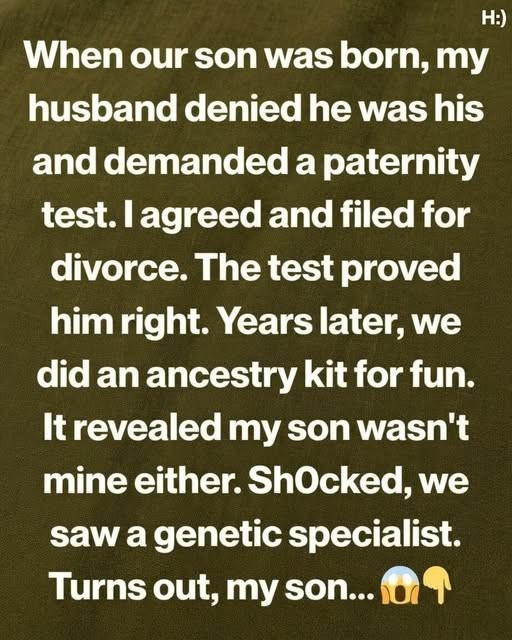
My Husband Left After a DNA Test Said Our Baby Wasn’t His. Years Later, Another Test Revealed a Truth Neither of Us Expected
The first time my husband held our newborn son, I expected to see tears in his eyes.
I had imagined that moment throughout nine months of pregnancy. I pictured him smiling down at our baby, touching his tiny fingers, and whispering that he couldn’t believe we had created something so beautiful together.
Instead, he stared at the child in his arms and asked a question that changed our lives forever.
“Are you sure he’s mine?”
For a moment, I thought I had misunderstood him.
“What do you mean?” I asked.
He looked from our son’s face to mine. His expression had changed in a way I had never seen before. The warmth I had expected was gone, replaced by suspicion.
“He doesn’t look like me.”
Our baby was only hours old. His face was still swollen from birth, his eyes were barely open, and his tiny hands curled instinctively around our fingers. There was no reasonable way to determine his paternity simply by looking at him.
But my husband had already begun to doubt me.
I thought the shock of becoming a father had overwhelmed him. I tried to reassure him, telling him that babies changed quickly and that our son might resemble him more as he grew.
He didn’t seem convinced.
Over the next several days, his questions became accusations. He wanted to know whether I had been seeing someone else, whether there was anything I had failed to tell him, and why he should trust my word when he believed his own eyes were telling him something different.
I answered every question honestly.
It made no difference.
Eventually, he demanded a paternity test.
I agreed.
Not because I had anything to prove, but because I believed the results would end the accusations. I thought that once he saw the truth, he would apologize, hold our son again, and understand how deeply he had hurt me.
I never imagined that the test would become the beginning of the loneliest chapter of my life.
The Test Result That Destroyed Our Marriage
The results arrived several days later.
My husband opened the report before I did. I watched his eyes move across the page, and within seconds, his face hardened.
“He’s not mine,” he said.
I took the report from his hands.
I read the conclusion once. Then I read it again, hoping I had misunderstood the technical language.
The report excluded my husband as the child’s biological father.
I could barely breathe.
“That can’t be right,” I whispered. “I have never been with anyone else.”
He shook his head.
“You said the test would prove everything.”
“It was supposed to.”
He looked at me with an expression that made my stomach turn. It wasn’t confusion anymore. It was certainty.
He believed the report had answered every question.
I begged him to consider the possibility of a mistake. I asked whether we could speak to the laboratory, repeat the test, or consult a specialist. I told him that I knew what had happened during my pregnancy and that our son was his child.
But he had already decided what the result meant.
He accused me of lying, of humiliating him, and of bringing a child into his life who wasn’t his.
I remember holding our newborn against my chest while he packed a bag.
I remember asking him to wait until we understood what had happened.
I remember him looking at our son one final time before walking out.
That day, my marriage ended.
I had entered the hospital believing I was beginning a family. I left with a newborn in my arms and a future I had never planned to face alone.
Learning to Raise My Son Without Him
The first months were difficult in ways I hadn’t anticipated.
My body was recovering from childbirth. My nights were broken into short stretches of sleep, and every decision seemed to carry more weight than I could manage.
I learned how to soothe a crying baby while trying not to cry myself. I learned to make meals with one hand, attend appointments alone, and smile at people who asked whether my husband was enjoying fatherhood.
Some people knew what had happened. Others heard fragments of the story and formed their own conclusions.
I stopped trying to explain myself to everyone.
I knew the truth about my marriage. I knew I had been faithful, and I knew I had never given my husband a reason to believe otherwise.
Yet the test result remained like a shadow over those early years.
Whenever my son laughed, I wondered whether his father would have loved that sound. Whenever he reached for me, I felt both gratitude and grief. I loved him more than I could express, but I sometimes mourned the family life I had imagined before he was born.
Still, my son needed a mother who was present, not one who spent every day waiting for an apology that might never come.
So I began rebuilding.
I returned to work when I was able. I accepted help from family and friends. I learned to budget carefully and plan for the future without relying on someone who had chosen to leave.
My son grew from a helpless newborn into a curious little boy who asked endless questions, laughed at his own jokes, and insisted on doing things himself.
He loved picture books, building blocks, and running ahead of me whenever we walked through a park.
As he grew older, I made sure he knew he was loved.
I never told him that he had been unwanted. I never made him responsible for the choices his father had made.
When he asked about his dad, I answered as honestly as I could without placing the weight of adult pain on a child’s shoulders.
His father had left when he was a baby, I explained. It wasn’t his fault.
That was the most important thing I wanted him to understand.
He had done nothing wrong.
And neither had I.
The Years Passed, and the Questions Faded
By the time my son became a teenager, our life had settled into a comfortable rhythm.
We had our routines, our inside jokes, and the kind of closeness that comes from facing difficult years together. Our home wasn’t perfect, but it was peaceful.
My son had grown into a thoughtful, confident teenager. He was kind to younger children, protective of his friends, and curious about the world beyond our neighborhood.
Sometimes, I saw glimpses of the baby I had once held in the hospital. Other times, I was surprised by how much he had become his own person.
One afternoon, he came into the kitchen holding his phone.
“Mom, have you ever thought about taking one of those ancestry DNA tests?”
I laughed.
“Why? Are you trying to find out whether we have a secret royal relative?”
“Maybe,” he said, grinning. “Imagine if we did.”
He had been reading about genetic ancestry kits that could estimate family origins and identify potential relatives through shared DNA. He thought it would be interesting to learn more about our family history.
I agreed.
At first, it seemed like a harmless experiment. We would send our samples, wait for the results, and perhaps discover distant cousins or learn something unexpected about our ancestry.
Neither of us imagined that the results would reopen a chapter of our lives I had spent years trying to leave behind.
The Second DNA Result
The first notification arrived on an ordinary weekday.
My son opened his results while sitting beside me on the couch. He was excited to see the geographic regions associated with our ancestry and began reading through the information.
Then his expression changed.
“Mom, something’s wrong.”
I leaned toward him.
“What is it?”
He turned the screen toward me.
The relationship analysis suggested that our biological relationship was inconsistent with what we expected. Instead of showing the close maternal relationship we anticipated, the results appeared to indicate that I was not his biological mother.
I stared at the screen.
“That can’t be right.”
My son looked frightened.
“Does this mean something happened when I was born?”
“No,” I said quickly, taking his hand. “It doesn’t mean that. We’re going to find out what it means.”
But inside, I was shaking.
I had spent years living with the accusation that my son was not my husband’s child. The original paternity test had seemed to confirm that accusation, and my husband had used the result as the reason to abandon us.
Now another DNA test was suggesting something even more difficult to understand.
If I was not genetically related to my son, how could I have carried him, given birth to him, and raised him from the moment he entered the world?
I knew I was his mother. I remembered every appointment, every kick, every hour of labor. I remembered the first time I held him against my chest.
No genetic report could erase those memories.
But I needed to understand what the results meant.
For the first time in years, I wondered whether the original test had been wrong for a reason nobody had recognized.
Searching for an Explanation
I contacted a medical genetics specialist and explained the history as carefully as I could.
I brought the original paternity report, the newer ancestry results, and every document I had kept from those years.
The specialist listened without making assumptions.
Rather than immediately accepting either result as definitive, she explained that DNA testing depends on the sample collected, the methods used, and the genetic markers examined. Different tests are designed to answer different questions, and unexpected results sometimes require further investigation.
She also explained a rare biological phenomenon called chimerism.
In humans, chimerism occurs when one person has two or more genetically distinct populations of cells. This can happen through different biological mechanisms, including the early fusion of embryos. Depending on the type of chimerism, different tissues may carry different genetic profiles.
I listened carefully.
The specialist described how rare cases of chimerism had complicated parentage testing. In published medical reports, investigators had encountered situations where DNA from one tissue produced a misleading result, while testing other tissues revealed a different genetic relationship.
For the first time, I understood that DNA testing, although powerful, was not always as straightforward as people assumed.
A result could be important evidence without necessarily explaining every aspect of a complicated biological situation.
The specialist warned me that chimerism was rare and that we could not assume it explained our family’s results. Sample identification, laboratory procedures, the type of test used, and other genetic explanations also needed to be considered.
Still, she recommended additional testing.
I agreed.
I wanted the truth, whatever it turned out to be.
The Rare Condition That Changed the Investigation
Over the following weeks, the specialist arranged further genetic analysis. The process required patience, additional samples, and careful comparison of the results.
The investigation eventually identified evidence consistent with a rare form of chimerism in my son.
His body contained two genetically distinct cell populations. The genetic profile represented in one sample did not necessarily capture every genetic lineage present in his body.
That discovery offered a possible explanation for the unexpected ancestry result and raised serious questions about the assumptions made from the original paternity report.
The specialist explained that the relationship between chimerism and DNA testing could be complex. In certain documented cases, a person’s genetic profile varies across tissues enough to complicate biological relationship testing.
But she was careful not to oversimplify what we had discovered.
The specific implications for my son’s parentage required specialized analysis of the relevant samples and genetic markers. Chimerism alone was not a magic explanation for every discrepancy, and a diagnosis could not automatically prove that the original test had been wrong.
The findings gave us a scientific path to investigate the mystery rather than relying on suspicion or guesswork.
For me, that was already significant.
For years, a single report had been treated as the final word on my character, my marriage, and my son’s place in the family.
Now experts were examining the evidence again, with a more complete understanding of the possibilities.
I realized how much damage could occur when a complicated result was interpreted as though it were simple.
The Truth My Husband Never Wanted to Hear
After the specialist explained the findings and the limitations of what we could conclude, I faced a difficult decision.
Should I contact my former husband?
For years, I had imagined what I might say if I ever had the chance. I had rehearsed explanations, accusations, and questions I knew he might never answer.
But this was different.
I now had information that could help explain why the earlier test and later results seemed inconsistent. I wanted him to know that the situation was more complicated than he had believed.
I called him.
He sounded surprised to hear from me after so many years.
“I need to tell you something about the DNA test,” I said.
He went quiet as I explained the ancestry results, the genetic consultation, and the investigation into chimerism.
I told him that the new findings raised questions about the conclusions he had drawn when our son was born. I offered to share the reports and the specialist’s explanation.
For a moment, I hoped he would listen.
I imagined him asking questions. I imagined him acknowledging that he might have acted too quickly, that the test had not answered every question, and that his decision to leave had hurt two people who had never deserved that pain.
Instead, he became defensive.
He accused me of inventing an explanation to obtain financial support for our son. He suggested that I was trying to reopen the past because I wanted something from him.
I sat silently, listening to the same distrust that had defined our final days together.
When he finished speaking, I realized something painful.
The evidence could change. Our understanding could change. A scientific investigation could reveal information neither of us had known existed.
But I could not force him to reconsider his beliefs.
“I wanted you to know what the specialist found,” I said. “You can decide what to do with that information.”
Then I ended the call.
I cried afterward, though not for the same reasons I had cried when he left.
Back then, I had wanted him to believe me because I needed his trust to feel that my family was whole.
Now I understood that my life did not depend on his agreement.
I had spent years building a home for our son. I had been there for his first steps, his school performances, his disappointments, and his achievements.
I had done the work of loving and raising him.
That truth did not require my former husband’s permission.
What DNA Can Tell Us—and What It Cannot
The experience changed the way I thought about genetic testing.
DNA analysis can provide powerful information about biological relationships. But interpreting an unexpected result requires attention to the type of test performed, the samples collected, and the question the test was designed to answer.
Chimerism is one rare condition that can complicate genetic analysis. Scientific reports have documented cases in which a person’s DNA profiles differed across tissues, leading to unexpected or misleading conclusions in parentage testing.
In some cases, additional testing of different tissues helped clarify the biological relationships involved. Such investigations require specialized expertise and should not be replaced by assumptions based on a single consumer ancestry result.
It is equally important to understand that chimerism does not explain every disputed paternity test. Laboratory errors, sample mix-ups, differences in test methods, and other circumstances may also need to be investigated when results conflict.
For families facing an unexpected result, the most responsible next step is to seek an appropriately qualified genetics professional or accredited parentage-testing laboratory. A specialist can determine which tests are suitable and whether additional samples or analyses are necessary.
In our case, the investigation offered a possible explanation for a mystery that had shaped our family for years. But its most important lesson was not that DNA tests should be dismissed.
It was that results deserve careful interpretation, especially when the consequences affect people’s relationships and lives.
The Son Who Never Needed to Prove His Worth
My son was old enough to understand that the investigation involved more than scientific curiosity.
One evening, he sat beside me and asked whether the results changed anything between us.
I looked at him.
“Not one thing.”
He was quiet for a moment.
“Even if the tests say something different?”
I took his hand.
“You are my son. I’ve loved you every day since before I met you. We are investigating a complicated biological question, but you don’t have to prove that you belong in this family.”
He leaned against my shoulder.
I realized then that I had spent too much of his childhood worrying about the man who had walked away. I had wanted my former husband to recognize our son, to acknowledge the truth, and to understand the damage his accusations had caused.
But my son had never needed his father’s approval to become the person he was.
He had grown into a kind, capable young man who treated people with respect and approached the world with curiosity. He knew that love meant showing up, keeping promises, and being willing to listen when someone was hurting.
Those qualities had not come from a DNA report.
They had grown through the life we shared.
I could not change what happened in the hospital. I could not make my former husband return or undo the years he had missed.
But I could continue giving my son a home where questions were allowed, mistakes could be acknowledged, and love was never conditional on proving something to someone else.
That was the family I had built.
And it was enough.
I Lost a Marriage, but I Found My Freedom
Sometimes I still think about the woman I was when my husband walked out.
She was exhausted, frightened, and holding a newborn. She believed that if she could only make the truth clear enough, the man she loved would come back.
I wish I could tell her that she would eventually stop waiting for his apology.
I wish I could tell her that her son would grow into someone she would be proud of, that their home would become a place of laughter, and that she would learn to trust her own judgment again.
Most of all, I would tell her that being abandoned does not mean being unworthy of love.
The genetic investigation did not erase our past or give me a perfect ending. It did not force my former husband to accept a different explanation. It did not return the years he had spent away from our son.
What it gave me was a reason to question a conclusion that had once seemed final.
It reminded me that even scientific evidence must be interpreted carefully, and that human lives are rarely as simple as a single report might suggest.
I had lost a marriage built on suspicion. In its place, I built a life shaped by patience, resilience, and the kind of love that does not demand proof before it offers care.
My son no longer needed to understand why his father left in order to know who he was.
And I no longer needed my former husband to admit that he had been wrong before I could move forward.
I had spent years believing that the most important thing was proving my innocence.
Now I understood that the more important thing was living a life that reflected the truth I had always known.
I had loved my son from the beginning.
I had raised him through every difficult year.
And no unexpected result, no accusation, and no unanswered question could take those years away from us.
Sometimes, the most painful chapters of our lives do not end with the apology we hoped to receive.
Sometimes, they end when we finally stop waiting for it.
And that was the moment I understood that, although I had lost the marriage I once believed would last forever, I had never lost the ability to build a loving family.