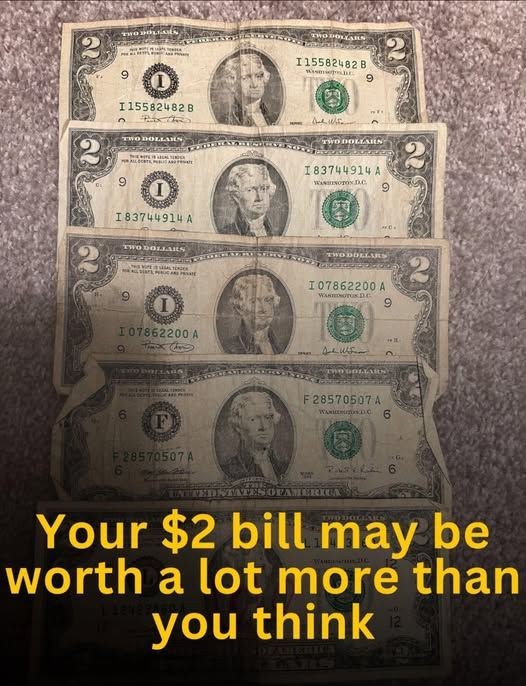
The $2 Bill: Myths, Value, and Collectibility in America
At one time, superstitious people believed the $2 bill was unlucky and even carried a curse. However, this myth is far from the truth. In fact, owning a $2 bill could bring you good luck—and maybe even a few thousand dollars if you know how to spot its value.
An American Oddity: The Origins and Myths Surrounding the $2 Bill
The $2 bill is one of the most misunderstood American banknotes. Throughout its history, it has been surrounded by misconceptions and superstition. Traditionally, some Americans avoided handling $2 bills, believing they brought misfortune or even a curse. Historians point to political bribery scandals and gambling associations in the 19th and early 20th centuries as sources of these superstitions. For example, in the past, $2 bills were sometimes used for bribery in political conventions and among gamblers, adding to their suspicious reputation.
The belief in the $2 bill’s bad luck gradually became entrenched in folklore, but there is no factual basis for it. Over time, these unfounded beliefs contributed to the bill’s relative scarcity in circulation, as people preferred to use or keep $1, $5, or higher denominations.
The $2 Bill Today: Circulation Status and Misconceptions
Contrary to popular belief, the United States $2 bill is still legal tender and remains in production. According to the U.S. Bureau of Engraving and Printing, the $2 bill is currently being printed, though in much lower volumes compared to other denominations. Each year, the Treasury introduces new $2 bills into circulation, but due to their less common usage, many Americans mistakenly believe the bill has been discontinued or is a rare collector’s item by default.
The reality, however, is that $2 bills are no rarer than other denominations, aside from their limited production. Their relative rarity in daily monetary transactions can be traced to reduced demand and unfamiliarity; most Americans are more accustomed to using $1, $5, $10, and $20 bills. Many financial institutions do not regularly dispense $2 bills unless requested. However, anyone in the U.S. can request $2 bills at their local bank branch, as long as supplies permit.
Design and Features: What Makes the $2 Bill Unique?
The contemporary $2 bill, featuring Thomas Jefferson on the obverse (front) and a depiction of the signing of the Declaration of Independence on the reverse (back), was last redesigned in 1976 to mark the United States Bicentennial. The historical imagery and distinctive size make the bill easily recognizable among U.S. currency.
Some earlier editions of the $2 note, particularly those issued in the 19th and early 20th centuries, have unique features, such as red seals, blue Treasury signatures, or different portraits. The evolving designs also factor into the collectibility and potential value of certain $2 bills.
How to Identify Valuable $2 Bills: Collecting and Assessing Worth
While most $2 bills currently in circulation are worth their face value, some specific examples are considered highly valuable by collectors. The field of notaphily—the study and collection of paper currency—offers insight into what increases a bill’s value. Here are main factors collectors consider:
- Age and Series: Older $2 bills, such as those printed in the 19th century or during World War II, can fetch higher prices.
- Star Notes: Bills with a star symbol in the serial number are replacements for defective bills and are usually more rare.
- Low Serial Numbers: Notes starting with several zeroes, or those with repeating or patterned numbers, are more desirable.
- Condition: Bills in uncirculated, crisp, or proof-like condition preserve their full value and are more attractive to collectors.
- Signatures and Printing Errors: Certain combinations of signatures and rare printing errors can dramatically increase a bill’s value.
Some 1928 $2 bills, and rare issues from the 1800s, can sell for hundreds or even thousands of dollars at auction, depending on their condition and serial number. Recent auction records show special notes in pristine condition achieving surprisingly high prices among enthusiasts.
How to Find and Handle $2 Bills
If you are interested in finding $2 bills, you can inquire at major banks or savings institutions. Most banks keep a supply of $2 bills for requests, although they are rarely distributed at ATMs or through routine cash withdrawals. Collectors recommend handling bills with care, especially older examples, to maintain their value. Use archival sleeves and avoid prolonged handling to protect paper fibers and printing ink.
The $2 Bill in Popular Culture and Society
The $2 bill holds a unique place in American popular culture. Some see it as a symbol of good luck or prosperity. For example, people have been known to tip with $2 bills or give them as gifts to mark special occasions, such as graduations or birthdays. Others hold onto $2 bills as nostalgic reminders of childhood or family heritage.
Many organizations—such as clubs, restaurants, and charities—have used the $2 bill in promotions and fundraising efforts to create a sense of novelty. In Las Vegas, for instance, casinos have occasionally paid out winnings in $2 bills to attract attention and create buzz among visitors. The bill’s distinctive look also makes it a favorite for educators teaching students about U.S. currency and history.
Expert Views and Collector Insights
Numismatic experts explain that the value of any $2 bill depends on a combination of historical significance, rarity, and condition. According to the American Numismatic Association, demand for unusual serial numbers has grown among collectors worldwide. Meanwhile, the Smithsonian Magazine describes the $2 bill as “the oddball of American currency”—cherished by a devoted minority but misunderstood by the general public.
Currency appraisers and coin dealers advise everyday holders of $2 bills to check their bills’ serial numbers, year of issue, and condition before opting to spend, trade, or sell them. With the right features, a simple $2 bill could be worth much more than face value in the collector’s market.
International Comparisons: $2 Bills and Low-Denomination Currency Abroad
The U.S. $2 bill is not the only low-denomination banknote with an intriguing history. Globally, many countries have experimented with or discontinued similar bills. For instance, Canada discontinued production of their $2 bill in 1996, replacing it with a coin known as the “toonie.” Likewise, Australia replaced its $2 note with a coin in 1988.
These transitions were often part of government efforts to enhance durability, reduce costs, and thwart counterfeiting. The U.S., meanwhile, has retained the $2 bill mostly due to tradition, and it continues to fascinate both citizens and visitors alike.
Sustainability, Production, and the Future of the $2 Bill
Although the $2 bill represents a small fraction of overall paper currency in circulation, it fulfills unique functions within the economy. According to the Federal Reserve, U.S. paper currency is subject to periodic review for design improvements and security enhancements. The $2 note’s specialized production ensures a controlled supply, minimizing unnecessary printing and reducing environmental costs compared to larger denominations.
As contactless and digital payments continue to expand, the future of paper banknotes—including the $2 bill—remains uncertain. However, the cultural and historical significance of the $2 bill likely ensures its continued fascination among collectors and the general public for years to come.
Conclusion: The $2 Bill’s Enduring Legacy
Once labeled as unlucky and overlooked, the $2 bill has grown into a symbol of novelty and intrigue within American currency. While it remains in daily circulation, its relative scarcity and unique design have made it a favorite among collectors and enthusiasts. Whether you encounter a $2 bill in your change, receive one as a gift, or discover a rare bill with unique characteristics, it’s worth a closer look. For the curious, careful research and attention to unique features may reveal much more than just face value—transforming an ordinary transaction into a collector’s delight.
Sources
- U.S. Bureau of Engraving and Printing
- Federal Reserve
- American Numismatic Association
- Smithsonian Magazine
- NPR
- History.com
Disclaimer: This content is intended for entertainment purposes only and is not based on real events.