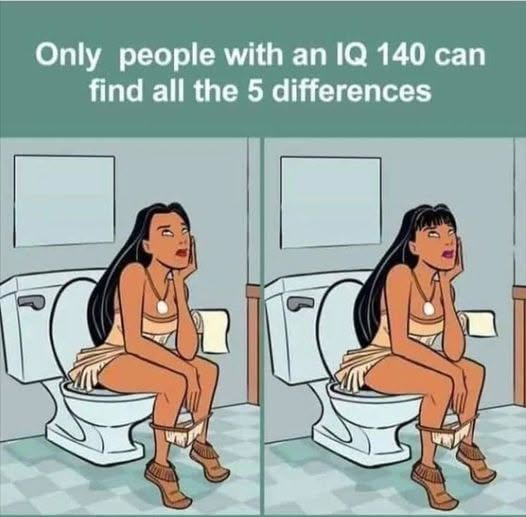
Five Tiny Differences Can Make You Question Your Entire Intelligence
Introduction
Picture puzzles are more than a passing internet diversion. In recent years, viral challenges such as the “IQ 140” picture puzzle have stirred up widespread engagement and introspection. These games, often presented with intimidating headlines, seem harmless at first glance, but their impact is surprisingly profound. Many who attempt to solve these puzzles report feelings ranging from amusement to self-doubt, especially when unable to spot all five tiny differences. What drives this experience, and why do these puzzles wield such influence over our perceptions of intelligence?
Anatomy of the Viral “IQ 140” Challenge
The “IQ 140” challenge typically appears as a simple spot-the-difference puzzle: two images, nearly identical, but with five subtle changes. The twist comes with a headline suggesting only those with genius-level IQs—specifically 140 or higher—will succeed. This assertion, while unsupported by rigorous scientific evidence, transforms a casual puzzle into a perceived measure of intelligence. The puzzle’s popularity is rooted in its accessibility and the universal urge to prove oneself capable, especially when intelligence is the underlying theme.
Psychological Impact of Challenging Puzzles
Engaging in picture puzzles such as these can evoke a range of psychological responses. According to cognitive scientists, the process of searching for differences leverages attention, memory, and pattern recognition. When people struggle to find all five, self-doubt can creep in. They may feel frustrated or question their intelligence, even if the puzzle was never designed as a genuine IQ test. This highlights a broader phenomenon: how playful activities, when framed competitively or with high stakes, can affect self-esteem and perceived competence.
Dr. Daniel Kahneman, Nobel laureate and psychologist, notes that humans are highly susceptible to framing effects. The way a puzzle is presented—the wording, the time pressure, the mention of unachievable standards—can reshape our experience from play to performance. As a result, some may perseverate, while others may disengage upon feeling that the challenge exceeds their cognitive boundaries.
Picture Puzzles: Fun Diversion or Flawed Intelligence Test?
Despite claims attached to such puzzles, experts widely agree that they are not accurate measures of intelligence. Dr. Howard Gardner, renowned for his theory of multiple intelligences, argues that intelligence is multidimensional and cannot be captured by a single test or challenge. Picture puzzles may test visual acuity and attention to detail, but they do not assess reasoning, memory, linguistic skills, or emotional intelligence.
Furthermore, the “IQ 140” label is misleading. Standard IQ tests, such as those developed by Stanford-Binet or Wechsler, involve an extensive battery of questions across multiple cognitive domains and take hours to complete. The casual puzzle does not remotely compare in complexity or scope. Social media viral quizzes are designed primarily for entertainment and engagement, not psychological assessment.
The Role of Social Media and Digital Virality
Social media platforms have been instrumental in amplifying the reach and impact of picture puzzles. The algorithmic nature of these platforms encourages content that provokes user interaction—likes, comments, shares—often prioritizing emotionally charged or competitive activities. When users encounter headlines referencing high IQ, genius status, or exclusivity, engagement surges as people attempt to prove themselves or simply challenge their friends.
This phenomenon has been studied in digital culture research. Dr. Shira Gabriel, a psychologist specializing in social connection and online engagement, describes viral puzzles as a “digital tribal rite,” where groups form around the shared experience of solving (or failing to solve) a challenge. The social aspect can be uplifting, but it can also foster comparison and competitiveness, leading some users to feel discouraged or self-conscious.
Cognitive Science: What Makes Spot-the-Difference Challenging?
Spotting differences in pictures draws on several cognitive skills. Psychologists have identified visual scanning, selective attention, and working memory as fundamental processes involved in this task. Visual scanning involves systematically processing spatial layouts, while selective attention helps filter out irrelevant details and focus on areas of probable change. Working memory is critical for keeping track of found differences and making comparisons between images.
Research published in neuropsychology journals indicates that individual performance on these tasks can vary significantly based on age, experience, fatigue, and stress. For instance, older adults may require more time to discern differences, while distractions or multitasking can lessen accuracy among all age groups. Thus, one’s performance on a single puzzle reflects a host of factors, rather than any innate intelligence level.
The Influence of Framing and Expectation
Framing plays a significant role in how we perceive and approach puzzles. When a challenge is labeled as “only geniuses can solve this,” it generates both aspiration and anxiety. Cognitive science shows that expectation affects performance—those told a task is difficult may feel greater pressure, which can either motivate or inhibit.
The notion that puzzle-solving is indicative of IQ establishes an unrealistic standard. The pressure to meet this standard can lead to overthinking or second-guessing, which, paradoxically, reduces performance. Positive framing, such as highlighting the fun and skill development aspects, is shown to increase engagement and satisfaction, regardless of outcome.
Intelligence: Definitions, Testing, and Misconceptions
Intelligence has been debated extensively in scientific circles. Early definitions focused on logical reasoning and problem-solving, but contemporary views embrace broader competencies, such as emotional regulation, creativity, and practical knowledge. Traditional IQ tests measure specific skills, but their limitations are widely acknowledged.
Experts caution against conflating puzzle-solving speed or accuracy with overall intelligence. While some individuals may excel at visual tasks, others might demonstrate strengths in verbal, mathematical, or interpersonal domains. Psychological associations advise using diversified approaches to evaluating intelligence, including self-awareness, adaptive behaviors, and learning capacity.
Societal Reactions and International Perspectives
The global response to viral picture puzzles reflects cultural attitudes toward intelligence and competition. In education systems where test scores are paramount, such challenges may reinforce existing anxieties. Conversely, in cultures emphasizing collective achievement, the puzzles are often viewed as games rather than assessments.
Internationally, the phenomenon has been discussed in the media. Outlets such as BBC and Reuters highlight that viral quizzes often serve as light-hearted entertainment, but caution is advised in attaching them to intelligence claims. Some societies have begun integrating similar puzzles into educational contexts to foster cognitive skill development, though without the competitive framing.
Expert Views: What You Should Know About Viral Puzzles
Psychologists and educators recommend approaching viral puzzles with a balanced mindset. Dr. Jean Twenge, a researcher in technology and mental health, suggests using such games for stress relief and skill practice, rather than as measures of self-worth. She emphasizes that the satisfaction of solving a puzzle derives from engagement and enjoyment—not from external validation or IQ scores.
Educational experts see value in picture puzzles for children and adults alike. They can enhance visual discrimination, persistence, and attention, but should always be contextualized as exercises rather than assessments. Parents, teachers, and individuals are advised to communicate the purpose of these activities clearly to prevent misunderstanding and undue disappointment.
How to Approach Picture Puzzles for Maximum Benefit
If you encounter a viral puzzle, keep these guidelines in mind:
- View the challenge as an opportunity to sharpen skills, not as a measure of intelligence.
- Acknowledge that everyone’s strengths differ—someone who excels at puzzles may not excel at other tasks, and vice versa.
- Take breaks if frustration sets in; cognitive fatigue impedes performance.
- Share your experience with others, but avoid comparison or competition.
- Enjoy the activity for what it is—a playful diversion that stimulates the brain.
Conclusion
The viral “IQ 140” picture puzzle is emblematic of how digital culture merges play with performance. While it can be entertaining and mentally stimulating, it is not an indicator of intelligence or cognitive worth. The psychological effects of framing, societal expectations, and individual differences underscore the complexity behind this seemingly simple challenge. By approaching these puzzles with awareness and balance, we can leverage their fun and skill-building potential without allowing misleading headlines to impact our self-esteem.
Sources
Disclaimer: This content is intended for entertainment purposes only and is not based on real events.