Optical Illusions: Find the Hidden Butterfly in This Classic Puzzle
Welcome, puzzle lovers and sharp-eyed readers! Today, we delve into the fascinating world of optical illusions and hidden object puzzles—a realm where our perception is constantly tested and our observational skills put through a rigorous challenge. Whether you are a lifelong enthusiast of visual puzzles or a curious newcomer looking for fun, optical illusions are a timeless way to entertain, exercise your brain, and learn about the science of how we see.
The Enduring Appeal of Optical Illusions
Optical illusions, also known as visual illusions, have captivated humans for centuries. Instantly accessible and often surprisingly tricky, these puzzles exploit the limitations and quirks of our visual processing, creating images that are simple at first glance but complex upon closer inspection. Psychologists, neuroscientists, and artists study optical illusions to understand how our minds interpret visual information, leading to discoveries about attention, perception, and cognition.
Hidden object puzzles are a popular form of optical illusion. The challenge is to find an object, often cleverly disguised or embedded within a larger illustration. This not only entertains but also sharpens skills such as attention to detail, pattern recognition, and spatial reasoning. Such puzzles can be enjoyed individually or shared among friends and family, making them a staple of both personal recreation and education.
A Vintage Puzzle That Tests Your Skills
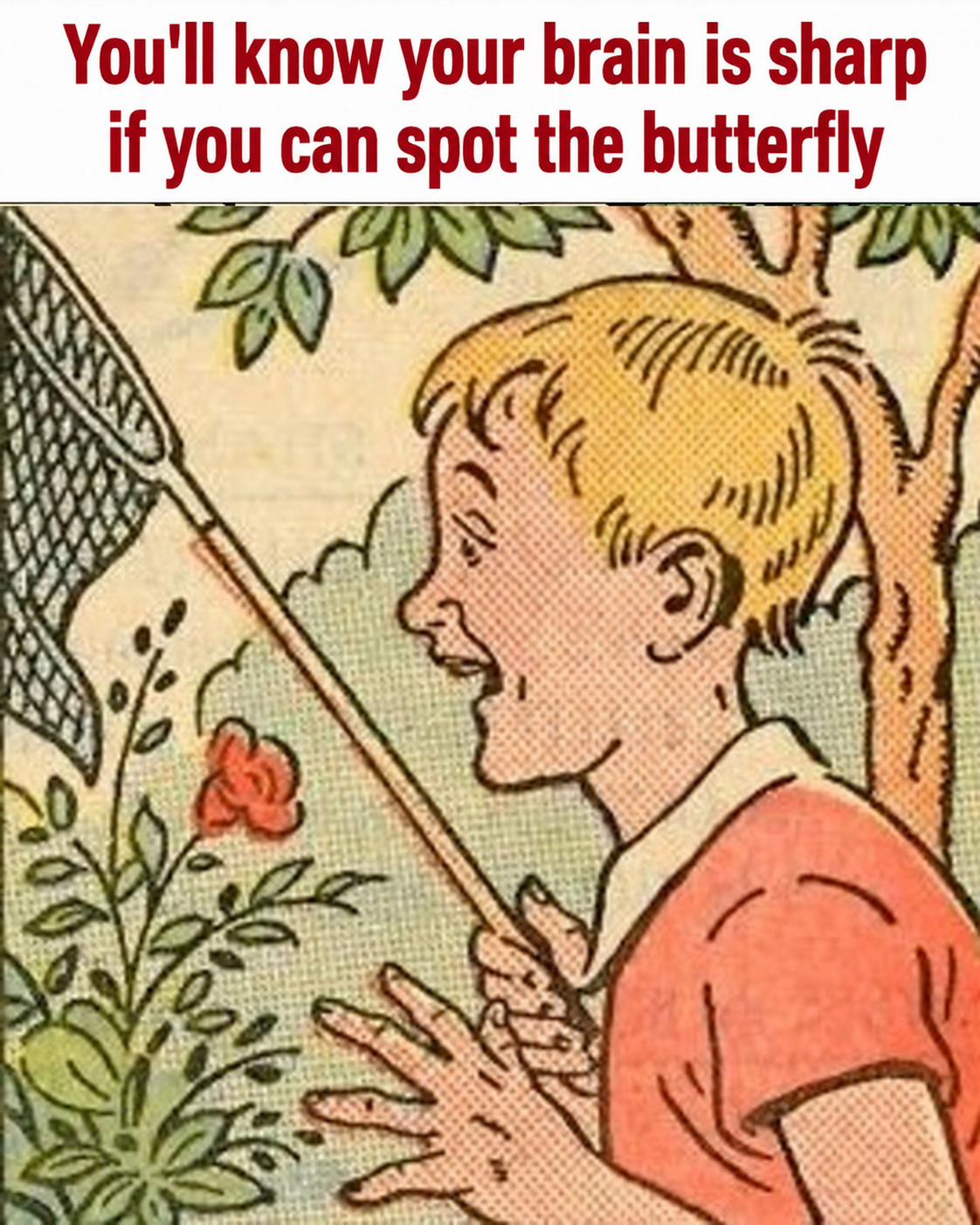
Today’s featured puzzle is a vintage illustration that has become widely shared across the internet. It challenges viewers to spot a tiny butterfly hidden in plain sight among a charming garden scene—an example of how art can cleverly play tricks on our perception.
The illustration shows a young boy standing outdoors on a sunny day, his posture suggesting excitement and anticipation. In his hands, he holds a net, hinting at a playful adventure or exploration. Surrounding him are lush green leaves and blooming flowers, creating a peaceful and inviting atmosphere.
Take a moment to look carefully at the image below:

At first, everything appears straightforward: a cheerful child, a garden alive with color. But somewhere in this idyllic scene, a secret lies waiting to be discovered—a butterfly, expertly camouflaged by the illustrator’s skillful use of lines and shapes. The invitation is simple: “Find the hidden butterfly as fast as you can.”
The Cognitive Challenge: Why Are Hidden Objects So Hard to Find?
Solving hidden object puzzles like this one requires both keen vision and mental flexibility. Our brains tend to look for familiar patterns, such as a brightly colored butterfly fluttering beside flowers. When the object is stylized, muted, or integrated into another form, we might overlook its presence entirely.
This phenomenon highlights how our expectations can influence perception. Cognitive psychologists describe it as “top-down processing”—we scan the picture based on what we think should be there, rather than what is actually present. When an artist disrupts this expectation, the brain must adapt and search anew, making the moment of discovery all the more rewarding.
Often, viewers report that after failing to spot the butterfly initially, a change in strategy—zooming in, taking a break, or systematically scanning each element—yields success. This not only exemplifies human persistence but demonstrates how perception is an active, constructive process.
Tips and Tricks: Sharpening Your Observational Skills
If you are struggling to locate the hidden butterfly, consider the following strategies:
- Break down the image: Examine specific areas such as the boy’s net, his clothing, and the surrounding trees and bushes.
- Look for unusual lines: Notice shapes or outlines that seem out of place or subtly different from their surroundings.
- Change your perspective: Sometimes stepping back, zooming in, or even flipping the image can help reveal hidden objects.
- Remove assumptions: Don’t expect the butterfly to appear in its typical form; it could be created by negative space, unique shading, or a composite of multiple elements.
Studies suggest that regularly practicing such puzzles can enhance cognitive abilities, including attention, visual discrimination, and working memory. For children, they provide an engaging way to develop problem-solving skills. For adults and seniors, they offer a fun and effective mental workout.
The Science Behind Visual Illusions
Optical illusions reveal much about the workings of the human brain. They demonstrate that seeing is not simply a passive function—our eyes receive information, but our minds interpret, organize, and sometimes even invent visual meaning. The butterfly in this puzzle is not hidden by invisibility, but rather by clever artistic design, which exploits our reliance on certain cues and patterns.
Neuroscientists and psychologists continue to study illusions to learn about neural pathways, the role of attention, and the interplay between memory and perception. Research at institutions such as the CDC, Mayo Clinic, and universities worldwide reinforces the value of mental exercises like these for brain health and cognitive longevity.
Puzzle Solutions: Reveal the Hidden Butterfly
Once you have spent time analyzing the illustration and feel satisfied with your efforts, you may wish to check your answer. Many find that even after staring at the scene for several minutes, the solution remains elusive until it suddenly leaps out—with a sense of surprise and delight.
Here is the answer, revealing where the butterfly is cleverly hidden within the picture:

If you found the butterfly quickly, congratulations! Your observational skills are truly exceptional. If it took longer, do not be discouraged—these puzzles are designed to trick even the sharpest minds. Psychologists note that appreciating the process and enjoying the moment are as important as finding the solution.
Feel free to share this puzzle with friends and family to see who has the quickest eyes. Comparing times and discussing strategies fosters social interaction and friendly competition, making hidden object puzzles a delightful activity for all ages.
Global Popularity and Educational Benefits
Hidden object puzzles like this vintage illustration are enjoyed worldwide, appearing in everything from children’s books to online challenges and educational materials. Internationally, educators use such puzzles to develop observation, concentration, and analytical thinking in students. They are also adapted in cognitive therapy programs for seniors, aiding in the maintenance of mental agility.
On social media, puzzles like these encourage community engagement, with users posting their findings, sharing hints, and debating solutions. This collective experience has helped revive interest in classic illustrations and vintage games, bridging generations and cultures.
Art historians note that many vintage puzzles reflect nostalgia and timeless artistic traditions, reminding us that sometimes, the simplest amusements offer the greatest satisfaction. The joy in discovering hidden details, the thrill of solving a mystery, and the communal aspect of sharing these challenges all contribute to the enduring popularity of optical illusions.
Conclusion: The Value of Visual Puzzles
Optical illusions and hidden object puzzles provide more than entertainment—they engage our minds, challenge our perceptions, and bring people together. Discovering the hidden butterfly, as simple as it seems, is a testament to both human creativity and the fascinating complexity of visual cognition. As you enjoy these puzzles, remember that the process of searching and learning is just as rewarding as the moment of discovery.
Whether for recreation, education, or cognitive well-being, keep exploring, stay curious, and share your experiences with others. You never know what hidden wonders you might find next!
Sources
Disclaimer: This content is intended for entertainment purposes only and is not based on real events.