The Orange Puzzle That is Driving Everyone Crazy

The Viral Orange Puzzle: Why Is It So Addictive?
On social media and online forums, simple puzzles often go viral, sparking heated debates and captivating audiences worldwide. One recent internet sensation is the so-called “orange puzzle,” an image that at first glance appears straightforward but continues to baffle millions of users. The premise seems simple: a photograph of some orange pieces, coupled with a seemingly easy question. Yet, the caption asserts, “90% of people will get this wrong!” Suddenly, a straightforward task becomes a mind-boggling riddle and fuels users’ determination to prove the statistic wrong.
What is behind the mass appeal of such puzzles? How do simple images turn into viral phenomena, and why is there so much debate over what should have been a definitive answer? Let’s break down the roots of this internet trend, analyze the actual orange puzzle, and discover why our brains crave these kinds of challenges.
The Psychology and Popularity of Visual Puzzles
At its core, the allure of visual puzzles lies in the human brain’s innate drive to find patterns and solve problems quickly. Visual recognition and mental shortcuts—known as heuristics—are evolutionary adaptations enabling humans to rapidly interpret the environment. This mental efficiency, while generally useful, makes us susceptible to optical illusions, ambiguous images, and the deliberate trickery found in viral internet puzzles.
Psychologists explain that the satisfaction we experience in solving such challenges originates from the brain’s reward center. When we think we quickly see the solution to a simple-looking riddle, we anticipate a rush of dopamine—the neurotransmitter associated with pleasure and reward. Yet, when a caption taunts us with statistics like “90% get this wrong,” our self-confidence is shaken, prompting a closer examination and deeper cognitive engagement. The desire to outthink the masses leads us to reconsider our initial answers and fuels the viral sharing of these images across social media platforms.
Analyzing the Orange Puzzle Image
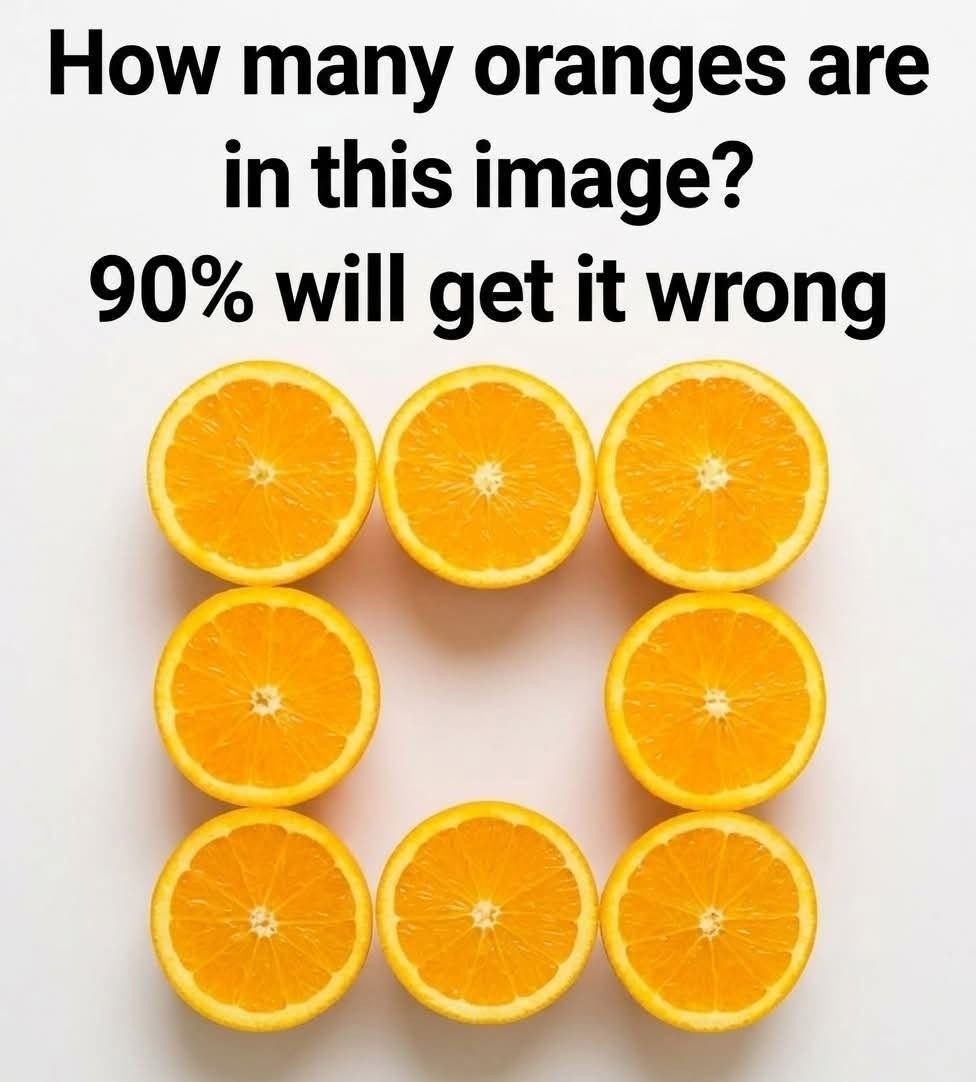
Take a closer look at the now-famous orange puzzle. The scene is composed of carefully arranged orange halves on a clean, white background. At first glance, viewers see a neat, symmetrical square: three pieces on the top row, one piece each on the left and right middle positions, and three more on the bottom row. The center of the square is notably empty.
If you simply count the visible orange segments as individual objects—a common reflex—you arrive at the number eight. Yet, the promise that “90% of people will get this wrong” injects doubt. Many begin to wonder if there is more nuance at play, suspecting that the trick might lie in semantics, visual deception, or clever photographic techniques. This triggers debates not only about the number of pieces but also about their nature and arrangement.
How Internet Puzzles Leverage Visual and Semantic Tricks
Internet puzzles often rely on ambiguity, both visually and linguistically. Sometimes, the puzzle’s challenge lies in the specific way a question is phrased. For instance, consider whether the query asks, “How many orange slices are there?” versus “How many oranges are in the image?” The subtle difference in phrasing can trip up even the most detail-oriented people.
Other times, these puzzles make use of digital editing or visual repetition—cutting, pasting, or rotating images to create misleading patterns. This tactic exploits our brain’s tendency to interpret images based on familiar shapes and configurations, making something ordinary, like a fruit, seem more complicated.
Deconstructing Possible Answers
To solve the orange puzzle accurately, let’s explore the main logical interpretations that tend to spark debate online:
1. Counting the Visible Halves
Examining the image closely, each orange segment appears to be one half of an orange rather than a thin slice. If you count a total of eight halves, simple math suggests you have four whole oranges represented (since two halves make up one whole).
This approach takes real-world logic into account, acknowledging the physical properties of oranges and how they are typically cut. Many users conclude that “four” is the most reasonable answer, as it respects both the image’s arrangement and everyday fruit-cutting conventions.
2. Interpreting Digital Manipulation
Some eagle-eyed observers notice striking similarities between the orange halves—identical pulpy patterns, matching edges, and duplicate textures. These telltale signs often indicate that the puzzle’s creator may have photographed a single half-orange, then duplicated the image multiple times using software. If that is the case, then regardless of how many orange shapes you see, only one real orange was ever used for the photographic composition.
This interpretation highlights a philosophical distinction: the difference between what is physically present and what is visually implied. In digital art and photography, objects can multiply without any actual increase in real-world items, creating yet another layer to the puzzle.
3. Literal Object Count
For those who focus strictly on the visual, a straightforward count yields eight distinct orange shapes. No tricks, no deeper meanings—just what the eyes see. From an artificial intelligence or computer vision standpoint, a program tasked with counting orange-like shapes would likely return “eight” as the answer.
This answer appeals to those who value empirical observation over layered interpretation. It demonstrates how context and purpose—whether logical, semantic, or visual—can fundamentally alter our conclusions.
Why Do People See Different Answers?
The orange puzzle is a prime example of what cognitive scientists call “ambiguity tolerance” and “confirmation bias.” Depending on our background, knowledge, and previous experiences, we unconsciously select the logic path that aligns with how we naturally interpret puzzles. Some readers prioritize physical realism (favoring answers like four), while others trust surface-level appearances (choosing eight). Still, others are attuned to digital trickery or rhetorical traps and look for “hidden” meanings (suggesting just one real orange in the image).
Across social media, these interpretations fuel lively discussions and friendly arguments. The puzzle transforms from a solitary activity into a shared experience, reflecting the diversity of human thought. It also brings to light how easily our perceptions can be manipulated based on the framing of questions and images—a topic studied extensively in the fields of psychology and behavioral economics.
The Science Behind Brain Teasers and Cognitive Bias
Experts in cognitive psychology explain that puzzles like the orange riddle exploit several mental shortcuts:
- Priming: The statement “90% will get this wrong” primes users to doubt their initial instincts, encouraging overthinking.
- Heuristic Reasoning: People tend to use general rules or previous experience (“if it looks like eight objects, it is eight”) instead of analytical thinking.
- Contextual Framing: The wording of the puzzle affects which part of our memory or logic we draw upon; small semantic changes yield different answers.
- Pattern Recognition: The brain is programmed to find and fill patterns, sometimes even where none exist, leading to imaginative or overly complicated interpretations.
These phenomena have been studied in depth by neuroscientists and behavioral economists, emphasizing the importance of critical thinking and awareness of cognitive biases in everyday life—especially in online environments rife with tricky content.
International Reactions and Societal Impact
While puzzles like the orange challenge are meant for entertainment, their viral spread also underlines the global nature of internet culture. Platforms such as Twitter, Facebook, Reddit, and Instagram routinely see such riddles shared among users of diverse backgrounds and languages. Each cultural lens brings its own interpretation, sparking educational discussions that bridge borders.
News outlets occasionally pick up on particularly viral visual puzzles, interviewing experts in psychology, mathematics, and digital media studies for insights. Teachers and educators incorporate such puzzles into curricula to hone students’ critical thinking and observational skills. Some universities use similar puzzles to study attention, memory, and cognitive bias. Ultimately, these simple visuals become tools for science communication and public engagement with the workings of the human brain.
Best Practices for Solving Viral Puzzles
If you want to improve your performance on viral puzzles—or simply enjoy them more—consider these tips:
- Read the question carefully and pay attention to wording.
- Look for potential digital edits, repeated patterns, or other signs of trickery.
- Count objects in more than one way to see if different perspectives yield different answers.
- Be aware of cognitive biases and priming effects.
- Remember that sometimes, the simplest answer is correct—but not always!
Engaging with these challenges can be more than just fun; it can sharpen your analytical and observational skills, both online and offline.
Conclusion: What Is the “Right” Answer?
The enduring appeal of the orange puzzle lies in its ambiguity. By considering the image, the context, and the question’s wording, we see that all the most common answers—one, four, or eight—are valid in their own way, depending on your logic. Most puzzle experts favor four, based on combining halves into wholes. However, the debate itself is the main event: it drives social interaction, highlights the complexity of perception, and encourages deeper thinking.
Ultimately, the orange puzzle reveals as much about human cognition and social behavior as it does about fruit. So next time you encounter a viral brain teaser, take a moment to enjoy the process of thinking—and maybe share your answer with friends for even more fun.
Sources
Disclaimer: This content is intended for entertainment purposes only and is not based on real events.