Classic Math Puzzles: Why Order of Operations Matters
Introduction to the Viral Classic Math Puzzle Trend
In recent years, classic math puzzles have become a staple of online entertainment and education. These puzzles, which often involve simple arithmetic problems reminiscent of childhood math classes, have seen a resurgence on social media platforms and educational websites. Their popularity can be attributed to their accessible nature, stimulating challenge, and the nostalgic sense they evoke among people of all ages.
Unlike complex brainteasers, these puzzles frequently revisit math problems similar to those encountered in middle or high school. As more users participate and share these problems, they not only enjoy friendly competition but also re-engage with fundamental mathematical principles that are crucial for accurate problem-solving.
The Puzzle That Sparks Debate
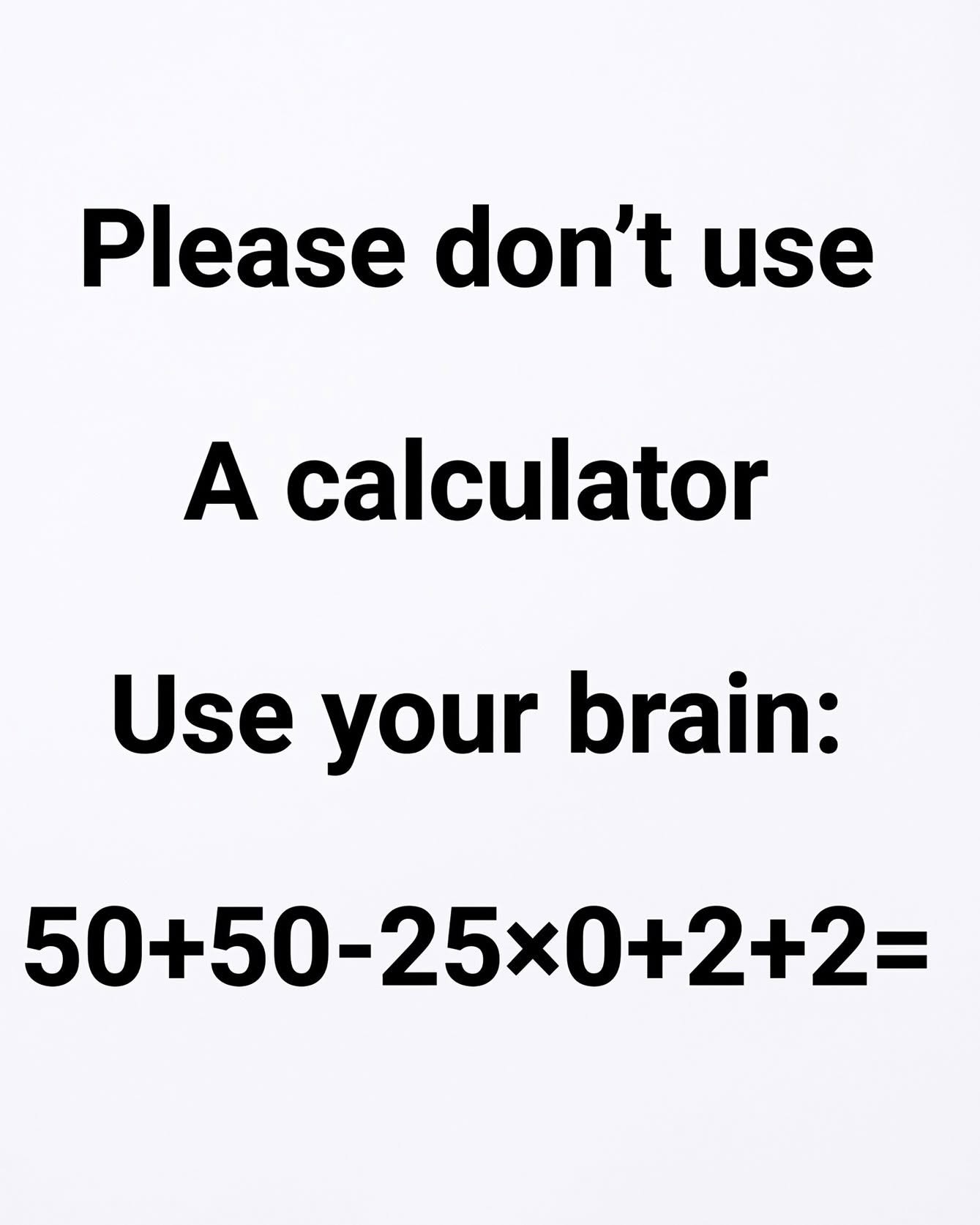
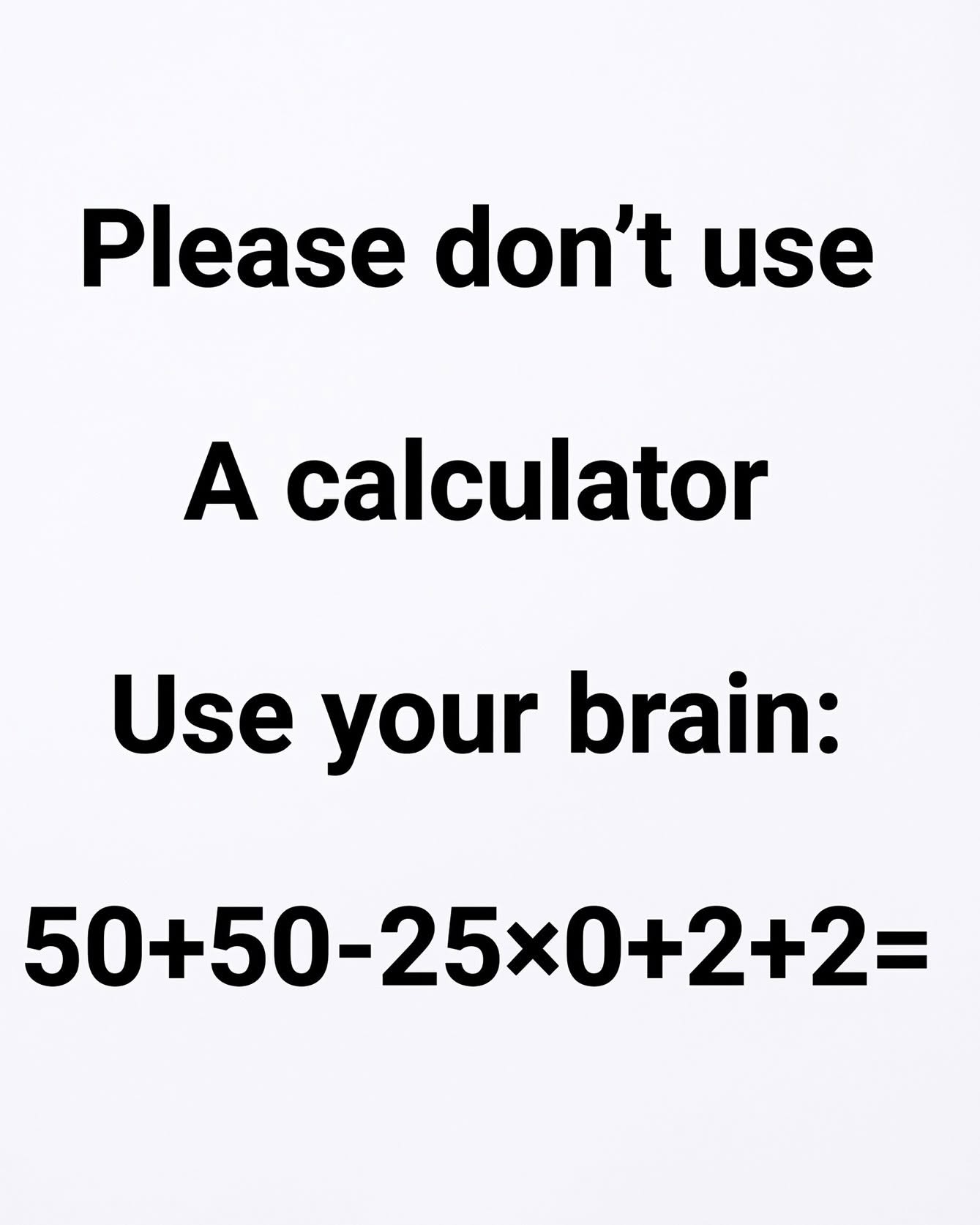
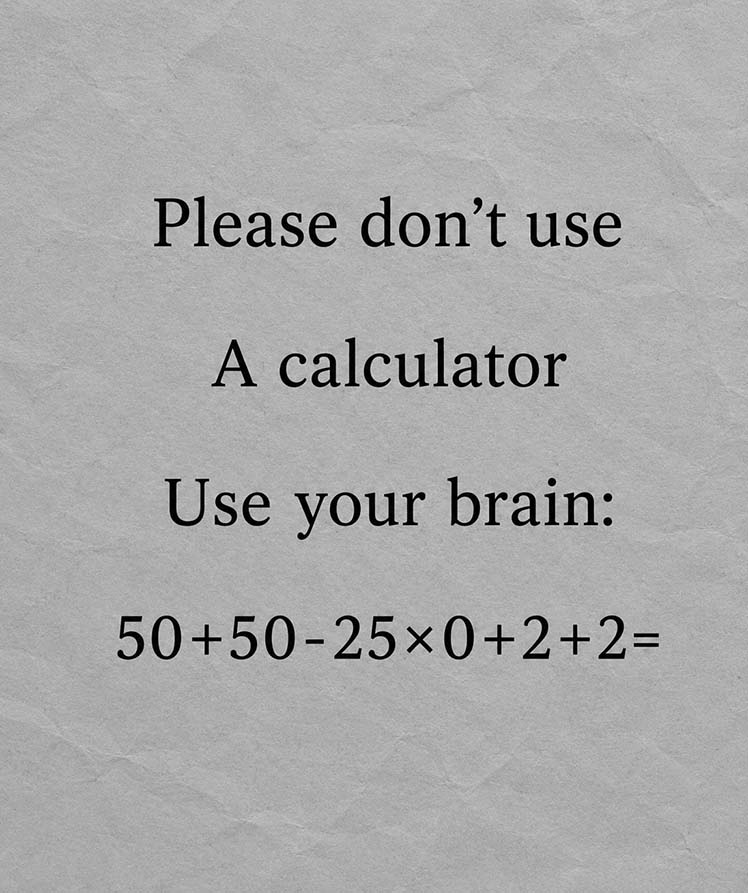
A perfect example of a viral math puzzle is the equation below, which has generated widespread discussion, debate, and varying answers online. Test your understanding and see if you can solve it correctly:
50 + 50 − 25 × 0 + 2 + 2 = ?
Many users rush to answer, often relying on intuition or speed rather than careful attention to mathematical rules. This often leads to mistakes and a variety of answers. What appears to be a straightforward arithmetic problem actually conceals a classic pitfall: overlooking the correct order of operations, a foundational concept in math education worldwide.
How to Approach Classic Arithmetic Puzzles
At first glance, the equation above may seem simple, but it underscores the importance of adhering to established mathematical principles. To solve it correctly, one must apply the order of operations—a set of rules that dictates the sequence in which mathematical operations should be performed.
Let’s break down the expression and solve it step by step:
Step 1: Apply the Order of Operations (PEMDAS/BODMAS)
Globally, students are taught to follow specific guidelines for solving mathematical expressions. In the United States, these are typically remembered through the acronym PEMDAS (Parentheses, Exponents, Multiplication and Division, Addition and Subtraction). Many other countries use BODMAS (Brackets, Orders, Division and Multiplication, Addition and Subtraction), which means essentially the same. These rules ensure consistency and accuracy in mathematical reasoning.
According to these principles, multiplication and division should be performed before addition and subtraction.
Let’s identify the multiplication in the equation:
- 25 × 0 = 0
After simplifying the multiplication, the equation now reads:
50 + 50 − 0 + 2 + 2
Step 2: Addition and Subtraction from Left to Right
Now, continue with the remaining operations from left to right, as is standard:
- 50 + 50 = 100
- 100 − 0 = 100
- 100 + 2 = 102
- 102 + 2 = 104
The correct and final answer is:
50 + 50 − 25 × 0 + 2 + 2 = 104
Common Pitfalls: Why Mistakes Happen
Despite the straightforward nature of the math involved, a surprising number of people arrive at the wrong answer. This common error is rooted in a misunderstanding or forgetfulness of mathematical conventions. A frequent incorrect approach is to simply work from left to right, ignoring the hierarchy of operations:
- 50 + 50 = 100
- 100 − 25 = 75
- 75 × 0 = 0
- 0 + 2 + 2 = 4
This flawed process yields the incorrect answer of 4, which is often given with confidence. This outcome vividly demonstrates why the order of operations is not merely a classroom rule, but an essential concept in ensuring universally accepted mathematical results.

The Psychological Draw of Math Puzzles
Classic puzzles enjoy enduring popularity for several psychological and educational reasons. Firstly, they offer a low-stakes environment to recall and test foundational knowledge. This reminder can serve as a modest check on one’s mathematical memory and accuracy. For many people, the sense of accomplishment from arriving at the correct answer is boosted by the knowledge that many others may not. On social media, such puzzles tap into competitive tendencies: users seek to showcase their problem-solving skills or challenge their friends and family to do better.
Experts in cognitive science highlight that these puzzles also help reinforce neural pathways associated with logical reasoning, attention to detail, and critical thinking. Dr. Jo Boaler, a professor of mathematics education at Stanford University, emphasizes that “actively engaging with math puzzles helps people of all ages retain and refresh essential mathematical concepts they might not use regularly.”
The Educational Value of Revisiting Math Rules
Beyond fun and competition, such puzzles serve a crucial educational purpose. They remind learners of the lasting importance of fundamental concepts taught early in education. The order of operations is not just a relic of school mathematics exams but a principle that underpins all of modern mathematics, science, engineering, finance, and beyond. Misapplying these rules can result not only in silly mistakes on puzzles but also in significant errors in professional or everyday contexts.
Math educators and curriculum designers frequently use these types of puzzles in classrooms to diagnose learning gaps and reinforce essential knowledge. According to the Centers for Disease Control and Prevention, strengthening STEM (Science, Technology, Engineering, and Mathematics) skills is closely linked to daily practice and engagement with fundamental mathematics, which includes the order of operations.
Order of Operations: Universal Standards Across Borders
Globally, educators strive to ensure that students internalize the order of operations to facilitate clear communication and cooperation. International standardized tests and school curricula from countries such as the UK (BODMAS), the US (PEMDAS), parts of Asia, and others, all emphasize its importance. Even professional disciplines—like accounting, engineering, and computer programming—rely on consistent mathematical rules to avoid ambiguity, prevent errors, and enable collaboration.
Discussions about puzzles such as 50 + 50 − 25 × 0 + 2 + 2 also often open up deeper dialogues about mathematical literacy, critical thinking, and the real-world value of academic education. While arithmetic puzzles might seem simple, their capacity to reveal subtle misunderstandings underscores the ongoing need for math education reform and lifelong learning.
Expert Views on Arithmetic Puzzles in Modern Learning
Educational experts view the viral popularity of arithmetic puzzles positively. Dr. Sherry Parrish, a notable mathematics educator, argues that “challenges like these are not only entertaining but also a powerful formative assessment tool for educators.” She notes that when students (or adults) get these problems wrong, it reveals harmless gaps that are easily corrected with gentle reminders and practice.
At the college and university level, mathematics professors maintain that such puzzles are an entry point into more sophisticated mathematical thinking, where logical rigor and sequential reasoning become critically important. These simple exercises are the first step toward more advanced topics like algebra, calculus, and data science, all of which also rely on strict adherence to procedural order.
Several educational technology platforms—such as Khan Academy, Coursera, and others—incorporate these kinds of puzzles to engage users. The approach encourages self-correction, discussion, and communal learning—aided by comment sections or discussion forums where people debate solutions and reasoning.
Global Public Response and Societal Reactions
The societal reaction to such puzzles is overwhelmingly positive. Social media threads, online learning groups, and educational forums teem with versions of these challenges. They serve both as a light-hearted pastime and as communal exercises in basic numeracy. For parents and teachers, these puzzles are valuable tools to re-engage children and adolescents with math, presenting learning as a game rather than a chore.
Internationally, these puzzles transcend language and cultural barriers, as the underlying mathematics remains universal. This universality fosters a shared sense of problem-solving and global citizenship, where millions can participate, discuss, and learn regardless of their educational or geographic background.
Moreover, educational outreach programs and non-profits working to improve numeracy rates in underserved regions have documented the appeal and effectiveness of these puzzles as “starter activities” before more advanced instruction.
The Takeaway: Mastering Order of Operations
In conclusion, classic math puzzles like 50 + 50 − 25 × 0 + 2 + 2 = ? offer far more than an opportunity for friendly online competition. They are reminders of the enduring value of following established rules, like the order of operations, for consistent problem-solving. As the global conversation around math education continues, such puzzles remind us that learning never truly ends and that foundational skills are always relevant.
If your answer was 104, you applied the correct order of operations and demonstrated keen attention to detail. For everyone else, puzzles like this offer a gentle, enjoyable refresher and a chance to boost confidence in math.
Sources
- BBC News – Education
- CDC – STEM Education
- Khan Academy – Order of Operations
- Reuters – Technology News
- The Guardian – Mathematics
Disclaimer: This content is intended for entertainment purposes only and is not based on real events.