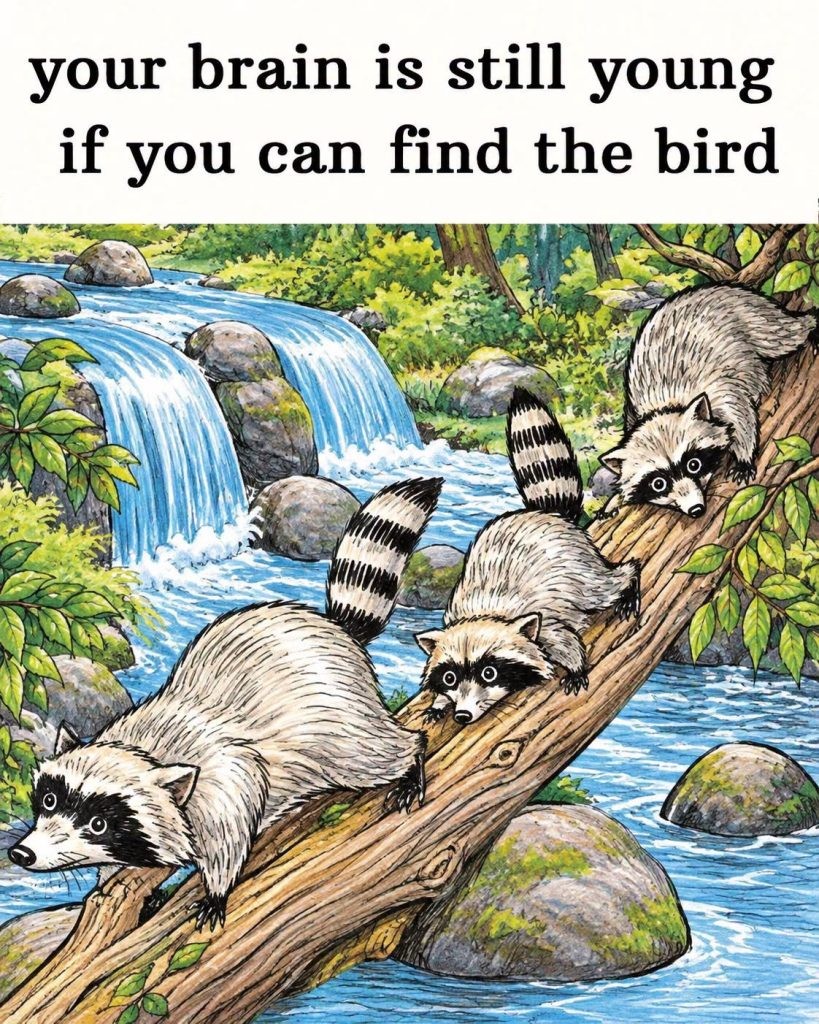
Can You Find the Hidden Bird in This Forest Drawing?
Introduction: The Power of Visual Puzzles
Visual puzzles have long captivated audiences around the world, engaging both casual observers and experts in psychology and art. Among the most intriguing are images that cleverly conceal an object or figure, challenging individuals to look beyond the obvious. One such illustration features a tranquil forest scene, depicted in black-and-white with meticulously detailed raccoons, trees, rocks, and a gentle stream. At first glance, the image appears straightforward and serene, but it harbors a hidden challenge: locating a bird skillfully disguised within the scenery.
How Visual Illusions Manipulate Our Attention
Visual illusions like this puzzle rely on subtle artistic techniques that take advantage of natural perceptual tendencies. The artist intentionally blends the bird’s outline into the forest background by using shapes, shading, and lines that mimic those of the tree trunks, rocks, and foliage. As a result, when viewers scan the picture their attention gravitates toward the familiar and distinct subjects—raccoons, a tree trunk, and other prominent features—while the hidden bird remains camouflaged.
This effect is rooted in psychological processes known as figure-ground perception. According to the American Psychological Association, figure-ground perception allows viewers to distinguish objects (figures) from the surrounding environment (ground). However, artists can exploit this by making the figure resemble the ground, tricking the brain into overlooking it altogether. In this forest drawing, the bird’s outline is so closely matched to the background that viewers must adjust their focus and perspective to even begin to see it.
The Science Behind Seeing: Why Hidden Images Are So Difficult
Understanding why so many people struggle with this puzzle involves delving deeper into the mechanics of vision and cognition. When scanning a new image, the human brain processes information efficiently by prioritizing bold shapes and familiar patterns. The raccoons and trees dominate attention because they contrast with negative space and follow expected natural forms. However, the bird—crafted to blend seamlessly—does not stand out, fading into the visual noise.
Neuroscientists have studied this phenomenon extensively. Research reported by outlets such as the BBC and Scientific American explains that attention is guided by the brain’s “salience map,” which identifies areas of importance based on contrast, color, and movement. In black-and-white drawings, the lack of color further increases the difficulty, forcing viewers to rely on form and shadow alone. The process of “inattentional blindness”—where obvious items go unnoticed when attention is focused elsewhere—comes into play, making hidden figures particularly elusive in this kind of puzzle.
Strategies for Solving Hidden Object Puzzles
For those eager to meet the challenge of the hidden bird, there are several strategies that experts recommend. Vision researchers at the Mayo Clinic and psychological studies from the CDC offer guidance for enhancing observational skills:
- Scan methodically: Instead of focusing on the raccoons or central tree, scan the image slowly from top to bottom and left to right. Examine each segment deliberately.
- Look at the edges: Hidden objects often lurk at the margins, where lines blur and details are less prominent. Pay attention to the boundaries between foreground and background.
- Change perspective: Sometimes, viewing the image from an unusual angle or even stepping back can help reveal disguised shapes. The bird may emerge as a subtle form only visible when you stop focusing on obvious elements.
- Analyze patterns: The artist uses patterns and repetitive lines to blend the bird into its surroundings. Search for breaks in these patterns—odd curves or feathers—that don’t quite fit the established rhythm of the drawing.
- Practice patience: Many viewers spend several minutes before finding the hidden bird. The puzzle tests both visual acuity and endurance, rewarding those willing to persist.
The Role of Visual Art in Cognitive Development
Hidden object puzzles are more than simple entertainment. Cognitive psychologists and educators recognize them as valuable tools for developing attention, concentration, and problem-solving skills. According to research highlighted by the World Health Organization (WHO) and scientific articles from organizations like the CDC, children who regularly engage in visual puzzles can improve their spatial awareness and memory.
Art teachers and therapists often incorporate these challenges into curricula and therapy sessions. The process of searching for hidden figures encourages mindfulness, patience, and analytical thinking. For adults, such puzzles can serve as a mental workout, stimulating brain regions responsible for pattern recognition and creative reasoning.
Public and Expert Reaction to the Forest Drawing Challenge
The forest drawing with the concealed bird has become popular in digital communities, sparking widespread interest on social media platforms and puzzle forums. International reactions highlight the universal appeal of optical illusions as a form of interactive art. Many observers report spending several minutes, or even longer, hunting for the bird before giving up or experiencing an “aha” moment.
Experts in vision science and psychology often weigh in on the discussion, offering insights into why certain individuals excel at spotting hidden images while others struggle. Factors such as age, visual training, and prior experience with optical illusions all influence effectiveness. Professionals from the Mayo Clinic note that patients recovering from brain injuries or vision impairments frequently use similar puzzles for therapeutic exercises.
Artistic Techniques Used in Concealment
The artist who designed the forest drawing employs several classic techniques to obscure the bird. These include:
- Camouflage: The bird’s feathers are drawn with the same textures as tree bark or leaf veins, making it indistinguishable at first glance.
- Negative space: By positioning the bird so that its shape fits perfectly within gaps between rocks or branches, the artist effectively hides it in plain sight.
- Line continuity: Strategic lines redirect viewers’ attention, creating flow and motion that distract from the concealed subject.
- Minimal shading: Subtle differences in light and shadow are minimized, increasing the challenge and requiring sharper observation.
These methods are familiar to artists specializing in visual deception. Historical examples include works by M.C. Escher and Salvador Dali, as well as popular hidden object illustrations in children’s books and educational materials.
Global Perspective on Optical Illusions
Optical illusions are celebrated worldwide, both as a form of entertainment and as tools for psychological research. Countries such as Japan and France have developed dedicated art exhibits showcasing illusions, while international scientists collaborate to explore their impact on cognition and learning.
Media outlets like Reuters and The Guardian regularly feature new puzzles and viral images, emphasizing the global fascination with these phenomena. Researchers at the WHO and CDC analyze how optical illusions can be applied in medicine, for example, helping patients with damaged visual processing to retrain their brains.
Enhancing Perceptual Skills for Everyday Life
While the forest drawing is a playful exercise, the skills developed in solving such puzzles transfer to real-world tasks. Enhanced perception is valuable for drivers avoiding hazards, scientists interpreting complex data, and artists refining their craft. According to the Mayo Clinic, activities that challenge observational skills contribute to overall brain health and may reduce cognitive decline.
Encouraging children, adults, and seniors to participate in visual puzzles fosters lifelong learning and mental agility. As society becomes increasingly aware of the importance of mental exercise, puzzles like the hidden bird drawing take on new significance as more than just a pastime.
Tips for Finding the Hidden Bird
Ready to take on the challenge? Keep these expert tips in mind:
- Don’t rush—move slowly and methodically.
- Use your finger or a pencil to trace over the image, looking for irregular shapes.
- Remain open to seeing the bird in unexpected locations—even within the rocks or stream.
- If you have trouble, try taking a break and returning later; fresh eyes often succeed where tired ones fail.
- Share the puzzle with friends or family—collaborative searching can reveal new perspectives.
Conclusion
The black-and-white forest drawing, with its hidden bird and engaging natural details, is more than just a test of patience. It exemplifies the power of visual art to challenge perception, encourage scientific inquiry, and foster cognitive growth. Whether you find the bird quickly or after much effort, you participate in a global tradition of using art to expand the mind and celebrate creativity. Take your time to explore each part of the image—and enjoy the journey of seeing the world in new ways.
Sources
- Reuters
- BBC
- The Guardian
- Al Jazeera
- World Health Organization (WHO)
- Centers for Disease Control and Prevention (CDC)
- Mayo Clinic
- American Psychological Association (APA)
- Scientific American
Disclaimer: This content is intended for entertainment purposes only and is not based on real events.