Can You Find the Hidden Bird? The Cognitive Science Behind Visual Puzzles
Introduction: The Challenge of Visual Puzzles
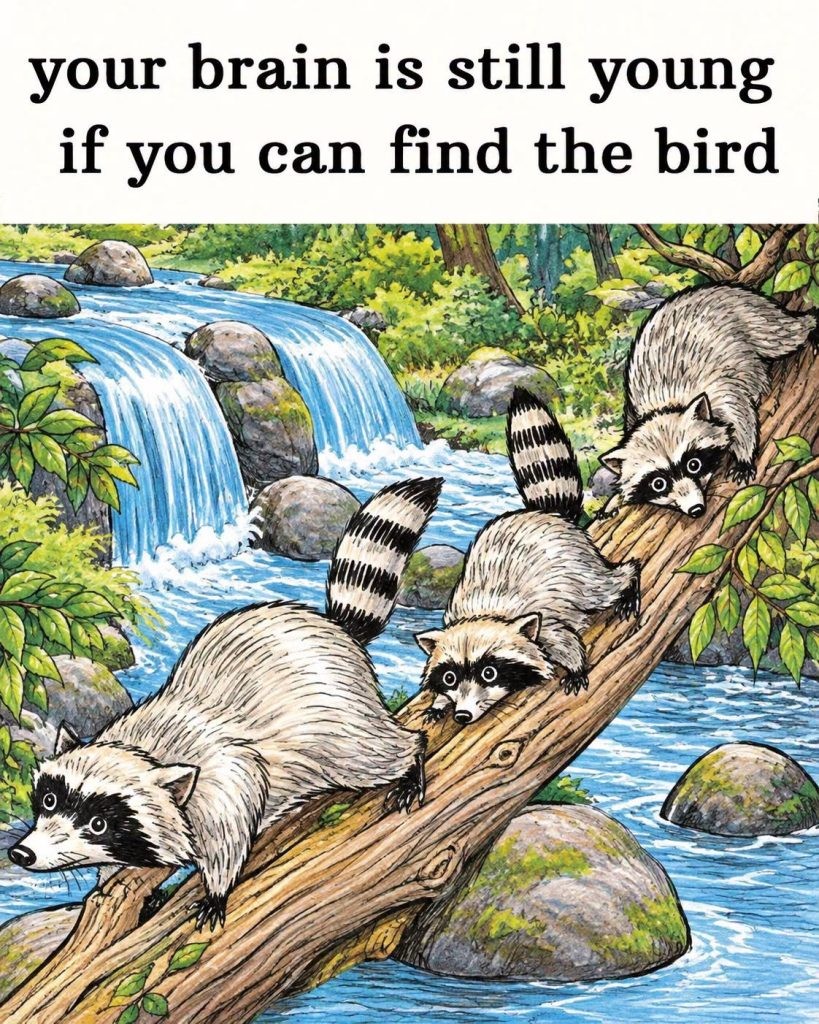
Visual puzzles and optical illusions have long fascinated both artists and scientists for their ability to challenge our perception and reasoning. One such puzzle features a black-and-white drawing of a forest scene composed of raccoons, trees, rocks, and a stream. At first glance, the illustration appears calm and straightforward, but it hides a cleverly concealed bird within its intricate detail. Despite its apparent simplicity, the task of locating the hidden bird proves difficult for many people, sparking curiosity about why our minds find such puzzles so tricky.
The Science of Perception and Visual Processing
Human visual perception is a complex process involving numerous regions of the brain. When viewing an image, our eyes transmit information to the brain, which then interprets shapes, colors, and patterns. Familiar objects like raccoons and trees tend to grab our attention first because our brains are wired to quickly recognize and categorize common features. This phenomenon, known as “top-down processing,” is a cognitive shortcut that helps us navigate the world efficiently but can cause us to overlook less obvious elements in a scene.
Optical illusions and hidden object puzzles specifically exploit these perceptual habits. Artists skillfully design such images to draw our focus to dominant objects or misleading cues while hiding a target—like the bird—in less obvious regions. Psychological research suggests that these puzzles work by overwhelming our visual attention with competing priorities, making the concealed subject difficult to spot without careful scrutiny.
Artistic Techniques: Camouflage and Concealment
Camouflage is an art technique often used in both nature and illustration to blend subjects seamlessly into their environment. In the forest drawing with raccoons and a stream, the artist deploys a variety of tricks: the bird is obscured among tree branches, rock shapes, and shadow lines. The use of monochrome colors and the dense layering of detail means your eyes tend to gloss over subtle distinctions. Shapes and negative spaces are manipulated so the hidden bird merges with background patterns.
This approach mimics strategies used by animals in the wild. Many species, such as certain birds or insects, rely on cryptic coloration and disruptive shapes to avoid detection by predators or observers. By adopting these methods, illustrators create challenges that echo natural camouflage and test our powers of observation.
Attention, Focus, and Pattern Recognition
The key to solving visual puzzles lies in attention and pattern recognition. Cognitive scientists have shown that our brains automatically prioritize familiar forms, like the raccoon silhouettes and tree trunks in the drawing. This automaticity allows us to quickly categorize scenes but often blinds us to anomalies or subtle cues. To counteract this tendency, one must shift focus away from the immediate, obvious features and carefully analyze edges, spaces, and intersecting lines.
One effective method is to deliberately scan areas of the image that seem unimportant or empty. Sometimes changing the perspective—such as viewing the scene upside-down or from the side—can reveal the hidden clue. This process, called “active visual search,” involves moving your gaze systematically and adopting different strategies when stuck. Cognitive research shows that increased patience, mindfulness, and willingness to reconsider assumptions significantly enhance puzzle-solving skills.
The Psychological Appeal of Hidden Object Puzzles
Why do people find these puzzles so compelling? According to psychologists, hidden object challenges tap into our innate desire for problem-solving and mastery. Successfully finding a concealed figure provides a sense of achievement and stimulates positive emotions. These puzzles also serve as a form of mental exercise—improving visual acuity, concentration, and resilience against distraction.
Additionally, visual illusions and hidden puzzles foster curiosity and exploration. The uncertainty and anticipation associated with searching for something unseen motivates repeated engagement and can even promote collaborative problem-solving when tackled in groups or shared online.
How to Approach a Visual Puzzle Like the Hidden Bird
If you wish to improve your ability to solve visual puzzles, cognitive science suggests several strategies:
- Slow Down: Take time to absorb details rather than rushing through the image.
- Examine Edges and Negative Spaces: Hidden objects often reside where lines converge or in seemingly empty regions.
- Change Perspective: View the puzzle from different angles or distances, as variations in focus can reveal concealed features.
- Look for Patterns: Search for subtle discrepancies in shapes or shades that could indicate the hidden figure.
- Practice Mindfulness: Clear your mind and concentrate, as distractions can prevent recognizing concealed cues.
In the specific case of the forest drawing, patience and methodical inspection are critical. Many viewers scan the illustration for minutes or even longer, often overlooking the bird until they purposefully adjust their approach. As with all puzzles, practice enhances skill—solving a range of visual challenges can sharpen your observational ability over time.
Art, Science, and the Global Popularity of Optical Illusions
Visual puzzles have grown in popularity worldwide, fueled by social media and digital platforms that encourage sharing and collective problem-solving. Artists continue to develop new and creative illusions, drawing upon advances in neuroscience and psychology. Museums, education programs, and online communities dedicate resources to the study and enjoyment of optical illusions, recognizing their value in both art and cognitive science.
Educational researchers advocate for the inclusion of such puzzles in classrooms as a means of fostering critical thinking and visual literacy. Experts argue that exposure to complex images helps students develop skills that are transferable to mathematics, science, and everyday reasoning tasks. Notably, many renowned institutions—such as the National Institutes of Health and Vision Science Laboratories—explore how visual illusions reveal fundamental processes in human cognition and perception.
International Reactions and Societal Context
Countries around the world appreciate visual puzzles both for entertainment and educational purposes. In Japan, “hidden picture” illustrations are featured in children’s magazines and artistic competitions. In the United States and Europe, optical illusions are used in science museums and therapy settings for rehabilitation after brain injuries.
The societal impact extends beyond mere fun. Researchers study these illusions to understand neurological disorders, visual impairments, and the psychology of attention. Such studies contribute to better treatments and improved educational methods, making the study of visual puzzles relevant for health and wellbeing globally.
On social media platforms, widespread sharing of optical illusions fosters cross-cultural dialogue and creative engagement. Challenges like “Find the Hidden Bird” unite people in friendly competition, promote perseverance, and highlight the fascinating interplay between art and science.
Expert Views: Psychology and Neuroscience Behind the Puzzles
Leading experts in psychology and neuroscience have dissected the components that make visual puzzles so effective. According to Dr. Richard Gregory, a pioneer in British neuroscience, illusions reveal the brain’s tendency to interpret incomplete information based on prior knowledge and expectation. Dr. Susana Martinez-Conde of the Barrow Neurological Institute notes that illusions help scientists study how visual information is processed and why certain conditions trick our minds.
Research published in journals such as “Vision Research” demonstrates that training with optical puzzles can improve visual attention and help rehabilitate deficits caused by stroke or injury. Artists, such as Maurits Escher and contemporary illustrators, employ mathematical proportions and symmetry to enhance the difficulty of their puzzles, blending the boundaries between art and scientific exploration.
Conclusion: The Enduring Value of Hidden Object Puzzles
The challenge to find the hidden bird in a calm forest illustration exemplifies the enduring appeal of visual puzzles. These artworks not only entertain and promote cognitive skills but also bridge art and science through their ability to engage our minds deeply. The process of searching for concealed objects encourages patience, mindfulness, and creative thinking, benefiting people across ages and cultures.
Whether for recreation, education, or research, optical illusions and hidden object puzzles offer timeless opportunities for learning and discovery. As artists continue to invent new challenges and scientists advance our understanding of perception, the fascination with visual puzzles is sure to endure, inspiring generations of observant problem-solvers.
Sources
- BBC News – The science of optical illusions
- Reuters – Why the brain falls for optical illusions
- The New York Times – How optical illusions trick our brains
- Vision Research Journal
- NIH – Visual Illusions and Cognition
Disclaimer: This content is intended for entertainment purposes only and is not based on real events.