I Was Against My Son Marrying a Woman with a Daughter, Until I Learned What Family Means
Family, for many, conjures images of shared ancestry and traditions passed down through generations. Yet in today’s world, the very definition of family is evolving, reflecting changing norms, blended relationships, and new beginnings. This is the story of how personal doubts about blending families transformed into an appreciation for love that can transcend bloodlines.
The Origins of Doubt: When Change Feels Unfamiliar
For years, I envisioned my son marrying someone whose background resembled our own, imagining grandchildren who would naturally fit into the patterns I’d always known. However, life offered a different path when he fell in love with a woman who had a daughter, Amy, from a previous relationship. Despite seeing my son’s happiness, I hesitated. Questions filled my mind: Would Amy ever truly feel like family? Could I open my heart to a child with no biological tie to me?
When the wedding took place, I attended out of love for my son, but my reservations lingered. I watched as he welcomed Amy as if she were his own, integrating her effortlessly into their new family. Yet, I remained a distant observer, unsure of my role and hesitant to embrace Amy as my granddaughter.
A Moment that Changed Everything
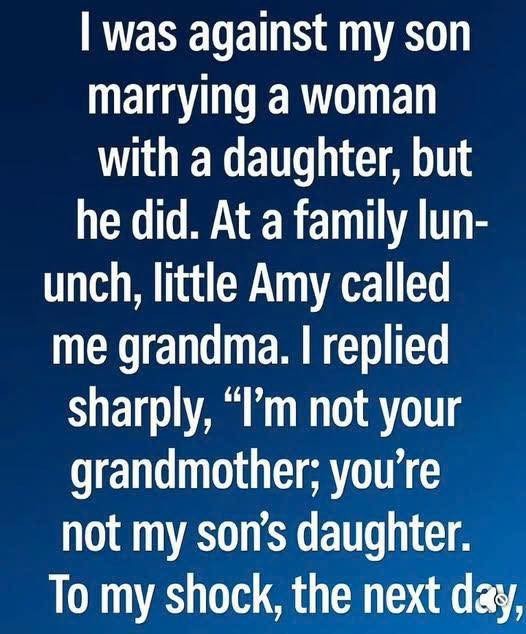
The shift occurred during a seemingly ordinary family lunch. Seated around the table, laughter and conversation filled the room. Then, Amy, with a shy smile, looked up at me and said, “Grandma, could you pass the bread?” Instinctively, words of rejection slipped from my mouth: “I’m not your grandmother; you’re not my son’s daughter.” The words, spoken sharply, seemed to freeze the room. Amy’s face, once bright with anticipation, fell in confusion and hurt.
After lunch, the day weighed heavily on me, but the true reckoning came the next. My son arrived at my doorstep, his usual easygoing expression replaced by disappointment and pain. He asked gently, yet firmly, why I would speak so harshly to a child who wanted nothing more than to love me. The conversation was brief, but the impact profound. For the first time, I truly considered the consequences of my words, the effect my actions had on Amy’s budding trust, my son’s happiness, and the unity of our growing family.
A Sleepless Night and a Change of Heart
That evening, sleep evaded me. Amy’s soft voice echoed in my memory, her confusion replaying in my mind. The innocence with which she saw the world—and me—stood in stark contrast to my own apprehensions. I recognized that my resistance had little to do with Amy herself and everything to do with my own uncertainty. She was a child seeking warmth and acceptance, hoping for the security and love a grandparent might give.
Through the long night, I questioned the roots of my unease. Why had I so fiercely clung to tradition and biology as barriers to love? The realization dawned that family could mean more than genetic ties. My son had chosen a partner filled with kindness, and Amy, with her bright eyes and thoughtful spirit, was attempting to offer me a new role—as her grandmother, by choice and by heart.
Taking the First Step: An Invitation to Love
The next day, determined to mend bridges, I invited my son, his wife, and Amy for dinner. When Amy entered, there was a visible hesitancy—her small hand clutched tightly in her mother’s, her eyes searching mine for reassurance. In that moment, I made a choice. I knelt down and silently held out my arms, inviting her to come closer. “If you still want to call me grandma,” I said softly, “I would like that.” Relief and delight crossed her face as she hugged me tightly, and I felt my own heart lighten. In that simple exchange, a barrier fell away, replaced by a gentle sense of belonging.
The Journey of Blending a Family: Lessons Learned
With time, small acts of kindness and acceptance wove us together. Amy’s laughter echoed through my home, her drawings festooned my refrigerator, and our weekends became filled with simple joys like baking cookies or gardening. These moments were not about replacing anyone or rewriting history; they were about extending love to include someone who dared to hope for it.
Through each passing month, I watched Amy blossom, her confidence growing as she felt secure in our bond. Her mother, too, became an integral part of our lives, bringing perspective, warmth, and a quiet resilience that buoyed us all. My son beamed with gratitude, reassured that his family—though unconventional by past standards—had found its footing and its heart.
The Broader Meaning of Family in Modern Society
Blended families are now a common part of the social landscape. According to the U.S. Census Bureau, nearly 1 in 6 children live in blended families, highlighting the prevalence and importance of navigating these relationships with empathy and openness. Experts from the Mayo Clinic and the American Psychological Association emphasize the importance of flexibility, clear communication, and patience as keys to building trust in blended households.
Such families bring unique challenges. Children may feel divided loyalties or worry about fitting in, while adults may grapple with new roles. Yet research consistently underscores the positive outcomes for children who are embraced and accepted, regardless of biological relationships. Stability, love, and acceptance within the home serve as protective factors, promoting healthy development and emotional security for children like Amy.
Cultural Perspectives: Redefining Grandparenthood
Across cultures, the definition of grandparenthood has often centered on bloodlines, with rights and traditions tightly linked to ancestry. However, there is growing recognition of the powerful influence non-biological grandparents can have. From step-grandparents to adoptive and foster grandparents, these relationships, though different in origins, can be just as meaningful and supportive as traditional ones.
Globally, societies are re-examining and sometimes expanding traditional family roles to accommodate diverse realities. Support groups, counseling services, and educational programs are increasingly available to assist families navigating new beginnings. These resources advocate that love and consistent presence, rather than genetics alone, are what truly define family for both children and adults.
Expert Insight: Psychological Effects on Children
According to leading child psychologists, children thrive most in environments where they feel genuinely accepted and supported. Blended families pose unique adjustments, but when adults set aside their apprehensions and prioritize the well-being of the child, trust and affection naturally follow. When a child feels welcomed, as Amy did when I finally accepted her open affection, significant emotional benefits accrue—not only for the child but for the family as a whole.
The Mayo Clinic encourages families to build new traditions, foster open dialogue, and recognize that relationships develop over time. Occasional setbacks are natural, but perseverance, patience, and a willingness to apologize and learn pave the way for rewarding connection.
Personal Growth: A New Understanding of Love
As the seasons changed, so did my perspective. Amy did not replace any grandchildren I might one day have by blood; rather, she expanded my definition of what it means to love and be loved. My home, once echoing with old ideas, became a space for new laughter, creativity, and shared experiences. My relationship with my son deepened, too, forged stronger by overcoming initial misunderstandings and building genuine acceptance.
The experience has taught me that the heart has a remarkable capacity for growth. When we let go of outdated beliefs, we make space for joy and connection in unexpected forms. Blended families do not diminish the past—they build on it, creating legacies rooted not just in genealogy, but in kindness, resilience, and shared hope.
Reflections: The True Meaning of Family
Family is ultimately defined by the bonds we choose to nurture. My grandson’s gentle rebuke, Amy’s courage to love, and my own willingness to learn have all converged to create a richer, more inclusive home. The lesson I’ve come to understand, one echoed by family counselors and social scientists alike, is simple: family is a commitment to care, irrespective of blood. It is something we shape, one act of kindness, one embrace, and one shared hope at a time.
If you find yourself in a blended family, know that challenges may arise. Yet with open communication, empathy, and a willingness to grow, new beginnings become possible, and family can be reimagined in surprising and beautiful ways.

Sources
Disclaimer: This content is intended for entertainment purposes only and is not based on real events.