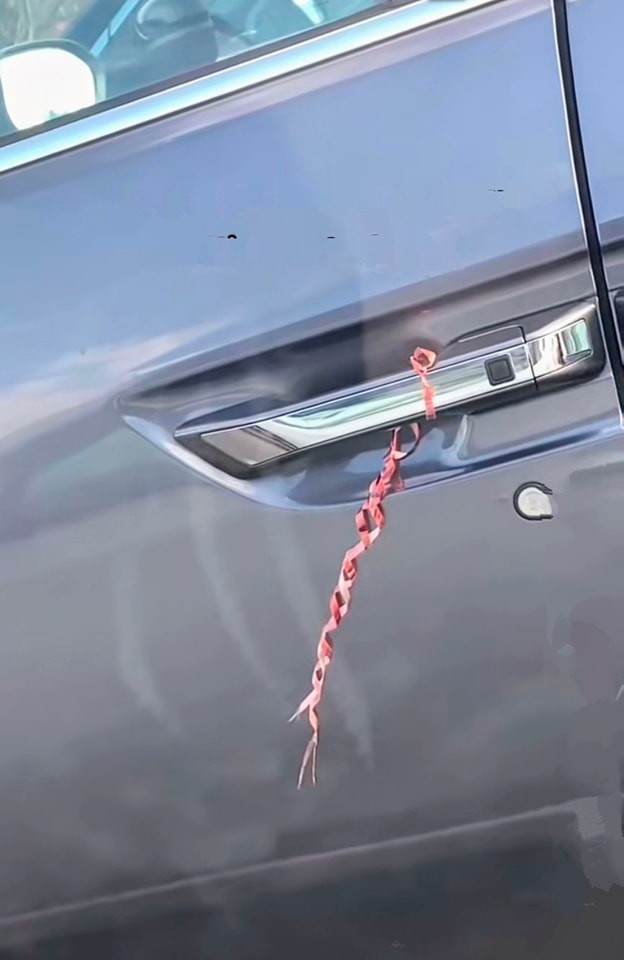
Have You Ever Noticed a Piece of String Tied Around Your Car Door Handle?
In recent months, a curious phenomenon has garnered significant attention across various social media platforms and news outlets. Drivers returning to their cars have reported finding a piece of string—or sometimes ribbon—tied around a door handle. For many, this unexpected discovery sparked both confusion and concern, especially after several videos and posts went viral describing similar experiences.
The Incident That Started the Conversation
One widely-discussed incident began with a TikTok user named Shannon, who recounted a typical day of shopping which ended in an unusual discovery. Upon returning to her vehicle in a busy parking lot, Shannon noticed what appeared to be a brightly colored ribbon, resembling gift wrap, tied around the driver’s side door handle. The situation became even more perplexing when she observed a similar piece of string on another nearby car, twice within the same day.
Shannon decided to share her experience on TikTok, prompting a wave of discussions and speculation in the comment sections. The story quickly gained traction, and soon, similar anecdotes began surfacing from people across different regions, turning an isolated event into a broader social phenomenon.
Public Reactions and Growing Concerns
The viral nature of Shannon’s experience sparked widespread debate on platforms such as TikTok, Twitter, and Facebook. While some social media users dismissed the appearance of strings as harmless pranks or accidental occurrences, others interpreted the situation with heightened anxiety. There was a notable trend of comments suggesting the strings could be related to criminal activity, specifically as a method to target potential victims for kidnappings or thefts.
Amid growing fears, individuals began to share secondhand accounts and warnings, further amplifying the concern. Many posts advised viewers to remain vigilant, check their vehicles carefully, and avoid interacting with or attempting to remove any unusual objects found on their cars, especially in isolated or poorly-lit areas.
Theories and Speculations: A Viral Mystery
Among the numerous responses to Shannon’s video, another TikTok creator known as Reese offered a speculative explanation. Reese suggested that perpetrators might use string, ribbon, or wire in an attempt to distract a driver, causing them to focus on removing the object and thereby giving a criminal more time to approach undetected. The theory posited that removing a tightly wound string or a piece of wire could delay a person by several minutes—potentially enough time for an opportunistic attack.
Such explanations, while plausible on the surface, are primarily speculative. Security experts and law enforcement agencies have weighed in, emphasizing that there is little verified evidence linking the phenomenon of string-tied door handles to organized criminal activity.
Fact-Checking and Police Advice
As the conversation continued gaining momentum, numerous fact-checkers and news outlets investigated the credibility of these claims. According to statements from several police departments in the United States and elsewhere, there is no established pattern or confirmed reports of criminals using string, ribbon, or wire to target drivers or orchestrate attacks.
Law enforcement agencies, including local police and the Federal Bureau of Investigation (FBI), have publicly clarified that the more common tactics employed by criminals—such as vehicle theft or carjacking—rarely, if ever, involve elaborate distractions like tied strings. Instead, they recommend focusing on basic safety measures: always park in well-lit areas, be aware of your surroundings, and report suspicious activities to authorities.
The Power and Pitfalls of Social Media Virality
Part of what makes the “string-on-the-door-handle” phenomenon noteworthy is not just the oddity itself, but its rapid spread across digital platforms. Experts in media studies and online behavior highlight how online virality can rapidly amplify genuine concerns and, in some cases, propagate misinformation or unverified claims.
As Professor Myrna Gopnik, a communications specialist, notes, “Stories that carry an emotional charge—like those involving personal safety—spread quickly. While social media can be an invaluable tool for raising awareness, it can also create unnecessary panic if rumors and theories are presented without verification.”
Multiple reputable outlets have advised consumers of social media content to carefully evaluate the reliability of sources and to seek confirmation from official channels before drawing conclusions.
International Responses and Local Variations
Although this social media trend emerged primarily in North America, reports of similar incidents have surfaced in other countries as well. In the United Kingdom and Australia, police departments have also received calls from concerned citizens about finding unusual markers on their vehicles. However, these have consistently been found to be unrelated to criminal intent. In several instances, ribbons or strings tied to car doors have been linked to local awareness campaigns, garage marking procedures, or even acts of vandalism or mischief by local youths.
Authorities stress that such objects can usually be removed without risk, and that their presence does not automatically indicate danger. They urge the public to respond rationally, gather information, and, if uncomfortable or if the vehicle has been otherwise tampered with, contact local law enforcement.
Practical Safety Precautions for Drivers
Regardless of the origins or motivations behind the appearance of strings on car door handles, maintaining a proactive approach to personal safety is important for all drivers. Security experts recommend the following standard safety precautions:
- Be aware of your surroundings, especially in parking lots and garages.
- Keep your car doors locked and windows closed when away from your vehicle and while driving.
- If something seems suspicious—such as a string, a note, or any item on your car—do not linger unnecessarily. Observe your environment before taking action.
- Consider returning to the store or location and asking for assistance or security support if you feel unsafe.
- Report any tampering, vandalism, or threatening situation to the police, providing as much detail as possible.
These recommendations apply broadly and are supported by the majority of police and security organizations, regardless of current trends or viral stories.
Understanding Viral Urban Legends
The phenomenon of the string on the car door is an example of a modern urban legend fueled by the fast-paced, interconnected environment of the internet. History is replete with similar stories that, through repeated sharing, become perceived as more widespread and dangerous than warranted by actual incident rates.
Urban legends and viral warnings often contain a kernel of truth but are magnified as they pass from person to person. This can sometimes cause unnecessary anxiety and put pressure on law enforcement to investigate hoaxes or benign occurrences. The phenomenon highlights the responsibility of both content creators and consumers to critically assess stories before sharing them widely.
Official Statements and Media Coverage
Major news organizations, including Reuters, BBC, and The Guardian, along with fact-checking sites, have thoroughly examined the claims surrounding the use of string or wire for criminal targeting. In their investigations, they have found no verifiable evidence supporting the existence of an organized scheme using this method.
Instead, these outlets stress the importance of accurate information and urge individuals to seek reputable sources when dealing with safety-related viral content. Law enforcement officers interviewed by these organizations have reiterated that, while personal vigilance is always advisable, there is no cause for public alarm regarding isolated instances of string or ribbon on car door handles.
Conclusion: Separating Fact from Fiction
While the appearance of a string or ribbon tied around a car door handle can understandably cause unease, extensive investigation reveals that this trend is more a product of social media amplification than an indicator of widespread criminal activity. Most police departments and security professionals classify such incidents as typically harmless or unrelated to any larger threat.
The best response remains one of calm, informed vigilance: report genuinely suspicious behavior, prioritize your personal safety, and use trusted resources and authorities for guidance. In an era of rapid information sharing, fostering a community of responsible media consumption is the most effective way to protect yourself and others.

Sources
Disclaimer: This content is intended for entertainment purposes only and is not based on real events.