The afternoon seemed completely ordinary.
People were enjoying the beach, swimmers were moving through the shallow water, and the sound of waves mixed with conversations from the shore.
Then something unusual happened.
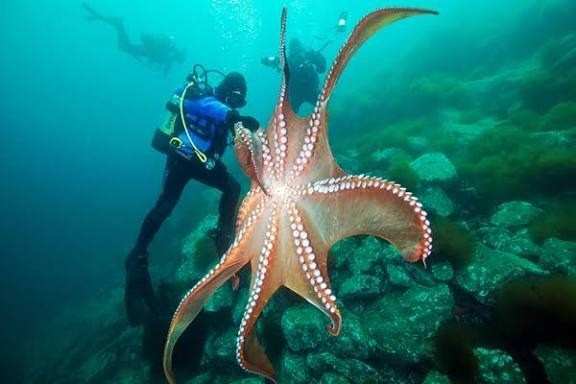
A swimmer suddenly found himself sharing the water with an unexpected visitor: an octopus.
The animal moved across his back, its tentacles spreading around him in a way that looked almost unreal. People nearby noticed what was happening, and within moments, the strange encounter became the kind of scene that naturally attracts attention.
Some spectators watched carefully.
Others reached for their phones.
The swimmer appeared startled as he tried to understand what was happening.
For anyone watching from the shore, the scene could easily look frightening.
An octopus has eight flexible arms covered with hundreds of suckers. When those arms move across a person’s body, the sensation can be unfamiliar and surprisingly strong.
But marine scientists point out something important about these fascinating animals: octopuses are generally not looking for confrontations with humans.
They are wild marine animals with their own instincts, senses and ways of responding to unfamiliar situations.
So what might cause an octopus to approach a swimmer?
And should people actually be afraid when they encounter one in the ocean?
An Unusual Meeting in Shallow Water
The encounter described in the viral account took place near a busy beach.
The swimmer was in the water when an octopus attached itself to his back.
From the perspective of someone watching the scene, the animal’s movement could easily appear dramatic.
Its arms spread across the swimmer.
Its suckers attached to his skin.
And because octopuses move in ways that are completely different from familiar land animals, the encounter looked almost like something from a movie.
Yet there is a major difference between something looking frightening and something actually being dangerous.
Wild animals often behave in ways humans do not immediately understand.
A bird may suddenly fly toward a person.
A seal may approach a boat.
A fish may swim directly between a swimmer’s legs.
And an octopus may investigate an unfamiliar object simply because it is curious.
The ocean is full of interactions that can surprise people.
Why Do Octopuses Have Suckers?
One of the most fascinating features of an octopus is its suckers.
An adult octopus can have hundreds of them distributed across its arms.
These structures are not simply designed for gripping.
They are also highly sensitive.
Research has shown that octopus suckers play important roles in touch and chemical sensing.
In other words, an octopus can gather information about its environment through its arms.
This is extremely useful for an animal that spends much of its life exploring complicated underwater environments.
Imagine moving through a rocky seabed in darkness.
An octopus cannot rely entirely on vision.
Its arms can interact with rocks, shells, food and other objects.
The suckers provide information that helps the animal understand what it is touching.
That means an octopus attaching itself to something does not automatically indicate aggression.
It may simply be exploring.
The Octopus Arm Is More Complicated Than It Looks
An octopus is not simply a creature with eight ordinary limbs.
Its arms have remarkable flexibility and contain extensive networks of neurons.
Much of the animal’s nervous system is distributed throughout its body, allowing its arms to process information and perform complex movements.
This gives octopuses an unusual level of control over their limbs.
Each arm can bend, extend and interact with objects in sophisticated ways.
That ability is part of what makes an octopus such an extraordinary marine animal.
For humans, this can make an encounter feel strange.
We are accustomed to animals whose limbs behave in predictable ways.
An octopus does not move like a dog, cat, bird or fish.
Its body can change shape.
Its arms can move independently.
Its skin can change appearance.
And its suckers can grip surfaces with surprising effectiveness.
No wonder an unexpected encounter can catch a swimmer off guard.
Are Octopuses Dangerous to Humans?
The answer depends heavily on the species and circumstances.
Most octopus species are not interested in interacting aggressively with humans.
They are generally more concerned with finding food, avoiding predators and surviving in their marine environment.
However, wild animals should always be treated with caution.
Some octopus species possess venom, and certain species can pose serious risks to humans.
The best-known example is the blue-ringed octopus.
These small animals are found in parts of the Indo-Pacific and are famous for their vivid blue markings when disturbed.
Their venom can be extremely dangerous.
But the existence of a few medically significant species does not mean that every octopus encountered by a swimmer represents a serious threat.
Species identification matters.
Geography matters.
Behavior matters.
And the safest approach is always to avoid deliberately handling unfamiliar marine wildlife.
Why an Octopus Might Approach a Human
There are several possible explanations for an octopus approaching a swimmer.
Curiosity is one possibility.
Octopuses are intelligent and exploratory animals.
They investigate objects in their surroundings using their arms, suckers and vision.
A swimmer moving through shallow water could simply become an unusual object in the animal’s environment.
Another possibility is that the animal was trying to find somewhere to hide.
Octopuses are well known for using camouflage and seeking shelter.
A human body may temporarily provide an unfamiliar surface that the animal interacts with while attempting to navigate its surroundings.
It is also possible that environmental conditions influenced the encounter.
Changes in water temperature, food availability, tides, habitat conditions or human activity can alter where marine animals are found.
Without observing the complete encounter and identifying the animal, however, it would be difficult to determine exactly why it approached.
The Amazing Camouflage Abilities of Octopuses
One of the reasons octopuses are so famous is their ability to change appearance.
Their skin contains specialized cells that allow them to alter color and patterns.
Some species can also change the texture of their skin, making their bodies appear more similar to rocks, coral or other surfaces.
This ability serves several purposes.
Camouflage can help an octopus avoid predators.
It can also help it approach prey.
And changes in appearance can play a role in communication.
For humans, these rapid changes can seem almost magical.
Historically, that may help explain why octopuses appear so often in stories, legends and popular culture.
They seem almost designed to challenge our assumptions about what an animal can do.
Octopuses in Mythology and Culture
Humans have been fascinated by large sea creatures for thousands of years.
Ancient coastal cultures created stories about mysterious creatures living beneath the waves.
In later European folklore, enormous tentacled sea monsters became common characters in legends and maritime stories.
Although these creatures were usually exaggerated, they reflected a genuine human experience.
The ocean was—and remains—a vast environment that people cannot completely control.
Before modern marine biology, many underwater animals were poorly understood.
A large octopus glimpsed beneath a boat could easily become the source of a much larger story.
Over generations, descriptions could become exaggerated.
A large animal could become enormous.
An unusual encounter could become a legendary battle.
And a real marine creature could eventually transform into a mythical sea monster.
Modern science has replaced many of those mysteries with detailed knowledge, but the fascination remains.
Why Viral Videos Make Animal Encounters Look More Frightening
There is another reason the swimmer-and-octopus encounter can appear especially dramatic online.
Video removes context.
A short clip may begin just seconds before the most unusual moment.
Viewers may not know what happened beforehand.
They may not know the species involved.
They may not know whether the animal was already familiar with the area.
They may not even know what happened afterward.
This can encourage viewers to create their own explanations.
A caption might describe an encounter as an “attack,” while the actual footage may simply show an animal interacting with an unfamiliar object.
That distinction matters.
The same video can appear very different depending on the words placed around it.
This is why viral wildlife footage should be approached with some skepticism.
The visual evidence may be real while the accompanying explanation remains uncertain.
What Should You Do If You See an Octopus?
The simplest advice is also the safest: give it space.
If you encounter an octopus while swimming or snorkeling, avoid trying to grab it.
Do not chase it.
Do not corner it.
And do not attempt to remove it from its environment simply because it looks interesting.
Instead, move away calmly and allow the animal to continue what it was doing.
This is good practice with virtually all wild marine animals.
Even a normally harmless species can react unpredictably if it feels threatened.
A wild animal does not understand human intentions.
What a person considers playful curiosity may be perceived by an animal as a potential threat.
Keeping a respectful distance protects both the swimmer and the animal.
Why Fear Can Change How We Experience the Ocean
The ocean can trigger a special kind of fear because humans are not naturally adapted to living underwater.
Our vision is different.
Our movement is different.
Our breathing is different.
And our knowledge of what is around us can be limited.
Even an ordinary object can look unfamiliar beneath the surface.
Add an animal with eight moving arms and an extraordinary ability to change color, and the situation can feel much more dramatic.
Fear is not necessarily a sign that something dangerous is happening.
It is often the body’s way of responding to uncertainty.
When people cannot immediately identify what they are seeing, the brain may assume that caution is necessary.
That response can be useful.
But it can also make harmless situations feel more threatening than they really are.
Understanding marine animals can therefore replace some fear with curiosity.
The Intelligence of the Octopus
Octopuses have become important subjects of scientific research because of their unusual cognitive abilities.
Researchers have observed problem-solving, exploration, object manipulation and flexible behavior in several octopus species.
Their nervous systems are highly unusual compared with those of vertebrates.
They evolved along a completely different branch of the animal family tree, yet developed impressive abilities to interact with their environment.
This is one reason scientists continue to study them.
An octopus may not think like a human, and it would be misleading to interpret every behavior through a human psychological lens.
But there is little doubt that these animals are sophisticated marine organisms.
Their intelligence is one more reason to observe them rather than treat them as simple underwater creatures.
A Reminder That the Ocean Is a Wild Environment
The most useful lesson from a strange octopus encounter may be surprisingly simple.
The ocean is not a swimming pool.
It is a living ecosystem.
Fish, rays, crabs, jellyfish, sea turtles, octopuses and countless other organisms live there.
Humans enter that environment temporarily.
That means unexpected encounters are inevitable.
Most will be harmless.
Some may be memorable.
A small number may require genuine caution.
The safest attitude is therefore not panic and not overconfidence.
It is respect.
Observe marine animals from a reasonable distance.
Avoid touching unfamiliar wildlife.
Follow local beach and marine-safety guidance.
And remember that every animal has its own behavior that may not be immediately understandable to us.
Final Thoughts: Curiosity Beneath the Waves
The image of an octopus suddenly appearing on a swimmer’s back is certainly unusual.
It is easy to understand why a moment like that could become a viral sensation.
But the science behind the animal is even more fascinating than the spectacle.
An octopus’s suckers are sophisticated sensory structures.
Its arms contain remarkable neural networks.
Its skin can transform its appearance.
Its behavior can be exploratory and surprisingly complex.
And its presence near humans does not automatically mean that the animal intends to cause harm.
Without reliable information about the exact species and circumstances surrounding a viral encounter, dramatic explanations should be treated cautiously.
What we can say with confidence is that the ocean remains a place where humans regularly encounter forms of life that behave very differently from us.
Perhaps that is why moments like this capture our imagination.
They remind us that beneath the familiar surface of a beach lies an entire world operating according to its own rules.
Sometimes the best response to an unusual encounter is not fear.
It is distance, respect and curiosity.
Because the more we understand the natural world, the less we need to turn every mystery into a monster.
Sources and Further Reading
National Oceanic and Atmospheric Administration, educational resources about octopuses and marine ecosystems: NOAA Ocean Service
Smithsonian’s National Zoo & Conservation Biology Institute, educational information about octopuses and marine animals: Smithsonian’s National Zoo
Monterey Bay Aquarium, marine-life resources and information about octopuses: Monterey Bay Aquarium
Encyclopaedia Britannica, background information on octopuses, their biology and behavior: Britannica
The original viral account referenced in this article: Teknoloji Bura