Encounter with the Spiny Orb-Weaver: A Journey from Fear to Fascination
Introduction: A Moment of Surprise
There are moments in everyday life when the familiar turns into the astonishing. Such was the case one evening as I entered my garage, only to spot a creature clinging to the wall, still and vivid. Instinctively, I approached, driven by curiosity yet tempered by caution. What appeared unnatural at a distance unveiled its detailed and unsettling form up close—sharper, brighter, and more enigmatic than first impressions suggested.
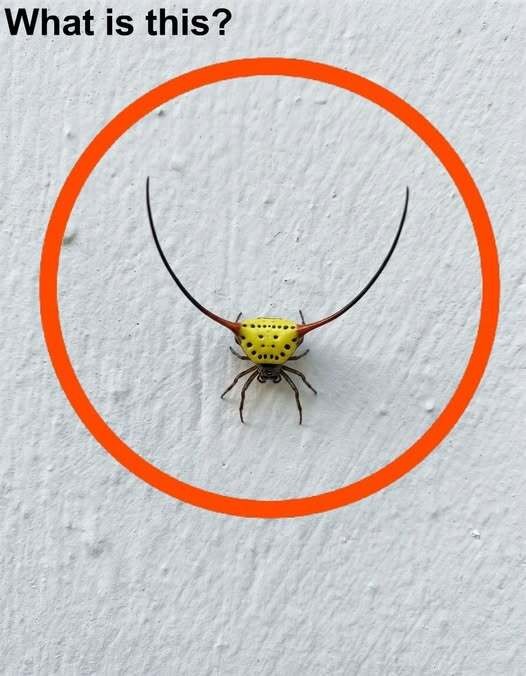
Its body was a striking yellow, marked with precisely arranged black spots that seemed too symmetrical to be the work of chance. Six rigid spines extended from its sides, giving it an armored appearance, seemingly more designed than grown. Every feature triggered a sense of alarm, the kind felt before understanding emerges. However, the creature did not move; it simply existed, motionless and composed in an uncanny display of stillness.
The Initial Emotional Response and Social Impressions
I hesitated, torn between intrigue and apprehension, before taking out my phone to capture the moment. Each second spent framing the photograph made me expect sudden movement—a dramatic reveal of aggression. To my surprise, it remained just as still, permitting a snapshot without reaction.
Quickly, I sent the image to friends. Their responses poured in rapidly: a mix of speculation, humor, warnings, and guesses ranging from harmless beetle to a creature described in nightmares. The uncertainty turned the garage’s visitor into something larger and more mysterious, amplifying its impact far beyond reality. The collective imagination demonstrates how unfamiliarity often intensifies emotions and perceptions surrounding nature’s more unusual forms.

Seeking Identification: The Path to Understanding
Still unsettled, I scoured the internet, searching for an explanation and identity. The impulse to resolve the tension born of unfamiliarity outweighed logical reasoning. Analysis of pattern and shape led me to the source: Gasteracantha, commonly known as the spiny orb-weaver spider. This species is renowned for its dazzling appearance, characteristic spines, and elaborate web-building behavior. Discovery eased my anxiety, replacing fear with fascination as research revealed its harmless nature and ecological importance.
Species Profile: Gasteracantha (Spiny Orb-Weaver Spider)
The genus Gasteracantha encompasses over 70 species commonly referred to as spiny orb-weavers. Their appearance is instantly recognizable by their brightly colored, flattened bodies adorned with prominent spines. Often mistaken for something dangerous, these physical features serve primarily as defense mechanisms against predators, rather than signals of aggression. The unique coloration varies widely, ranging from yellow, red, and white to vivid mixtures, depending on the species and region.
Spiny orb-weavers are distributed globally, with greatest diversity in tropical and subtropical climates such as Southeast Asia, Central and South America, Africa, and Australia. They are found in backyards, forests, and urban environments, often constructing intricate orb-shaped webs to catch prey. Web placement ranges from low shrubs to tree branches, and sometimes even building corners—making unexpected encounters with humans commonplace.
Behavior and Ecology
Despite their alarming appearance, spiny orb-weavers are harmless to humans. They rarely bite and pose no medical threat. Their primary role is as insect predators—feeding on flies, mosquitoes, moths, and other pests. Orb-weavers play a vital ecological function by controlling insect populations, contributing to a balanced ecosystem. Their web-building is intricately patterned and engineered for maximum efficiency in trapping prey.
According to entomologists at the Smithsonian Institution and the Royal Entomological Society, orb-weavers demonstrate fascinating behavior, including daily web reconstruction, strategic placement for optimal prey capture, and complex mating rituals. Females usually dominate the web space, while males remain smaller and less conspicuous.
The Role of Defense and Evolutionary Adaptations
Spiny orb-weavers’ physical adaptations are shaped by evolutionary pressures. Their prominent spines discourage birds and other predators by making them difficult to swallow. The vivid coloration serves as a warning—mimicking the strategies of other unpalatable or venomous species to avoid being eaten. This form of mimicry is known in scientific literature as Batesian mimicry, which helps non-toxic species benefit from associations with dangerous ones.
Research conducted by the Natural History Museum and published in peer-reviewed journals like ScienceDirect shows that the diversity of orb-weaver forms is a response to predator-prey dynamics and resource availability in their habitats. Their survival relies on remaining inconspicuous yet intimidating, leveraging visual deception as an effective strategy.
Human Perception and Psychological Response
The encounter with a spiny orb-weaver highlights the psychological impact of unfamiliar wildlife. Humans are conditioned to fear the unfamiliar, especially creatures with dramatic coloration and sharp structures. Throughout history, spider symbolism has ranged from admiration in ancient cultures to fear in modern ones—a phenomenon known as arachnophobia.
Psychologists from the American Psychological Association believe that the root of these responses lies in rapid threat assessment—the brain’s instinctive reaction to perceived uncertainty. However, exposure and education help mitigate these fears, transforming discomfort into appreciation and respect for biodiversity. Encounters with wildlife are opportunities for learning and expanding our understanding of nature’s complexity.
International and Societal Perspectives
Globally, spiders such as the spiny orb-weaver are both celebrated and misunderstood. In Australia, they are featured in educational campaigns aimed at children to foster familiarity with the natural world. Conservation groups like the International Union for Conservation of Nature (IUCN) promote the importance of spiders in maintaining healthy ecosystems. Their efforts encourage positive attitudes, highlighting that most spiders, including orb-weavers, provide substantial environmental benefits.
Meanwhile, urbanization and habitat loss pose challenges for the continued survival of such species. Studies published in Nature and reports from the World Wildlife Fund (WWF) indicate that habitat fragmentation disrupts spider populations. Awareness and appreciation among urban dwellers, therefore, play a role in conservation efforts.
The Garage Transformation: From Threat to Coexistence
Having learned about the spiny orb-weaver’s harmless nature and ecological role, my perception shifted. The initial fear and sense of invasion dissipated, replaced by curiosity and reluctant admiration. The garage, once feeling disturbed by an alien visitor, became a space of shared existence. This experience illustrates how knowledge transforms spaces and attitudes, opening possibilities for peaceful coexistence with urban wildlife.
The decision to leave the orb-weaver undisturbed was not resignation, but respect for its right to exist. By accepting their presence, we enrich our environments, making them more vibrant and interconnected. Scientific and conservation communities emphasize the value of maintaining urban biodiversity—not only for ecological stability but also for fostering respect and stewardship among residents.
Spiny Orb-Weaver: A Symbol of Nature’s Intricacy
Ultimately, the spiny orb-weaver is more than an oddity in a garage—it is a testament to evolution’s creativity and ecological balance. Its existence challenges our perceptions and invites us to look deeper into nature’s wonders. From evolutionary strategy to societal reaction, the orb-weaver reminds us of the complex relationships between humans and the natural world.
Encounters with such creatures offer valuable lessons: from initial fear to eventual fascination, from isolation to coexistence. Through understanding and education, each reminder of nature’s diversity becomes a step toward appreciation and protection.
Conclusion: Living with Urban Wildlife
As urban areas expand, opportunities for accidental wildlife encounters increase. The spiny orb-weaver, with its vivid colors and distinctive features, epitomizes the intersection of fear and fascination. The journey from unease to admiration reflects a broader narrative about humans and their environment. By embracing curiosity and informed awareness, we foster a culture of respect for all living things and reveal the interconnectedness that sustains us.
My experience with the spiny orb-weaver transformed a routine walk into an exploration of science, psychology, and conservation. The garage didn’t feel less mine—it felt more alive, reminding me that our spaces are shared with a multitude of remarkable residents, each contributing to the fabric of life.
Sources
- BBC News
- Reuters
- Smithsonian Institution
- Natural History Museum
- ScienceDirect
- Royal Entomological Society
- American Psychological Association
- IUCN
- WWF
- Nature
- Mayo Clinic
Disclaimer: This content is intended for entertainment purposes only and is not based on real events.