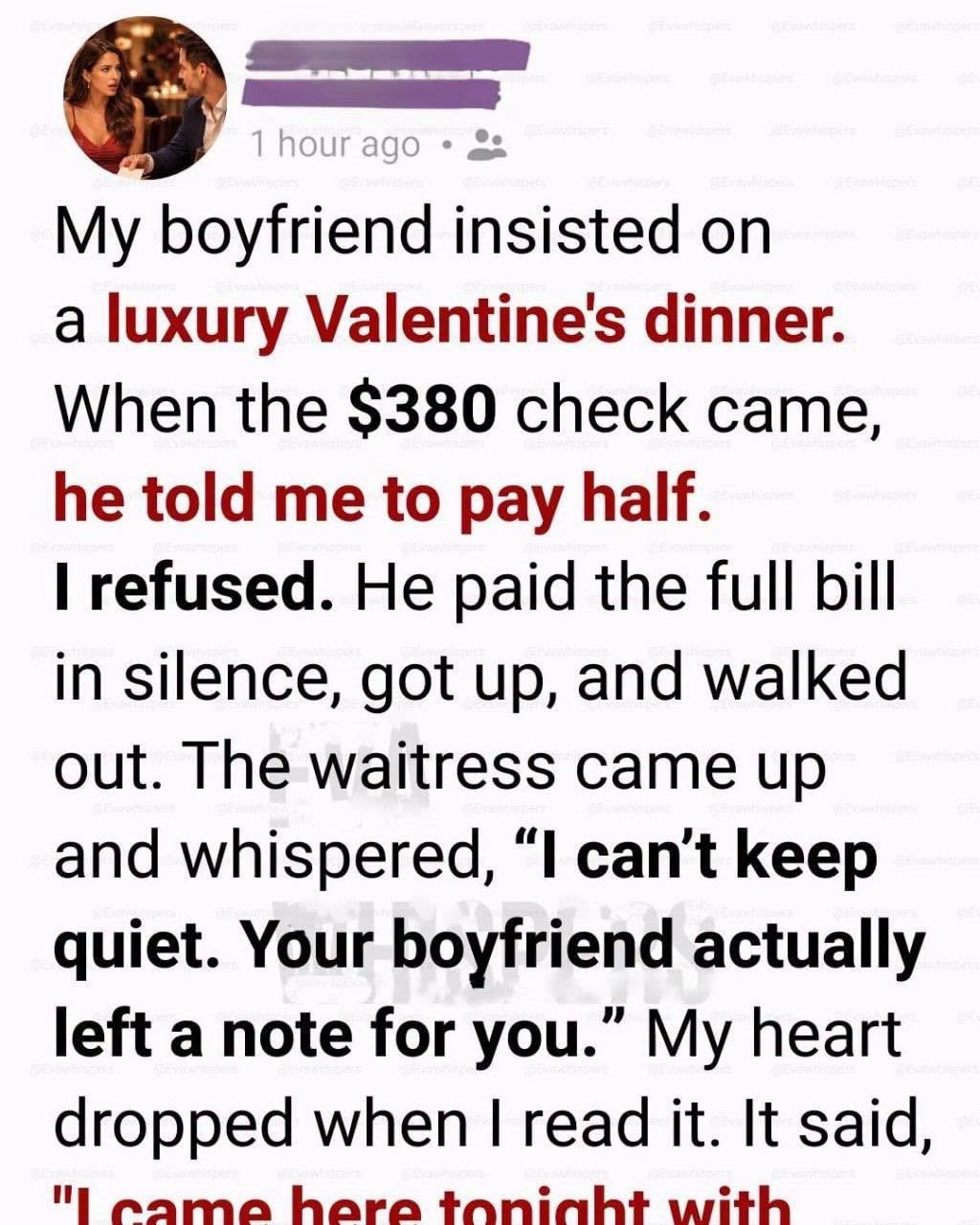
She thought he was about to propose. He was actually grading her.
Introduction: A Valentine’s Day Dinner With a Hidden Agenda
Valentine’s Day is often associated with romance and significant milestones in relationships, such as marriage proposals, declarations of love, or a celebration of commitment. For one woman, a meticulously planned Valentine’s dinner with her partner of seven years seemed to promise just that—a proposal to solidify their years together. Yet, instead of an engagement ring, what unfolded at the dinner table was an unexpected request that transformed the evening into a revealing moment about the fragile underpinnings of trust within relationships.
The Unseen Test: When Romance Turns into Evaluation
According to relationship experts and clinical psychologists, mutual trust and open communication form the cornerstone of healthy romantic partnerships. However, some individuals employ secret tests or evaluations, often without their partner’s awareness, to gauge the “worthiness” or “fit” of their significant other. These so-called “secret exams” can manifest in everyday situations—a hidden checklist, subtle manipulation, or orchestrated scenarios designed to elicit specific reactions.
In the illustrated case, the woman, expecting a declaration of lifelong commitment, instead found her relationship under silent scrutiny. Rather than a proposal, her partner revealed he had been grading her behavior, analyzing her choices, and scoring her response to the orchestrated dinner. This revelation didn’t merely end their seven-year relationship. It brought to light the damaging impact of conditional love and covert relationship testing—practices that, while rarely discussed openly, can have profound ramifications.
Why People Test Their Partners
The impulse to test one’s partner often arises from underlying insecurities, fear of vulnerability, or previous negative experiences. Clinical psychologist Dr. Susan Orenstein, in an interview with Psychology Today, notes, “Some people carry wounds from past relationships. Instead of discussing their fears, they try to preempt disappointment by testing their partner’s devotion or compatibility in covert ways.”
These tests can range from mild—such as observing whether a partner remembers an anniversary—to more manipulative or deceptive actions, like engineering situations that provoke jealousy or discomfort. While these tactics might temporarily reassure the tester, they usually erode trust and authenticity in the relationship.
The Impact of Secret Tests on Relationship Health
Surreptitious evaluation within relationships undermines the foundation of trust, which is critical for emotional intimacy. Relationship counselor Susan Winter explains, “When one partner feels they are constantly being evaluated, the dynamic shifts from partnership to teacher-student or examiner-examinee. This breeds anxiety, resentment, and a sense of inadequacy.”
A 2020 study published in the Journal of Social and Personal Relationships found that couples who engage in frequent covert testing report lower satisfaction and intimacy scores than those who address doubts directly with open communication. The aftermath of discovery—such as in the Valentine’s Day incident—can be particularly devastating. In this example, the woman felt her autonomy and worth as a partner had been reduced to passing or failing a secret test, effectively ending the mutual trust that underpinned their seven years together.
From Romance to Rupture: A Closer Look at the Valentine’s Dinner Incident
This particular case exemplifies the subtle yet harmful consequences of covert relationship testing. The partner’s careful orchestration of a romantic setting, followed by an abrupt revelation of ongoing evaluation, not only shattered the woman’s expectations but also her sense of relational security.
Dr. Leslie Baxter, a professor of communication studies, argues, “Turning what should be a moment of affection and vulnerability into an exam reframes love as conditional. It’s no longer about knowing and accepting the other, but about measuring up to hidden criteria.” The fallout from such actions often extends beyond the breakup, leading individuals to question their own judgment and future trust in relationships.
Cultural Context and Societal Expectations in Relationships
Societal norms and popular culture often reinforce the notion of relationship ‘tests’—from classic stories to reality television scenarios. Oxytocin-related research shows that, under stress or uncertainty, humans are more likely to create ‘safety nets’ such as tests or rules. “Unfortunately, these behaviors are typically counterproductive,” says Professor Jennifer Harman, who specializes in interpersonal relationships.
Furthermore, generational expectations around marriage, commitment, and loyalty can implicitly encourage people to adopt evaluative attitudes toward their partners. In an era where online dating and social media amplify comparison, the temptation to test one’s partner—whether through hypothetical situations or real-life challenges—has only increased. Yet, experts caution that relinquishing open communication for covert judgment rarely leads to lasting happiness.
International Perspectives on Relationship Evaluations
The phenomenon of covert testing is not limited to any one culture or country. Surveys conducted in the United States, Europe, and parts of Asia suggest that while the methods may differ, the underlying motivations—seeking reassurance and control—are universal. In individualistic societies, partners may be more inclined to ‘test’ each other’s independence or long-term compatibility, whereas collectivist cultures might focus on family acceptance or communal values. However, psychologists generally agree that honesty and direct conversation are key to resolving doubts more effectively than testing ever could.
Preventing the Harmful Effects of Secret Testing in Relationships
Experts recommend several strategies to prevent the breakdown of trust caused by covert tests:
- Open Communication: Encourage direct expression of needs, concerns, and insecurities within the partnership.
- Setting Healthy Boundaries: Mutual respect for each other’s autonomy and emotional wellbeing creates a foundation for lasting intimacy.
- Seeking Professional Support: Couples counseling can help uncover root causes of insecurity and develop healthier communication styles.
- Building Trust Gradually: Trust is cultivated over time through shared experiences, not by passing or failing tests.
“The healthiest relationships are those where partners feel safe to be vulnerable and imperfect,” says marriage therapist Dr. Carla Marie Manly. “This means facing uncertainty together, not trying to control it through hidden scoring systems.”
What to Do If You Discover You’re Being Tested
If you find out your partner is testing you, experts recommend addressing the issue openly and calmly. Ask your partner about their concerns and fears, and express the impact that being tested has on your sense of trust and security. If reconciliation feels possible, suggest ways to rebuild trust together, such as joint sessions with a relationship counselor or developing clear agreements for honest communication. If covert testing signals deeper incompatibilities or ongoing disrespect, it may be necessary to reconsider the future of the partnership.
Conclusion: Lessons Learned from a Broken Romance
The Valentine’s Day dinner gone wrong is a poignant reminder of how easily miscommunication and hidden agendas can unravel even the strongest relationships. Rather than reinforcing love and commitment, secret tests create an atmosphere of uncertainty and self-doubt. Long-term romantic success is best built on candor, mutual respect, and the willingness to accept each other not as exam-takers, but as equal partners in growth and affection.
As societal conversations about relationships evolve, encouraging emotional honesty and rejecting manipulative tactics is essential for healthy, fulfilling connections. The story serves as a powerful warning to those tempted to ‘grade’ love: Rather than measuring up, partners thrive when they are embraced for who they truly are.
Sources
Disclaimer: This content is intended for entertainment purposes only and is not based on real events.