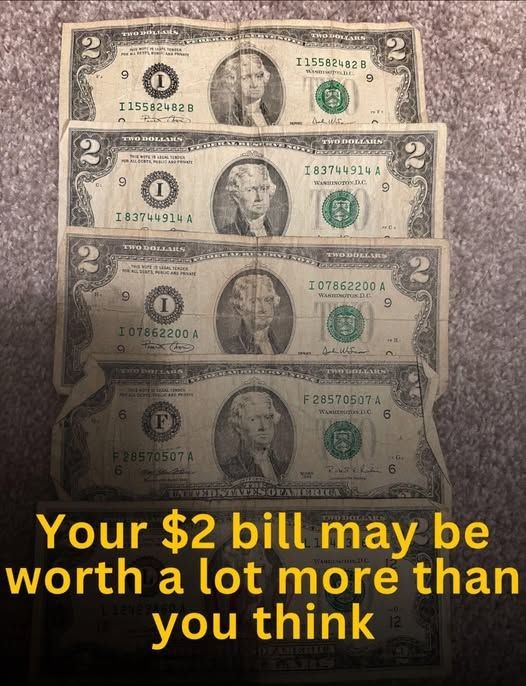
At One Time, Superstitious People Believed the $2 Bill Was Unlucky and Even Carried a Curse
The $2 bill, a unique and often misunderstood denomination of U.S. currency, has been subject to a wide range of myths and legends throughout American history. Believed by some to be unlucky or even cursed, the $2 bill has nevertheless maintained a fascinating place in the U.S. monetary landscape. Today, renewed interest from collectors and the general public highlights not only the bill’s enduring mystique but also its potential monetary value.
The Origins and History of the $2 Bill
The story of the $2 bill dates back to the early days of American banking. First issued in 1862 as a Legal Tender Note, the $2 bill originally featured the portrait of Alexander Hamilton. Throughout its history, various notable Americans have graced its face, but since 1928, the bill has featured Thomas Jefferson, the third President of the United States.
Despite its frequent redesigns and periodic discontinuation, the $2 bill has remained an official part of U.S. currency for over 160 years. For much of its history, the bill was primarily used in large business transactions or as a means of settling debts. Its association with special deals and its relatively infrequent use put it at the center of various rumors and superstitions.
Superstitions and Myths: Why Was the $2 Bill Considered Unlucky?
For decades, the $2 bill was shrouded in superstitions. Some Americans claimed that carrying a $2 bill would bring bad luck or lead to misfortune. Others believed that the bill was cursed—an idea perhaps rooted in practical circumstances as much as in mysticism. At horse racetracks, for example, $2 bets were common, so losers often associated the note with bad outcomes. Bars and taverns, where $2 bills were used to pay for bribes or questionable services, also gave rise to negative perceptions.
Despite these superstitions, there is no factual basis for the claim that the $2 bill is unlucky. In many cases, it has been a symbol of good fortune. Some people believe that giving a $2 bill as a gift will bring luck and prosperity to the recipient, a tradition that endures in some communities.
Understanding the Circulation and Rarity of the $2 Bill
One of the most persistent myths about the $2 bill is the belief that it is rare or no longer in circulation. In fact, the U.S. Treasury continues to print $2 bills, albeit in lower quantities compared to $1, $5, or $10 denominations. According to the Bureau of Engraving and Printing, several million $2 bills are printed each year, intended to meet continued but modest demand.
What makes the $2 bill seem rare is its infrequent appearance in daily transactions. Many banks do not regularly stock the denomination, and consumers seldom request them when withdrawing cash. As a result, the note often attracts attention when it is used, reinforcing the misconception of scarcity.
The $2 Bill as a Collectible: Value for Collectors and the General Public
While a typical $2 bill is worth exactly its face value, some notes can be worth much more, depending on rarity, age, condition, or unique features. Currency collectors, also known as numismatists, are especially keen to acquire $2 bills issued in certain years or those with special serial numbers.
- Older issues: Pre-1976 $2 bills—especially those in uncirculated or pristine condition—often sell for more than face value.
- Star notes and misprints: Bills with a star next to the serial number, or errors such as misprints, can command higher prices in numismatic circles.
- Unusual serial numbers: Collectors are attracted to notes with repeating digits, low numbers, or palindromic serials, each adding to the note’s appeal.
- Red seal notes: $2 bills printed before 1963 carried a distinctive red Treasury seal, which makes them especially desirable.
Some exceptionally rare $2 bills can fetch thousands of dollars at auction, particularly if they possess both historic and aesthetic appeal. The most valuable examples are typically certified and graded by professional services, ensuring authenticity and condition standards.
How to Identify Valuable $2 Bills
If you happen to find a $2 bill, it’s worth examining it closely to determine its potential value. Key features to look for include:
- Year of Issue: Check the date on the bill. Notes from 1928, 1953, 1963, and special anniversary issues may hold collector value.
- Serial Number: Unique patterns, low numbers, or star notes are often more desirable.
- Condition: Mint or uncirculated bills are worth more than those showing wear or damage.
- Seal Color: Red-sealed $2 bills predate 1976 and are generally more collectible.
For anyone unsure of a bill’s value, consulting a numismatic expert or referring to reputable currency guides is recommended. Several online platforms also provide estimates based on recent auction results and historical trends.
The Role of the $2 Bill in Modern America
In today’s economy, the $2 bill continues to occupy an unusual niche. Some businesses embrace the bill as a marketing tool, using it as a conversation starter or as unique change for customers. Others see it as a symbol of good luck—businesses in Las Vegas, for example, sometimes distribute $2 bills as promotional items, harnessing their reputation for fortune.
In everyday commerce, however, the $2 bill is a relative rarity. Many people save any $2 notes they encounter, leading to a self-perpetuating cycle of scarcity. This behavior, sometimes called “hoarding,” keeps the bills out of circulation but encourages interest among collectors and enthusiasts.
The $2 Bill in Popular Culture and International Context
The $2 bill has occasionally appeared in film, television, and literature as a symbol of eccentricity or nostalgia. Its place in American pop culture is reinforced by stories and urban legends that emphasize its mystique, superstitions, and connection to luck—both good and bad.
Internationally, few countries have a direct equivalent to the American $2 bill, but some, such as Canada and New Zealand, have or had low-denomination notes that emerged as collector’s items after being withdrawn from circulation. In the United States, the continued printing and occasional use of $2 bills set the nation apart from many others.
Expert Insights on the $2 Bill
Economic historians and numismatists generally agree that the continued fascination with the $2 bill is a reflection of American attitudes toward money, rarity, and tradition. Speaking to Reuters, currency expert John Schwartz explained, “The $2 bill is a perfect example of how scarcity—real or perceived—can drive interest and value, even when an item is still being produced.”
The American Numismatic Association regularly publishes guides and resources about currency collecting, emphasizing caution and research for anyone seeking to buy or sell collectible banknotes.
Societal Reactions and Community Traditions
Across various communities in the United States, the $2 bill has been repurposed for creative uses. During holidays or milestone events, some people give $2 bills as gifts in decorative holders, seeing the gesture as a wish for luck and prosperity. Military personnel have a tradition of carrying $2 bills, sometimes as tokens of camaraderie and remembrance.
Charities and non-profit organizations sometimes use $2 bills in fundraising campaigns, highlighting both the note’s unusual character and its perception as a “lucky dollar.” In recent years, social media has further amplified interest in the $2 bill, with viral posts and videos shedding light on stories of rare finds or high-value sales.
How to Obtain $2 Bills Legally
For anyone wishing to obtain $2 bills, the process is generally straightforward. Most banks can order $2 notes from the Federal Reserve, though immediate availability may vary. Collectors looking for particular editions or rare features are advised to consult numismatic dealers or participate in reputable online auctions where provenance is verified.
It is important to avoid online scams or inflated prices when seeking to purchase collectible currency. Consumers should rely on trustworthy institutions and compare prices based on expert grading and catalog listings.
Conclusion: The Enduring Fascination of the $2 Bill
The $2 bill remains a uniquely American curiosity—misunderstood by some, cherished by others, and occasionally the source of surprise or delight at the cash register. While its reputation as an unlucky or cursed object has faded, its potential value to collectors and its place in pop culture continue to grow. Whether as a keepsake, a collectible, or simply a piece of change, the $2 bill is a reminder of the stories behind our everyday money.
Should you encounter a $2 bill, consider its history, examine its features, and perhaps hold onto it as both a symbol of luck and a tangible link to America’s rich financial past.
For further information and expert analysis, see the sources below.

Sources
Disclaimer: This content is intended for entertainment purposes only and is not based on real events.