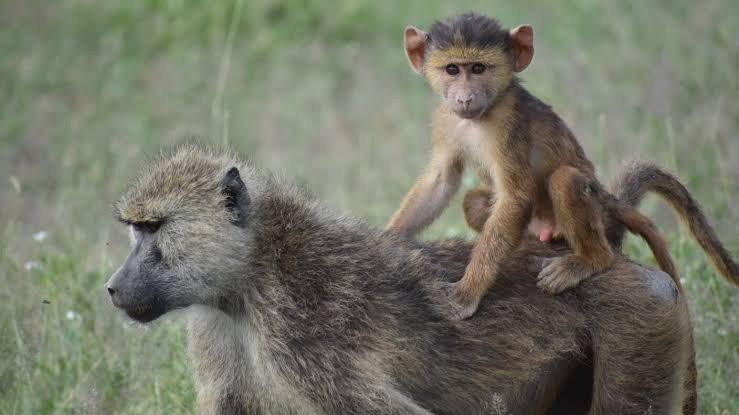
The forest can sometimes become the stage for moments that are difficult to forget.
A young monkey separated from its group, a sudden movement near the water, and several adults rushing toward the same place can create a scene that appears almost cinematic. When such moments are captured on video, viewers naturally begin asking questions. Why would an animal approach a dangerous situation? Was it trying to protect a younger member of the group? Could monkeys understand that another animal was in trouble?
Stories describing monkeys attempting to help a young infant during an encounter with a crocodile have attracted considerable attention online. The emotional reaction is understandable. The animals appear to gather together, while one or more adults seem to move toward the youngster.
Yet dramatic wildlife footage also deserves careful interpretation.
Animals certainly form strong social relationships, and many primate species demonstrate cooperation, communication, caregiving, and protective behavior. At the same time, scientists caution against automatically interpreting animal actions through human emotions and intentions.
The fascinating truth may lie somewhere between these two perspectives.
The Story Behind the Viral Wildlife Moment
The footage described in the original online story presents a tense scene involving a group of monkeys, a young infant, and a crocodile near the water.
According to the description, several adult monkeys appear to move toward the youngster while the group gathers nearby. The scene is presented as an example of animals responding to a vulnerable member of their social group.
However, the available description does not establish every detail of what happened before or after the filmed moment. It also does not provide sufficient evidence to determine the final outcome for the infant.
That distinction is important.
Viral wildlife stories can sometimes become more dramatic as they are reposted. A short video may be accompanied by increasingly emotional headlines, even though viewers have only seen a few seconds of the original event.
For that reason, it is better to treat extraordinary interpretations as possibilities rather than established facts.
What can be discussed with considerably greater confidence is the social behavior of monkeys.
Why Monkeys Form Such Strong Social Groups
Many primates live in highly organized social communities.
Depending on the species, these groups can include parents, infants, siblings, relatives, and unrelated individuals. Members may travel together, search for food together, groom one another, communicate about potential threats, and care for younger animals.
For an infant, being surrounded by a social group can provide important protection.
Young primates are generally more vulnerable than adults because they are smaller, less experienced, and more dependent on others. In many species, mothers provide most of the direct care, while other members of the group can still influence the infant’s safety and development.
This creates an important scientific explanation for dramatic group reactions.
A monkey approaching an unusual situation involving an infant does not necessarily need to understand the event in exactly the same way a human would. Its behavior could be influenced by social attachment, alarm signals, territorial behavior, curiosity, or an instinctive response to the distress of another group member.
Several motivations can produce similar outward behavior.

The Science of Protective Behavior in Primates
Researchers have documented many forms of social behavior among primates.
Grooming is one of the most familiar examples. It can help maintain relationships within a group and may contribute to social bonding. Communication also plays a major role, with monkeys using different vocalizations, facial expressions, body positions, and movements in different situations.
Care for young animals is another important feature of primate societies.
In some species, individuals other than the mother may interact with infants, carry them, groom them, or remain close to them. This behavior is sometimes described as alloparental care, meaning care provided by individuals other than the biological mother.
Such observations help explain why a group might respond strongly when an infant becomes separated or appears distressed.
However, scientists generally avoid assuming that an animal’s motivation is identical to a human emotional experience.
A monkey can show behavior that looks protective without us being able to conclude exactly what the animal was thinking.
Could the Monkeys Have Been Trying to Rescue the Infant?
This is where the story becomes particularly interesting.
From a human perspective, several monkeys moving toward a vulnerable infant can look like a coordinated rescue attempt.
That interpretation is possible, but the footage alone may not prove it.
Animal behavior is influenced by many factors. A monkey might approach because it recognizes the infant’s distress. Another might respond to the movements or vocalizations of other members of the group. Others could simply be reacting to an unfamiliar disturbance near their territory.
There may also be a social contagion effect.
When one animal becomes alarmed, others can quickly become alert as well. Their movements may therefore appear coordinated even when there is no deliberate plan comparable to a human rescue operation.
This does not make the behavior less fascinating.
In fact, it reveals how complex animal societies can be.
Why Infants Matter So Much to Monkey Groups
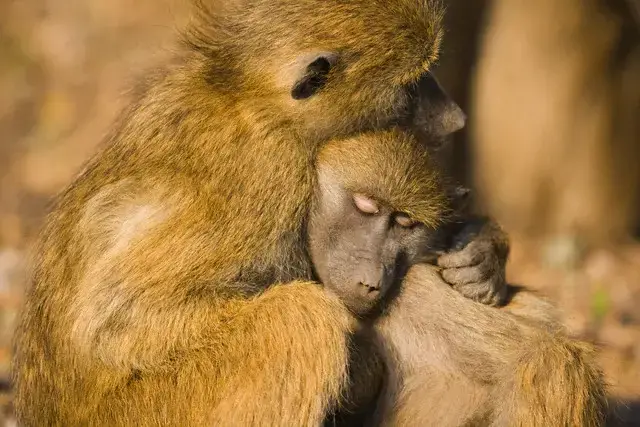
Across many primate species, infants occupy an important position within social groups.
They represent the next generation and often receive considerable attention from adults.
For mothers, infant care is especially demanding. Young animals require feeding, protection, physical contact, and opportunities to learn appropriate social behavior.
Other group members may also interact with infants.
Researchers studying primates have observed forms of social learning in which younger animals watch and imitate older members of their community. Through these interactions, young monkeys gradually learn how to navigate their environment.
This makes the protection of young animals more than an emotional subject.
It is also an important part of understanding how primate societies function.
Crocodiles and the Natural Environment
Crocodiles occupy a very different ecological role.
They are aquatic and semi-aquatic reptiles that have existed for millions of years. Their behavior is shaped by survival, feeding opportunities, territory, temperature, and environmental conditions.
A crocodile near a river or wetland is not automatically interacting with another animal because of a specific intention. Its movements may simply reflect normal behavior within its habitat.
This is why wildlife researchers emphasize context.
A dramatic encounter between a monkey and a crocodile can look like a carefully structured story when viewed through a human lens. In reality, both animals may simply be responding to immediate environmental conditions.
The apparent confrontation is therefore better understood as an interaction between different species sharing the same ecosystem.
The Human Tendency to See Ourselves in Animals
Perhaps the most fascinating part of stories like this is not only what the monkeys do.
It is how humans interpret what they see.
People naturally recognize familiar emotions and relationships in animals. When we see an adult monkey staying close to an infant, we may immediately think of parental affection. When several animals gather around a distressed youngster, we may interpret their behavior as teamwork.
This tendency is sometimes called anthropomorphism, which means attributing human characteristics, emotions, or intentions to non-human animals.
Anthropomorphism can sometimes lead to inaccurate conclusions.
But it can also encourage people to become interested in animal behavior and conservation.
The key is knowing where observation ends and interpretation begins.
We can say that monkeys form social relationships and respond to one another’s behavior. We should be more cautious about claiming that they consciously understood a situation according to human concepts such as heroism or self-sacrifice.
What the Viral Story Can Teach Us About Animal Intelligence
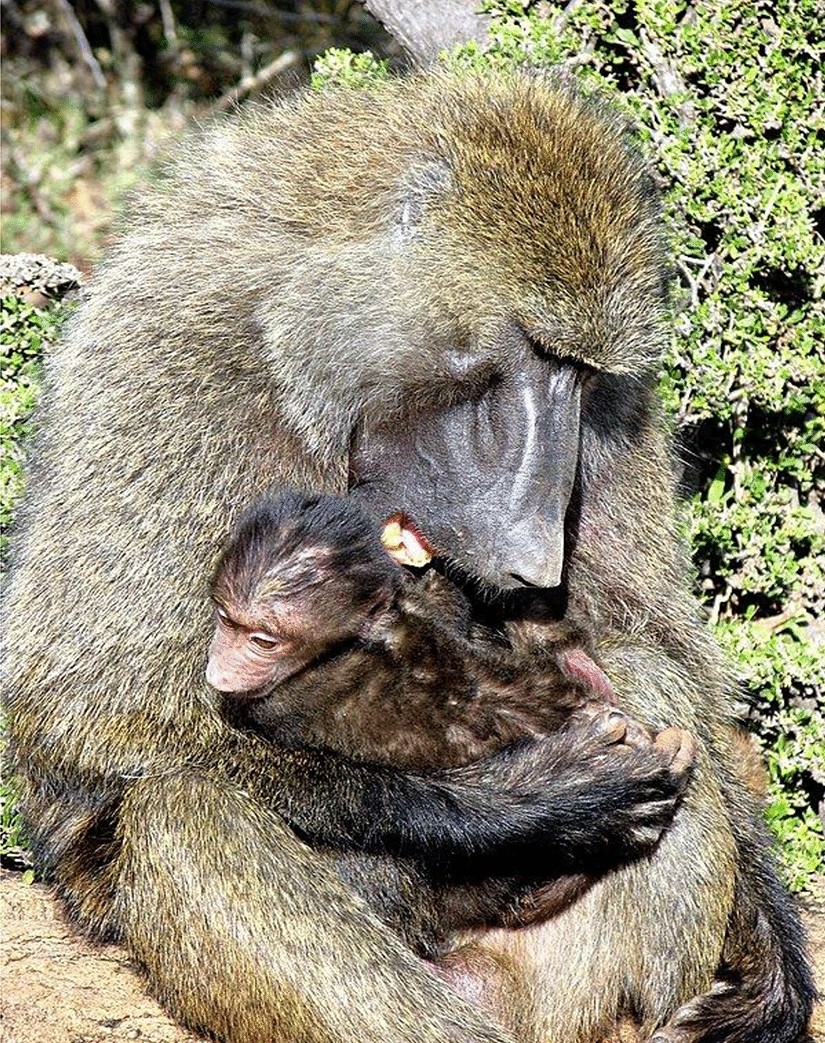
Monkeys are among the animals that demonstrate remarkable cognitive abilities.
Different primate species have shown evidence of memory, problem-solving, communication, social learning, and the ability to adapt their behavior to changing circumstances.
Some primates can use objects in their environment to accomplish particular tasks. Others demonstrate sophisticated social strategies within their communities.
These abilities do not mean that monkeys think exactly like humans.
Instead, they demonstrate that intelligence can take many forms.
An animal does not need to speak a human language or reason in the same way we do to have a complex relationship with its environment.
The dramatic wildlife encounter therefore raises an important scientific question: how much of animal behavior can we understand from observation alone?
Researchers continue to investigate that question.
Why Viral Wildlife Videos Need Careful Context
Wildlife footage can provide valuable opportunities for education, but short clips have limitations.
Viewers often do not know what happened several minutes before the recording began. They may not know the location, species, age of the animals, or environmental conditions.
Sometimes captions also contain claims that cannot be independently verified.
This is particularly important when a headline describes an animal as “saving,” “rescuing,” or “sacrificing” itself for another animal.
Such words communicate a human interpretation.
A more scientific description might simply say that an adult monkey approached an infant during a potentially threatening encounter.
That wording may sound less dramatic, but it leaves room for the evidence to speak for itself.
A Different Kind of Courage in the Animal World
Even without assigning human emotions to the monkeys, the behavior remains remarkable.
A social animal responding to the distress of another group member demonstrates that survival is not always an entirely individual process.
For many species, living together provides advantages. Group members can share information, care for young, monitor their surroundings, and respond collectively to environmental changes.
What appears to us as an emotional rescue story may therefore also represent something scientifically important: the power of social living.
The group itself can become part of an animal’s survival strategy.
The Mystery That Keeps People Watching
One reason stories like this spread so quickly is uncertainty.
When viewers do not know exactly what happened next, their imagination fills in the missing pieces.
That uncertainty can make a short wildlife clip feel like an entire story.
But uncertainty should not be confused with evidence.
If the original footage does not clearly establish the outcome, then claims about what happened afterward should remain unconfirmed. Likewise, assumptions about exactly what an animal intended should be treated cautiously unless supported by reliable behavioral research.
The mystery is still worth discussing.
In fact, acknowledging uncertainty can make the story more interesting because it encourages viewers to ask better questions.
What We Can Learn From the Encounter
The strongest lesson may not be that monkeys behave like humans.
It may be that humans and other social animals share certain broad biological challenges.
Young members of a community require care. Groups depend on communication. Individuals react to the behavior of those around them. Social bonds can influence how animals respond to their environment.
These similarities help explain why people feel such a strong connection when watching primates.
At the same time, the differences are equally valuable.
Monkeys have their own communication systems, social structures, instincts, and ways of understanding the world. Their behavior deserves to be studied on its own terms rather than simply translated into human language.
Final Reflection: Why We Are So Fascinated by Animal Stories
A few seconds of wildlife footage can raise enormous questions.
Did the monkeys understand that the infant was in danger? Were they deliberately trying to help? Did their social bonds influence their response? Or were several animals simply reacting to the same sudden disturbance?
We may not have enough information to answer every question with certainty.
And perhaps that is part of the fascination.
Humans have always looked toward the natural world and searched for meaning in what they see. Sometimes we discover genuine examples of cooperation, intelligence, communication, and social care. Other times, our imagination adds a story that the evidence cannot fully support.
The most rewarding approach is to keep both curiosity and caution.
The dramatic monkey encounter reminds us that animal societies can be remarkably complex, while also showing why careful observation matters. We do not need to turn every unusual moment into a mystery or a heroic tale for wildlife to be fascinating.
Sometimes, the real wonder is simply discovering how much there is still to learn.
Sources
Primate Research Institute, Kyoto University — Research and educational resources concerning primate behavior, social relationships, and cognition.
Primate Research Institute, Kyoto University
Smithsonian’s National Zoo and Conservation Biology Institute — Educational information about primates, animal behavior, and conservation.
Smithsonian’s National Zoo
International Union for Conservation of Nature (IUCN) — Species information and conservation resources concerning primates and crocodilians.
IUCN Red List
Animal Diversity Web, University of Michigan — Species profiles and scientific information about animal behavior and natural history.
Animal Diversity Web
Source article provided for context: Teknoloji Bura, “Monkeys Risk Everything to Rescue a Baby from a Crocodile.” The dramatic interpretation and outcome described in that article should be treated cautiously where independent verification is unavailable.