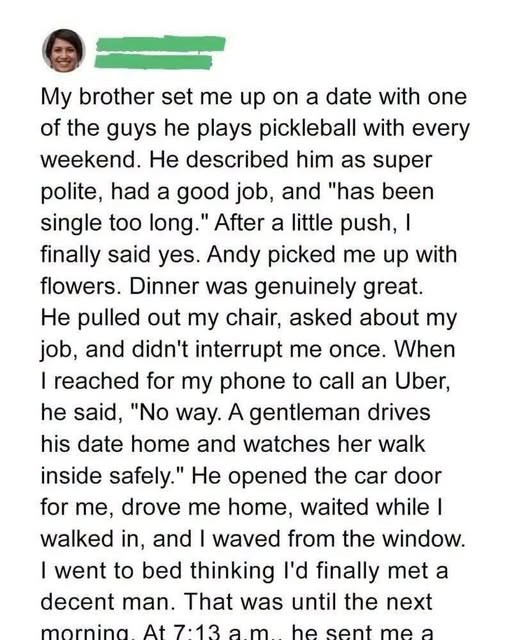
The evening had started almost exactly the way a first date was supposed to.
There were wildflowers, polite conversation, thoughtful gestures, plenty of laughter, and a man who seemed genuinely interested in listening. After years of hearing her brother Marcus insist that she should give one of his friends a chance, the narrator had finally agreed to meet someone.
And surprisingly, Marcus appeared to have gotten it right.
Andy was charming. He was attentive. He opened doors, made her laugh, and even waited until she was safely inside her building before driving away.
She went to sleep thinking that perhaps her brother’s matchmaking skills had finally improved.
Then, at exactly 7:13 the next morning, her phone buzzed.
It wasn’t a good-morning message.
It wasn’t a request for a second date.
Instead, Andy had sent her a PayPal request for $37.25.
The itemized list that followed transformed what had seemed like a promising romantic evening into one of the strangest first-date stories imaginable.
When a Romantic Evening Became an Expense Report

At first, the narrator assumed the payment request had been sent by mistake.
People make accidental transfers and send invoices to the wrong person all the time.
But this was no ordinary payment request.
Andy had apparently calculated the expenses associated with their evening together. The list reportedly included items such as fuel, parking, vehicle depreciation, and even a cleaning charge connected to puddle splash marks.
Suddenly, the flowers, laughter, and gentlemanly gestures of the previous evening looked very different.
What had seemed like traditional dating etiquette now appeared to have an unexpected financial component.
The narrator was faced with a decision.
She could become angry.
She could ignore the request.
Or she could do something much more memorable.
She chose humor.
Her $50 Response Was the Perfect Comeback

Instead of sending Andy the exact $37.25 he had requested, she decided to send him $50.
But there was a catch.
She added a note explaining that the extra money was a tip for opening the doors.
The response transformed an awkward situation into a memorable punchline.
Rather than treating the invoice as a serious financial disagreement, she used the same transactional logic Andy had introduced and turned it into a joke.
Then she blocked him.
There would be no second date.
No lengthy argument.
No attempt to convince him that romance should work differently.
The evening was over, and so was the relationship before it had even begun.
Marcus Could Hardly Believe What Happened
When the narrator told her brother what had happened, Marcus was reportedly horrified.
After all, he had been the person responsible for making the introduction.
He had described Andy as polite, intelligent, and single.
From Marcus’s perspective, the date had initially sounded like a success.
Now he had to process the fact that his carefully recommended gentleman had apparently sent his sister an itemized bill the morning after their date.
The situation was so unusual that Marcus eventually found the humor in it.
And the story became even more entertaining when he discovered that Andy had been telling his pickleball friends about the evening.
According to the story, Andy apparently considered himself a model gentleman.
Unfortunately for him, Marcus now had screenshots.
The Screenshots Changed Everything
Marcus shared the conversation with the group, and the reaction was immediate.
The strange invoice became the center of attention.
The contrast was almost too perfect.
Andy had apparently wanted people to see him as a thoughtful romantic who had behaved impeccably.
Instead, his detailed expense report made the entire evening sound more like a business meeting.
Fuel.
Parking.
Vehicle costs.
Cleaning.
A first date had somehow become an accounting exercise.
The group found the situation hilarious, and Andy’s carefully polished image of himself as a gentleman began to look considerably less convincing.
The story demonstrates one of the strange powers of screenshots in modern relationships.
A person’s description of an event can sound very different from the actual messages exchanged.
Once the conversation was visible, everyone could interpret it for themselves.
The Story Didn’t End There

A few weeks later, the narrator received another unexpected reminder of the bizarre date.
Another woman apparently posted a TikTok showing an almost identical itemized invoice she had received after going out with Andy.
When the narrator saw it, she immediately sent it to Marcus.
Instead of being upset, the two reportedly found themselves laughing all over again.
The coincidence transformed what had initially been an uncomfortable experience into an even stranger story.
If the first invoice had been an isolated misunderstanding, it might have been easier to dismiss.
But seeing a similar story from another person made the situation seem much more unusual.
It also gave the narrator confirmation that her experience was not necessarily as unique as she had initially thought.
Why Itemizing a Date Feels So Strange
There is an interesting social reason why the invoice became such a memorable part of the story.
Dating often involves an informal exchange of time, attention, effort, and generosity.
People naturally spend money on dates.
Someone may pay for dinner, another person may purchase coffee, and couples may eventually develop their own approach to sharing expenses.
But most people do not calculate every small cost afterward.
The difference is not necessarily the amount of money.
It is the expectation.
A few dollars for parking might be completely ordinary in everyday life. A few dollars for fuel might also be reasonable.
What changes the emotional meaning is turning those expenses into an itemized bill addressed to the person who joined you for the date.
Instead of feeling like a shared experience, the evening can suddenly feel like a transaction.
That is precisely what made the narrator’s story so memorable.
Romance and Accounting Operate by Different Rules
There is nothing inherently wrong with discussing money while dating.
In fact, financial communication can become increasingly important as relationships become more serious.
People have different budgets, expectations, and attitudes toward spending.
The challenge comes when those expectations are not communicated beforehand.
If someone wants to split the cost of transportation, dinner, or another activity, it is generally much easier to discuss that before the expense occurs.
Surprising someone afterward with a detailed list can create confusion, particularly when the other person believed the evening was being offered as a date.
The story illustrates how two people can apparently experience the same evening in completely different ways.
One person may see thoughtful gestures and romance.
The other may see expenses that should eventually be reimbursed.
Neither perspective can be understood properly without communication.
The Importance of Setting Expectations
One useful lesson from this unusual story is the importance of clarity.
Dating does not come with a universal rulebook.
Some people expect one person to pay.
Some prefer to split everything equally.
Others alternate who pays.
Some couples barely think about it.
There is no single arrangement that works for everyone.
Problems often arise when assumptions remain unspoken.
If Andy expected reimbursement for his transportation costs, he could have mentioned that before or during the date.
Likewise, if the narrator believed that he had invited her out as a traditional date, she had no reason to anticipate receiving an invoice the next morning.
The unusual PayPal request therefore became a communication failure as much as a dating story.
Why Her Sense of Humor Mattered
The narrator’s response is perhaps the most entertaining part of the entire episode.
She could have spent hours arguing about whether she owed the money.
Instead, she recognized the absurdity of the situation.
By sending $50 and identifying the additional amount as a “tip” for opening doors, she effectively responded in the same language Andy had chosen: accounting.
Her answer was brief, playful, and final.
Then she moved on.
That can be an important lesson in handling awkward social situations.
Not every uncomfortable encounter requires a long confrontation.
Sometimes humor provides a way to acknowledge what happened without allowing the situation to dominate your life.
The Story Also Shows the Power of Boundaries
Blocking Andy after the exchange was another clear decision.
Once the narrator concluded that the interaction was not compatible with what she wanted from a relationship, she did not continue negotiating.
That does not mean every disagreement should end with someone being blocked.
But people are allowed to decide what behavior they are comfortable accepting in their personal relationships.
A first date is often about discovering compatibility.
Sometimes that discovery is positive.
Sometimes it happens very quickly in the opposite direction.
In this case, the invoice apparently gave the narrator all the information she needed.
What Makes a Good First Date?
A memorable first date does not necessarily require an expensive restaurant, elaborate plans, or extravagant gifts.
Often, the most important elements are much simpler.
Conversation.
Respect.
A sense of humor.
Mutual interest.
And perhaps most importantly, compatible expectations.
The narrator initially believed Andy had many of those qualities.
He brought flowers, opened doors, listened, and made her laugh.
Those details created the impression of someone thoughtful and considerate.
But the next morning introduced a completely different side of his personality.
That contrast is what made the story so striking.
It demonstrates that first impressions can be incomplete.
Sometimes a person’s behavior during a single unusual moment reveals more about compatibility than an entire evening of pleasant conversation.
When a Bad Date Becomes a Great Story
The good news for the narrator is that the experience did not become a total loss.
She did not find a romantic partner.
Instead, she gained a story that she could laugh about with her brother for years.
Marcus also got a memorable example of why matchmaking can be unpredictable.
And the later TikTok discovery gave the story an unexpected second chapter.
Not every unsuccessful date has to become a regret.
Sometimes the best outcome is simply realizing early that two people are not a good match.
That can save both sides from investing more time in a relationship that was unlikely to work.
The Difference Between Generosity and Obligation
One of the broader questions raised by the story concerns generosity.
When someone invites another person on a date, spending money can be part of the experience.
But generosity loses some of its meaning if the recipient later discovers that every expense was being mentally recorded.
A gesture feels generous because it is offered freely.
Once it becomes an obligation that was never clearly communicated, its meaning can change.
This does not mean people should never divide expenses.
It simply means that expectations are best discussed openly.
Clear communication can prevent a surprising number of awkward situations.
Final Reflection: Sometimes the Best Lesson Comes From a Bad Date
The narrator went into the evening because her brother Marcus promised that Andy was polite, intelligent, and single.
For a few hours, everything seemed to confirm his recommendation.
Then came the $37.25 invoice.
A date that had appeared to be the beginning of a romantic possibility suddenly became a story about expectations, communication, boundaries, and humor.
Perhaps the funniest part is that Andy may have believed he was demonstrating responsibility by carefully documenting his expenses.
Instead, the invoice gave the narrator a remarkably clear answer about whether they were compatible.
She did not find her perfect match that night.
But she found something else: a story worth telling.
And maybe that is one of the underrated benefits of dating. Not every evening leads to romance, but almost every experience can teach us something about what we want, what we value, and what we are willing to accept.
In the end, her lesson was wonderfully simple:
If someone sends you a bill for romance, tip yourself by walking away.