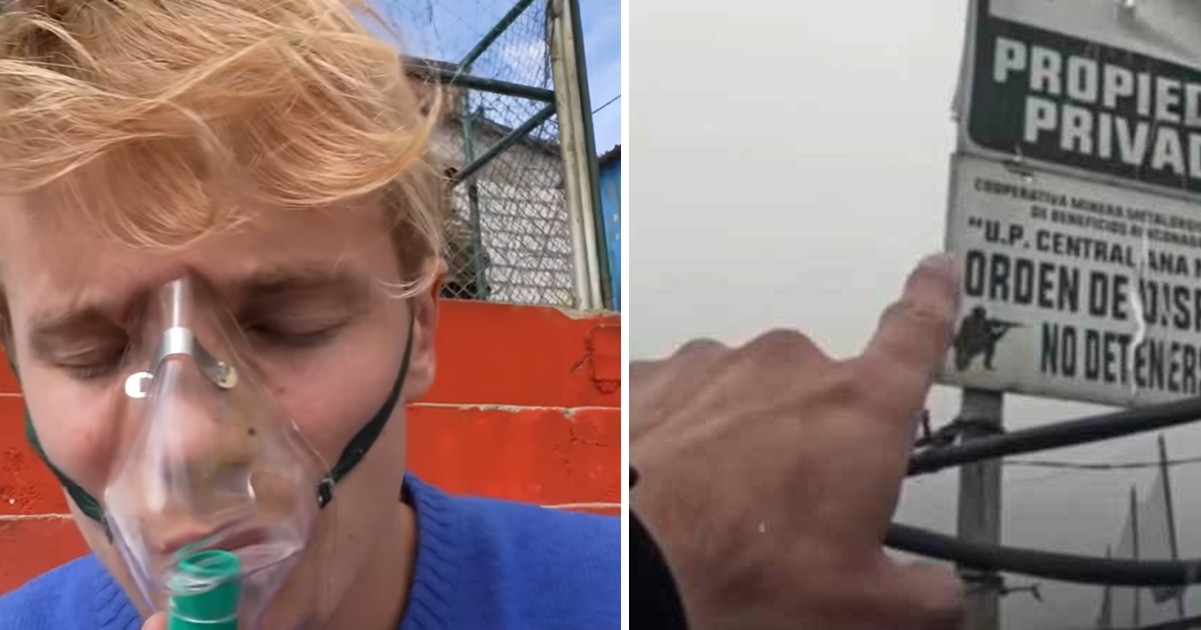
Inside La Rinconada: Frank van Dam’s Journey to One of the World’s Highest Cities
High in the Peruvian Andes, far above the altitude of most major cities on Earth, there is a settlement where simply walking up a hill can feel like an exhausting physical challenge.
La Rinconada sits at roughly 5,100 meters (16,732 feet) above sea level and is recognized by Guinness World Records as the highest permanent human settlement in the world. The town developed around gold mining and has become known for its extreme altitude, harsh climate, limited infrastructure, and difficult living conditions.
For Dutch filmmaker Frank van Dam, visiting La Rinconada was not a typical travel experience. His goal was to spend 72 hours documenting what life is like in a place where the environment itself presents an enormous challenge.
His journey offered a rare look at a community shaped by gold, extreme altitude, isolation, and the determination of people who have chosen to build their lives in one of the most demanding environments on the planet.
A City More Than 5,000 Meters Above Sea Level

La Rinconada is located in Peru’s Puno region, near Mount Ananea. At approximately 5,100 meters above sea level, it stands considerably higher than many of the world’s famous mountain destinations.
For comparison, Cusco sits at around 3,350 meters, while even some of the best-known high-altitude destinations remain considerably below La Rinconada. The altitude is not simply an interesting statistic. It influences almost every aspect of daily life.
At such elevations, atmospheric pressure is much lower and the body receives less oxygen with each breath. The CDC notes that travelers at high altitude can experience problems because of reduced oxygen levels, with the risk increasing as elevation rises and as people ascend too quickly.
That makes La Rinconada remarkable for another reason: people do not merely visit this environment. They live and work there.
Why Do People Live in La Rinconada?

The answer can largely be traced to one word: gold.
La Rinconada grew as a mining settlement, attracting people hoping to find economic opportunity in the surrounding mountains. National Geographic has documented how the rise in gold prices helped transform the area from a relatively small settlement into a sprawling mining community.
The gold deposits brought workers, families, businesses, and an expanding population into an environment that would otherwise be extraordinarily difficult to inhabit.
This is an important part of understanding La Rinconada. It is not simply a mysterious mountain town where people somehow ended up living. It is a community shaped by economic necessity and the possibility of earning a living from the surrounding mineral resources.
For generations of residents, the mountains represent both opportunity and hardship.
A Community Built Around Mining
Gold mining remains central to La Rinconada’s identity.
Reports about the settlement describe numerous small-scale and artisanal mining operations, along with infrastructure that has struggled to keep pace with population growth. National Geographic has described the town as a dense settlement of mining structures and homes beneath the snow-covered slopes of Mount Ananea.
The International Labour Organization has also documented concerns surrounding labor practices in the region, including a system known as cachorreo, in which miners may work for extended periods under arrangements that allow them limited opportunities to search for gold themselves.
These realities reveal another side of the gold rush.
Gold can represent wealth from a distance, but the process of obtaining it can involve difficult working conditions, economic uncertainty, and significant environmental and social challenges.
Frank van Dam’s 72-Hour Challenge

Against this backdrop, Dutch filmmaker Frank van Dam traveled to La Rinconada for a 72-hour filming project.
Instead of simply passing through the town as a tourist, he attempted to document its atmosphere and everyday reality.
His journey was designed to show viewers what it actually feels like to spend time at an altitude of approximately 5,100 meters.
The experience was very different from conventional adventure travel.
At extreme altitude, even ordinary physical activities can become more demanding. Walking, climbing stairs, carrying equipment, or moving quickly can require significantly more effort than they would at sea level.
And unlike a short mountain excursion, Van Dam was trying to work, film, communicate, and sleep while his body was adapting to the environment.
Why His Visit Required Extra Security
La Rinconada has developed a reputation for serious social problems, including crime and limited infrastructure. This has contributed to descriptions of the settlement as a place with weak law enforcement and difficult security conditions.
However, calling it simply a “lawless city” can be misleading. La Rinconada is still a real Peruvian community with residents, businesses, government structures, and law enforcement. The phrase mainly reflects the challenges created by remoteness, rapid growth, mining activity, and limited infrastructure.
According to Van Dam’s account of his trip, he traveled with police protection because of the security concerns surrounding his visit.
The presence of officers became part of the story itself, demonstrating how unusual his journey was compared with an ordinary trip to a tourist destination.
During his stay, Van Dam also described experiencing a serious incident that reinforced the need for caution.
Rather than turning those events into sensational entertainment, his experience highlights a broader reality: remote destinations can combine environmental hazards with social risks, making preparation particularly important.
The Invisible Challenge: Thin Air

Perhaps the most fascinating part of La Rinconada is the danger that cannot be seen.
There are no warning signs in the sky announcing that the air has become dramatically thinner. A person can look around and see buildings, roads, mountains, and other people just as they would anywhere else.
Yet the human body knows the difference.
The CDC explains that altitude illness can occur because of reduced oxygen availability. Symptoms can include headache, tiredness, dizziness, nausea, and other signs that the body is struggling to adjust.
At approximately 5,100 meters, La Rinconada is far beyond the elevation at which travelers are routinely advised to take acclimatization seriously.
The CDC recommends gradual ascent because the body needs time to adapt. At high elevations, acclimatization becomes particularly important, and rapid travel from low elevations can significantly increase the risk of altitude-related problems.
That makes Van Dam’s three-day stay especially challenging.
Sleeping at Extreme Altitude
One of the biggest challenges of extreme altitude is not necessarily walking during the day. It can be sleeping at night.
The CDC notes that sleep disturbance is one of the most common complaints among travelers at high altitude. Above approximately 2,700 meters, changes in breathing during sleep become common, and people may experience frequent awakenings.
La Rinconada is almost twice that elevation.
Van Dam reported significant physical effects during his stay, including difficulty adjusting to the thin air and unusually low oxygen readings while sleeping.
Those measurements should be understood as part of his individual experience rather than as a universal prediction for every person visiting the town. People respond differently to altitude, and medical professionals emphasize that susceptibility varies from one individual to another.
Still, his experience demonstrates just how dramatically different the environment can feel to someone arriving from a much lower elevation.
Life Without the Infrastructure Most People Expect
Altitude is only one part of the challenge.
La Rinconada has historically struggled with basic infrastructure, including sanitation, waste management, water systems, healthcare access, and other services that residents of larger cities often take for granted. Guinness World Records notes that the settlement has historically lacked many forms of conventional urban infrastructure.
National Geographic has similarly documented the difficult environmental conditions surrounding the community, including problems associated with rapid mining-driven growth.
Imagine trying to construct and maintain roads, plumbing, hospitals, sewage systems, and other public services at more than 5,000 meters above sea level.
Every construction project faces the same fundamental obstacle: the environment.
Cold temperatures, thin air, difficult terrain, and remoteness make ordinary infrastructure much more complicated and expensive.
More Than an Adventure Story
It can be tempting to view La Rinconada simply as an extreme destination for adventurous travelers.
But the people who live there are not tourists looking for a temporary thrill.
They are workers, families, business owners, and members of a community whose lives are connected to the region’s economic opportunities.
That distinction matters.
For someone like Van Dam, the extreme conditions become the subject of a documentary. For residents, they are part of everyday life.
The gold beneath the mountains has created an unusual relationship between human ambition and the natural environment. People are willing to live at an altitude where many visitors struggle to remain comfortable because the possibility of economic opportunity can outweigh the difficulties of the location.
What Frank van Dam’s Journey Reveals
Van Dam’s 72-hour experience offers more than dramatic footage from an unusual destination.
It raises a much bigger question about how far humans are willing to adapt when they have a reason to stay.
Across history, people have established communities in deserts, frozen landscapes, remote islands, dense forests, and high mountain regions.
La Rinconada represents another extreme of that human story.
At 5,100 meters, the environment constantly reminds residents and visitors that humans were not naturally designed for easy life at such elevations. Yet people continue to build homes, work, raise families, and search for better opportunities there.
The settlement therefore represents both human resilience and the difficult choices that can accompany economic survival.
What Travelers Can Learn From La Rinconada
Van Dam’s journey also provides an important lesson for anyone fascinated by extreme travel.
A destination being physically accessible does not necessarily mean it is easy or safe.
High-altitude travel requires preparation, gradual acclimatization, awareness of symptoms, and realistic expectations. The CDC specifically recommends ascending gradually and avoiding further ascent when symptoms of altitude illness appear.
Remote locations also create another challenge: access to medical care may be limited.
That combination of altitude, isolation, weather, infrastructure, and security means that visiting places such as La Rinconada requires considerably more planning than an ordinary city trip.
The Human Curiosity Behind Extreme Places
La Rinconada continues to fascinate people because it challenges our assumptions about where humans can live.
At more than 5,000 meters above sea level, the town exists in an environment that seems almost impossible for a large permanent community. Yet people have created homes, workplaces, businesses, and lives there.
Frank van Dam’s three-day journey provides an unusual window into that world. His experience shows the physical difficulty of extreme altitude, the challenges created by limited infrastructure, and the complicated relationship between gold mining and the people who depend on it.
Ultimately, La Rinconada is more than a record-breaking location.
It is a reminder of human curiosity, ambition, and resilience—and of the extraordinary lengths people can go when opportunity, necessity, and hope draw them toward a place most of us would never imagine calling home.