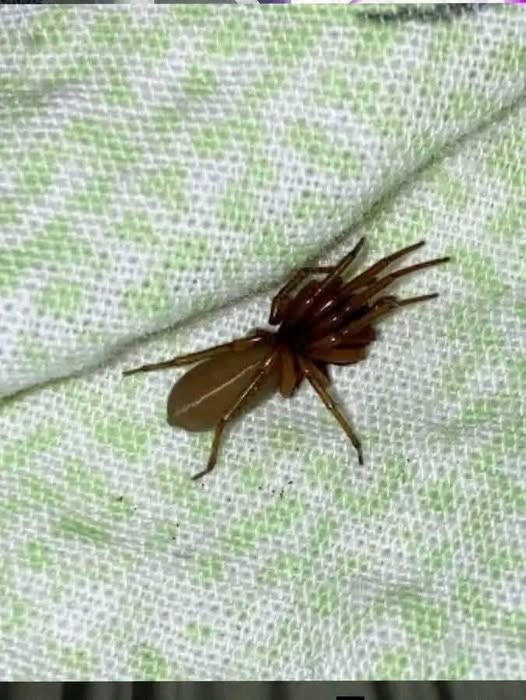
When most people picture a spider, they imagine an animal quietly waiting in the center of a delicate web, patiently allowing its next meal to come to it. But not every spider follows that strategy.
The red-fanged wandering spider represents a very different approach to survival. Instead of depending on a web to capture prey, this nocturnal hunter leaves its shelter after dark and actively searches for food. It relies on sensitive senses, careful movement, and impressive speed to navigate the darkness.
Its most memorable feature is, of course, its striking red fangs. While the appearance may seem intimidating, these structures have a practical biological purpose and are part of the spider’s highly specialized hunting system.
The result is a fascinating example of how different species can develop remarkably different solutions to the same basic challenge: finding food.
What Is a Wandering Spider?
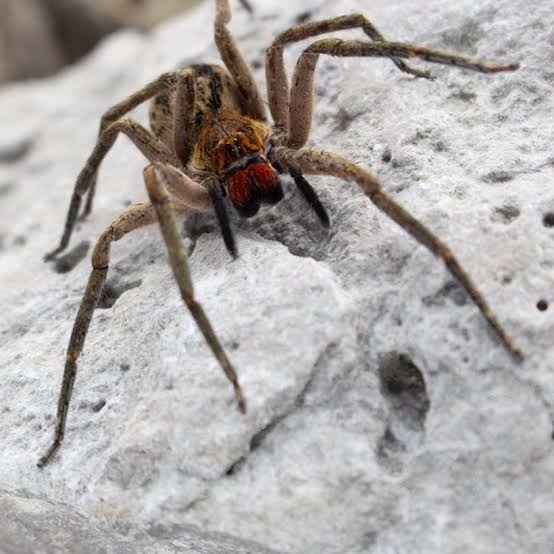
Wandering spiders are generally associated with an active hunting lifestyle rather than the familiar web-based strategy seen in many other spiders.
Instead of remaining in one location and waiting for insects to become caught, wandering species spend time moving through their surroundings in search of potential prey.
This lifestyle requires a different collection of adaptations.
A hunting spider needs to detect movement, navigate different surfaces, recognize potential prey, and react quickly when an opportunity appears. Rather than allowing a web to do much of the work, the spider itself becomes the primary hunting mechanism.
That makes its behavior particularly interesting from a biological perspective.
Why Does It Hunt at Night?
The red-fanged wandering spider is primarily active after sunset.
During the day, remaining hidden beneath rocks, fallen leaves, logs, or other sheltered locations can provide protection from environmental conditions and potential predators.
Once darkness arrives, the spider becomes much more active.
Nighttime hunting also creates a different sensory environment. Vision may be less important than detecting vibrations and movements through the surrounding surface. For an animal adapted to active hunting, these sensory abilities can provide valuable information even when visibility is limited.
This is one reason the spider’s nighttime behavior can appear almost mysterious.
It may seem to move through darkness without an obvious source of information, but its surroundings are filled with physical signals that a highly sensitive predator can detect.
A Hunter That Uses Its Senses Instead of a Web
One of the most fascinating aspects of this spider is the way it locates potential prey.
Many spiders are famous for their webs because silk can function as both a shelter and a highly effective prey-catching structure. A wandering spider takes a different route.
It actively explores its environment.
Tiny movements and vibrations can provide clues about what is happening nearby. The spider can respond to changes in its surroundings and use those signals to investigate potential food sources.
This strategy is somewhat comparable to searching rather than waiting.
Instead of spending energy maintaining a large prey-catching structure, the spider invests in movement, sensory abilities, and rapid responses.
From an evolutionary perspective, neither approach is universally better. Each represents an adaptation to a particular lifestyle and environment.
The Moment of the Strike
The wandering spider’s hunting sequence can be remarkably efficient.
After detecting a potential target, it may approach carefully rather than immediately rushing forward. Remaining inconspicuous can reduce the likelihood that the prey detects the predator.
Then, when the opportunity is right, the spider can move rapidly.
This contrast between slow exploration and sudden movement is one of the defining features of active predation.
To an observer, the encounter may seem almost instantaneous. One moment the spider is cautiously moving across the ground; the next, it has reached its target.
For small insects and other invertebrates, this speed can provide a major advantage.
What Are the Red Fangs Used For?
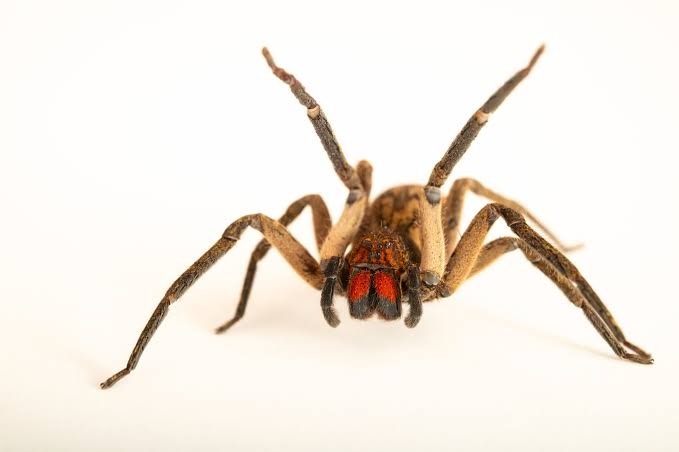
The spider’s red fangs are its most visually distinctive characteristic.
Scientifically, spider fangs are specialized structures associated with feeding and venom delivery. When a spider captures suitable prey, its fangs can help introduce venom and begin the process of subduing the animal.
Venom is an important adaptation among many predatory spiders because it allows them to handle prey that may otherwise be difficult to control.
The exact appearance of the fangs can vary between species, which is why brightly colored structures can become such memorable features.
The vivid red coloration may make the spider appear more dramatic to human observers, but color in nature can have many possible biological explanations. Without species-specific research, it is better not to assume that the red color exists for one particular reason.
A Simple but Highly Effective Hunting Sequence
Although the spider’s behavior may appear complicated, its hunting strategy can be described through several basic stages.
First comes detection.
The spider searches its surroundings for signs of potential prey.
Next comes approach.
Rather than immediately exposing itself through unnecessary movement, it can move carefully toward a suitable target.
Then comes the strike.
Its speed and specialized mouthparts allow it to capture prey efficiently.
Finally comes feeding.
This sequence illustrates an important principle in biology: successful predators do not necessarily need the same equipment.
Some species use webs.
Others use camouflage.
Some rely on speed.
Others use patience.
The red-fanged wandering spider represents the active-hunting approach.
Why Does It Not Need a Large Web?
The absence of a large prey-catching web is not a sign that the spider lacks an important survival tool. Instead, it reflects a different evolutionary strategy.
A web can be extremely effective for an animal that remains relatively stationary and allows prey to come to it.
But a spider living in an environment where suitable prey is dispersed across the ground may benefit from actively searching for food.
Its body and behavior therefore become part of the hunting system.
Sensitive sensory structures help detect the environment. Strong legs allow movement across different surfaces. Fangs and venom assist with prey capture. And nighttime activity can help the spider search while avoiding some daytime challenges.
Together, these adaptations create a complete hunting strategy.
The Science Behind Its Remarkable Speed
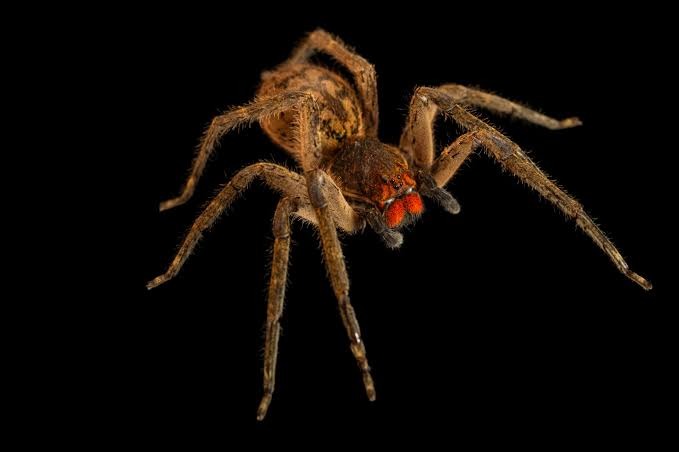
Speed in predatory animals is rarely an isolated characteristic.
It usually works together with sensory perception, body mechanics, and timing.
For a hunting spider, detecting prey is only useful if the animal can respond appropriately. A predator that senses movement but reacts too slowly may lose the opportunity.
The wandering spider’s success therefore comes from coordination.
Its sensory systems gather information while its nervous system processes those signals and coordinates movement. Its legs then generate the physical response needed to approach or capture the target.
What looks like a sudden burst of speed to a human observer is actually the result of a sophisticated biological system operating extremely quickly.
Myth, Mystery, and the Human Fascination With Spiders
Spiders have occupied an unusual place in human culture for thousands of years.
In some traditions, spiders have represented patience, creativity, cleverness, or perseverance because of their ability to construct intricate webs.
In other cultural traditions and popular stories, spiders have been portrayed as mysterious or intimidating creatures.
These different interpretations reveal more about human imagination than spider biology itself.
A red-fanged spider can look particularly dramatic because humans naturally pay attention to strong visual contrasts. Bright coloration combined with unusual body structures can make a small animal appear much more mysterious than it actually is.
Stories about unusual spiders sometimes become exaggerated online, especially when photographs are presented without information about the species or its natural habitat.
That is why scientific identification remains important.
A striking photograph can inspire curiosity, but appearance alone does not tell us everything about an animal’s behavior.
Should People Be Concerned?
Despite its intimidating appearance, a wandering spider is generally more interested in finding suitable prey than interacting with people.
Like many wild animals, it has little reason to approach a much larger creature unless environmental circumstances bring the two into close proximity.
It is also important to avoid assuming that every spider with a similar appearance belongs to the same species.
Common names can sometimes refer to different animals in different regions, while photographs shared online may lack reliable identification.
For that reason, extraordinary claims about a spider should be treated cautiously unless they are supported by reputable zoological or scientific sources.
An Important Part of the Ecosystem
Predatory spiders play a useful role in natural ecosystems.
By feeding on insects and other small invertebrates, they participate in food webs and contribute to the natural regulation of prey populations.
This does not mean that every spider has a measurable impact on a particular ecosystem in exactly the same way. Ecological relationships are complex and depend on habitat, climate, available prey, predators, and many other factors.
Nevertheless, spiders are important predators in many terrestrial environments.
Their presence is another reminder that even small creatures can play meaningful roles in nature.
Evolution’s Different Solutions to the Same Problem
Perhaps the most fascinating lesson offered by the red-fanged wandering spider is that evolution does not produce only one successful solution.
Imagine two spiders living in different ecological circumstances.
One builds a web and waits.
Another moves through the environment and searches.
Both need food.
Both need to avoid danger.
Both need to reproduce successfully.
Yet their lifestyles can look completely different.
This is one of the central themes of evolutionary biology. Natural selection can favor different traits depending on environmental conditions, available resources, and ecological relationships.
The wandering spider demonstrates this principle on a remarkably small scale.
Final Reflection: Nature Is Full of Unexpected Strategies
The red-fanged wandering spider may look unusual, but its lifestyle is part of a much larger story about adaptation.
It does not need to sit quietly in a large web waiting for food to arrive. Instead, it enters the darkness and searches.
Its sensitive sensory systems help it interpret its surroundings. Its movement allows it to explore. Its speed helps it respond to opportunities. And its specialized fangs form part of the final stage of prey capture.
What appears mysterious at first becomes more understandable when viewed through science.
Yet that does not make the spider any less fascinating.
In fact, learning how an unusual creature actually lives often makes nature even more remarkable than the myths surrounding it. The natural world is filled with animals that have developed extraordinary strategies simply to survive in their environments.
And perhaps that is why creatures like the red-fanged wandering spider continue to capture our imagination: they remind us that even in the smallest corners of the world, there are still countless biological stories waiting to be discovered.